Search “black ballerinas” online and you will be offered shoes, which doesn’t say much for the racial diversity of classical dance in today’s Britain. Black male dancers, even at principal level, are not doing badly, and there has been the odd breakthrough for their female counterparts, with Birmingham Royal Ballet leading the way. But the fact that Ballet Black is now marking its 25th birthday – it having been conceived to give exceptional dancers of colour a platform – suggests that things haven’t changed nearly enough.
Founded by a 21-year-old with a vision in 2001, Ballet Black is also a prolific commissioner of new work, which brings challenge and surprise to every programme. Heritage ballets are not its business, and I dare say not even Cassa Pancho OBE, the company’s dauntless founder and artistic director, imagines ever staging an all-black Giselle. What Pancho has achieved over the past quarter-century is a remarkable body of work that broadly presents an aesthetic, and a particular dynamic, that otherwise wouldn’t exist on the British dance scene. And dance goers would be all the poorer for it.

This anniversary programme, seen at the start of a national tour, is a bold double bill, marrying an extensive new piece with an older one which has garnered so many awards that it’s almost a modern classic.
The new choreographer on the block is the American Hope Boykin – and if her name rings a bell it’s because she was a key dancer in the Alvin Ailey company for two decades and featured prominently on their UK visits. Her Ballet Black commission …all towards hope is ambitious not only for its technical scope and flair, but also for her input as poet and narrator. Taking the place of a musical score for some sections of the work is a spoken verse-poem whose opening line repeats, with incremental variations, until it becomes a statement of humanistic belief, made all the more compelling by Boykin’s melting-chocolate tones and beautiful diction.
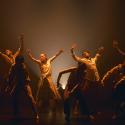
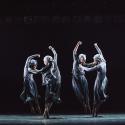
What first strikes the eye is the personal styling. This isn't just a homogenous bunch of fabulously fit bodies (pictured above) – these are men and women with attitude and hairstyles to match, with afro, buzzcut, cornrow and ballet bun all in evidence. The choreography, working from a strong classical base, not only exploits each dancer’s strengths, but hints at diverse cultural backgrounds. It’s remarkable what ballet can absorb and still remain ballet: African rhythms, the pulse snaking through the torso from neck to hips; jazz shimmies; even the percussive footwork of kathak – in pointe shoes what’s more. Original music by Bill Laurance, himself a jazz pianist, covers all the bases and deserves to be issued as an album.
Pulling all these elements together is a formal geometry of fast-forming-and-dissolving circles and lines that’s highly satisfying to watch. The dancers’ speed and accuracy, not to mention stamina, is impressive, and the joy on their faces infectious. It was clever of the choreographer to select one dancer – Isabela Coracy in the performance I saw – to represent the thinker of the words of the poem. At times Coracy simply stands and listens, which draws us closer to the import of the text. With its seven parts …all towards hope is a longish watch, but I’ve rarely known an hour to pass so quickly.
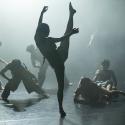
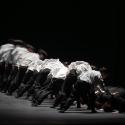
The second half of the programme is a reprise of Ballet Black’s 2019 standout hit Ingoma (main picture). It’s hard to say which is more remarkable – the sight of dance in gumboots, or the feat of imagination that made art from a piece of shameful recent history. This was the miners’ strike in South Africa in 2012 when police opened fire killing 34 miners, an echo of the Sharpeville massacre of 1960, out of whose ashes the anti-apartheid movement was born.
Choreographer Mthuthuzeli November, once a dancer with Ballet Black, has a fine sense of dramatic structure, framing tender images of pain and loss within sections of ferocious dynamism that make you sit rigid in your seat. As miners in torch-mounted helmets stomp and leap, they slap their bare chests and the sides of their rubber boots, adding even more percussion to the thudding drum soundtrack. In another section they punch the air wielding axes and belt out a call-and-response song in Xhosa. The sense of extreme physical toil bolstered by iron will and community spirit is so sharp it hurts. Now audiences around the country will have the chance to experience this phenomenal work.