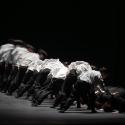
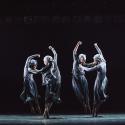
South Korea’s soft power isn’t restricted to K-pop and K-drama. The latest Festival of Korean Dance, hosted by venues around the UK, is a demonstration that its contemporary dance scene is impressive too.
Now in its ninth iteration, this year I caught two of the festival’s programmes, one indie, the other by the Korea National Contemporary Dance Company, who presented a piece on a double bill that was so good, I returned the next night to catch it again.
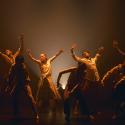
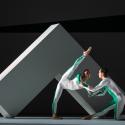
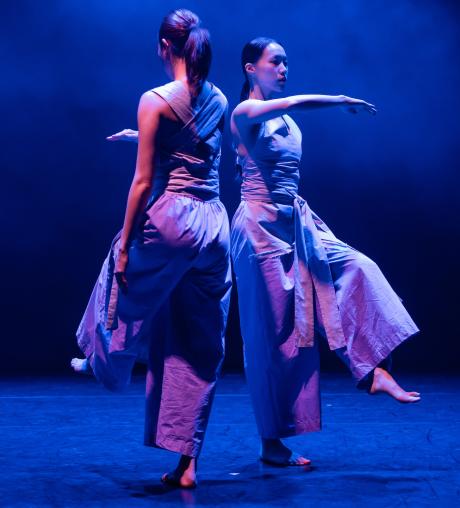
The other offering from the KNCDC, Voyage, could have been from another planet. Indeed, it claims to be inspired by the Voyager spacecraft’s lonely journey into eternity, begun in 1977, but I needed the programme notes to understand that. With choreography by Young-doo Jung, whose Olivier-nominated movement work on a Korean-opera Lear was previously at the Barbican, it’s an enigmatic piece for six women and two men, dressed alike in pale lilac baggy pants and cross-bandaged tops (pictured below, left).
Like all the pieces this year, this one uses an electronic score, a sort of ticker tape of modern life blending a background of beeps and beats with smatterings of polyglot voices, the gurgles of a baby, a slowed down extract from Debussy’s Clair de lune. The pace quickens as it proceeds, each section featuring a handful of the dancers typically in measured, almost stately moves with echoes of tai chi arm and hand movements, lunges, arabesques with jagged feet. One striking passage has two women with their backs to us suddenly extending an arm at right angles, to a sharp whip-crack on the soundtrack, but only in the final tableau, where all eight dancers appear, shielding their eyes from a source of golden light above them, does the idea of space travel really announce itself, a bit late.
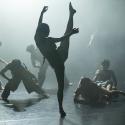
Not quite as intent on presenting a mysterious narrative is Gravity, from Ryu and Friends, a company led by director-choreographer Jang-hyun Ryu making its UK debut. The 11 dancers, a mix of genders, are dressed alike in beige costuming that gives them the impression of being naked. They first appear as an intertwined drum-shaped mass of bodies that slowly starts to unravel as the score picks up pace, adding crackling sounds and what seems to be gunfire, with a bright white light overhead.
The dancers are like a mechanism learning how to operate, bursting into extensions and handstands and explosive leaps. Partnering involves piggybacks and bodies twirling on shoulders, and there’s a lot of Wim Wandekeybus-style hurtling/rolling onto the floor. As the beats speed up, so do the bodies, individual “solos” subsiding as the dancer returns to the main group. Until suddenly, everything stops and a woman holding a flaming torch enters, and the others lie with their legs in the air. Then it’s onwards again, with what sounds like an aircraft overhead. The dancers line up, linked like a fence for others to clamber onto, and once again there’s a shift in tone, as women appear with what seem to be enormous pregnant stomachs — white balls stuffed under their costumes — and men skitter in on all fours, like weird creatures. One woman is unable to stand and is passed from dancer to dancer.
Finally, a large red ball appears (with a dancer inside?) that moves and hovers and is passed by a line of dancers over their heads, solemnly. I deliberately didn’t read the programme notes for this piece until I had seen it, and wasn’t surprised to find it described in the blurb as “extraterrestrial”. I saw the performers as part of a system gearing up into action; Ryu sees their moves as the convulsions of energy as it mutates and sets things alight. Same difference. His dancers are dynamic, super-flexible and eminently watchable.
The KNCDC piece I returned to, Hakkö, has some of the same qualities and a slightly similar start: the cast (pictured below) are in a massed group that slowly begins to establish its individual elements. But its creator, Ryu Suzuki, doesn’t try to take the audience to outer space or into a giant scientific concept. What makes the piece zing is that it is embodying a real process that is actually happening before us, not telling us a story about one.
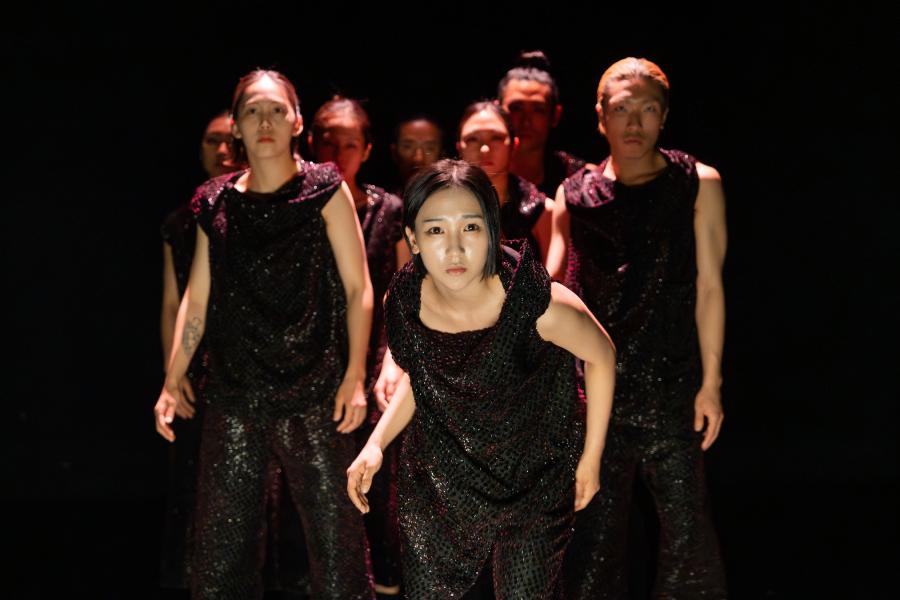
Seven of the eight dancers involved (four women, three men) emerge from the stage gloom standing close together. Slowly a pulsing beat starts up, a rhythm not unlike the drumming of Native Americans, where one beat is favoured. The standing group begin to make small head movements, like little birds, then react to a slight change in the drumming pattern, shifting their bodies until they start moving apart, slowly but obviously. A woman dancer arrives and edges backwards towards them bit by bit until she is absorbed into the group.
An extraordinary 35 minutes follows, in which the dancers’ bodies loosen and flow to ever more complex time signatures, never touching yet somehow following the complicated patterning of the notation. You begin to notice that in each formation there is one element that’s slightly different — a dancer facing in the opposite direction from the rest, one embarking on a new step that the others start to join In with until the first dancer changes again.
The sheer exhilaration of this piece has to be watched to be believed, as arms flow and ripple in unison formations, then change, dancer by dancer. Suzuki has likened what’s happening to the dancers’ bodies to the experience of playing the cup and ball game (kendama in Japan), where players repeat actions until they are mesmerised by them, like people at a rave. The audience is mesmerised, too. Let’s hope this exceptional piece makes a return visit soon.