

Japanese director Kon Ichikawa’s An Actor’s Revenge is something of a one-off. Even in the context of the prolific director’s career variety, it’s an unusually stylised and visually captivating story of high artifice – there’s rich melodrama in its kabuki emotional playing and theatrical setting – that is set against the lowlife criminal comedy of 19th century Tokugawa Tokyo, or Edo as it was then known. Rich and strange, indeed.
As much as anything else, Ichikawa’s film is a vehicle for star Kazuo Hasegawa, whose 300th screen appearance it marked. He plays two roles, the main one as Yukinojo, an onnagata, or female impersonator actor who pursues revenge on the three characters responsible for the past ruination of his parents. We first encounter him/her (pictured below) playing grand kabuki tragedy, but his off-stage life, as he engineers an elaborate process of interactions that will see him achieve his aim, continues the elaborate feminine mannerism.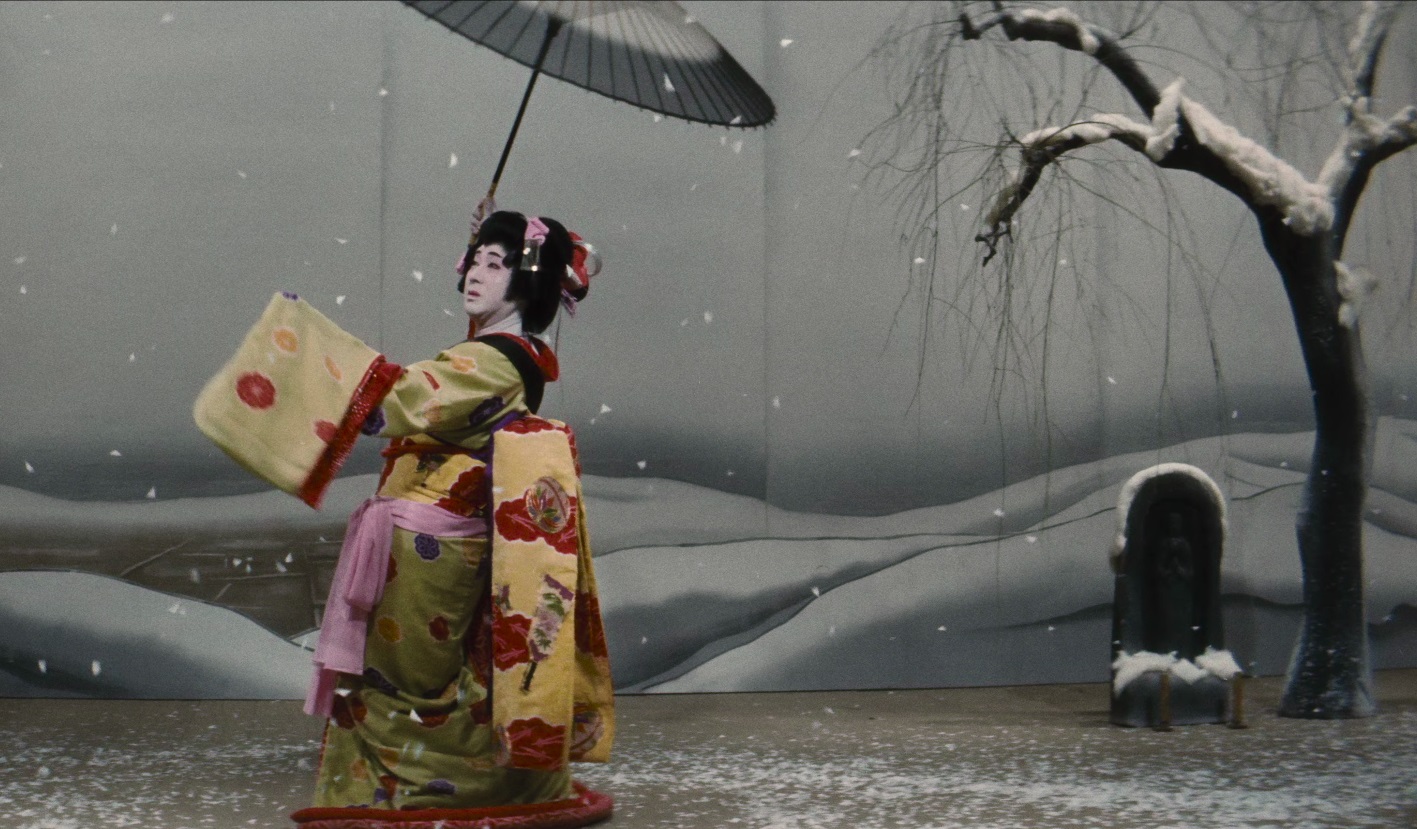 The specific nature of the titular revenge lies in the fact rather than tracking his targets down directly, Yukinojo’s skill is to insinuate himself into their world and have them destroy one another from within, his principle ploy the encouragement of romance with the daughter of one of them, Lady Namiji (the beautiful Ayako Wakao). She knowingly falls in love with him, a man who is playing a woman in life as well as theatre, resulting in a level of emotional convolution that might seem almost out of Shakespearean comedy. But attempts to find points of comparison with precedents from the western dramatic tradition – another might be to the revenge elements of Jacobean tragedy – finally prove more elusive than anything else.
The complexity only extends into Ichikawa’s parallel lowlife plot strand, with star Hasegawa also playing the robber Yamitaro, a Robin Hood-style figure who robs the rich. Part of this comic underworld revolves around the theatre world – its denizens are enthusiastic audience – in which Yamitaro’s female fellow thief, the cunning Ohatsu (Fujiko Yamamoto, main picture, with Kazuo Hasegawa) is herself attracted towards the actor. The cherry on the cake is the doubling – if that's not actually tripling? – that comes with Yamitaro’s own fascination with Yukinojo, the robber’s agility and comedy in character the diametric opposite of the formal dignity of the actor.
But even if it was imposed on him, Ichikawa treated the film as a glorious experiment
Further layering comes from the fact that Ichikawa’s 1963 film was itself a remake of a popular 1930s original, in which Kazuo Hasegawa had played the same two roles. Apparently Ichikawa was assigned the later version by the studio to which he was attached as something of a penance for recent films that hadn’t delivered. But even if it was imposed on him (and his screenwriter partner and wife Natto Wada), Ichikawa treated it as a glorious chance to experiment: the film revels in its glorious CinemaScope colour and a screen scale that gives exterior scenes as much visual style as the kabuki stage scenes, complete with a score that combines traditional Japanese motifs with elements of jazz and Hollywood lounge music (fascinating that Disney had been a crucial influence on Ichikawa!).
This new restoration looks excellent, and the audio commentary by the critic and Japanese cinema expert Tony Rayns elucidates the film’s fascinations and curiosities as well as could be imagined. The main extra on this BFI dual-format release is Nagisa Oshima’s 1995 100 Years of Japanese Film, a 52-minute documentary which the In the Realm of the Senses director made as part of the BFI’s The Century of Cinema series. For a director who once famously said, “My hatred of Japanese cinema includes absolutely all of it”, you might have thought they went to the wrong man, but this clips-and-stills confection, with voice-over narration, is actually quite captivating.
After initial attention on the later rediscovery of some 1920s silents, many of which had been presumed destroyed in a 1923 earthquake, Oshima moves through the war films, comedy and struggles against censorship, and into his key era, the appearance of the New Wave movement and the growth of independent filmmaking, always accentuating the connections between films and the wider political conditions in which they were made. Oshima faced criticism that he left out some major figures and films – and he certainly didn’t neglect his own work – but it comes across as an engaging journey through a world which, as An Actor’s Revenge brings home, remains very different from filmmaking traditions familiar to us in the West.










Add comment