DVD: Once Upon a Time in Anatolia

Just because a film is slow, boring and foreign, it doesn't mean it's good

share this article

It's over an hour before we see a woman in Nuri Bilge Ceylan's Once Upon a Time in Anatolia. And even then, she arrives slowly, appearing at first more of a heavenly human smudge than a fully formed figure. But moments later she is filling the screen, and setting it ablaze with warm light. Light that seems to emanate as much from her blue eyes and young face as it does from her lamp. For the first time in the film, we can see. The male-dominated darkness that grips the opening 60 minutes lifts in response to this moment of clarity and beauty. The tired male eyes that greet her, all double-taking, blinking with awe, say it all.

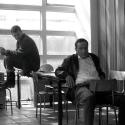
It's ironic that the title to this film alludes to Sergio Leone's American epic. Despite the basics - the car, the cops, the dead body, the hard-bitten detective with his hands stuck in his pockets - Ceylan's movie has much more to do with Russian than American film-making. Ceylan's metaphorical positioning of the female sex - as everything that is good, wholesome and spiritual - is pure Tarkovsky, as is his juxtaposition of the rational Doctor and the mystical Detective.

And though ostensibly a whodunnit (and in fact also a whatdidtheydo and whydidtheydoit, too), the main journey is, like the desperate trek to the Zona in Tarkovsky's Stalker, a sideshow to the psychological voyage that the characters undertake while on their gruelling bodyhunt across the plains of central Anatolia. Even the black dog who finally reveals the coordinates of the grave appears to be the same pointy-eared breed that guides the visitors to the Zona.

Only in one crucial respect does Once Upon A Time not resemble Stalker; it's simply not as good. Despite a decent formal set up, the film spends too much time demanding respect in a passive-aggressive way typical to art-house movies and too little trying actively to attract respect with things like, say, a half decent script or some really good acting. All of which underlines the fact that just because a film is slow, boring and foreign, it doesn't mean it's any good.

Add comment

The content of this field is kept private and will not be shown publicly.
Name that you would like to appear as the author of the comment
The film spends too much time demanding respect in a passive-aggressive way typical to art house movies

rating

3

explore topics

share this article

the future of arts journalism

You can stop theartsdesk.com closing! 

We urgently need financing to survive. Our fundraising drive has thus far raised £33,000 but we need to reach £100,000 or we will be forced to close. Please contribute here: https://gofund.me/c3f6033d

And if you can forward this information to anyone who might assist, we’d be grateful.

Subscribe to theartsdesk.com

Thank you for continuing to read our work on theartsdesk.com. For unlimited access to every article in its entirety, including our archive of more than 15,000 pieces, we're asking for £5 per month or £40 per year. We feel it's a very good deal, and hope you do too.

To take a subscription now simply click here.

And if you're looking for that extra gift for a friend or family member, why not treat them to a theartsdesk.com gift subscription?

more film

When Lucian Freud and Kate Moss brushed up against each other
Influential and colourful Italian comic book adaptation returns in a gleaming new print
Steven Soderbergh directs Ian McKellan and Michaela Coel in virtuoso performances
An immersive tale of tangled paternity in a battered Budapest
Bob Odenkirk stars in a fast and furious Eastern Western
Lee Sang-il’s handling of this intriguing subject is conventional but compelling
Magnificent Czech coming-of-age epic, set in the dying days of World War Two
James Cameron co-directs a sometimes bland account of an important star and her fans
A teenage girl uncovers Spanish ghosts in a lyrical tribute to a lost generation
The 34-year-old actor drank a double dose of disorientation playing a man out of time in Mark Jenkin's ghost story
Top-tier Kurosawa melds visual beauty with moral clarity
... as well as Ridley Scott, Jacques Audiard, Julia Ducourneau and Charles Aznavour