How do you solve a problem like The Birth of a Nation? Do you admire the first part and turn away from the second (after all, the Germans screened The Sound of Music for years in a Nazi-free version ending with the marriage of Maria and Captain von Trapp)? Can you balance social, historical and aesthetic responses?
My own were to admire every technique D W Griffith throws at the story-telling of the American Civil War as a fine, at times Tolstoyan interweaving of truth with the fiction of two families from north and south, only to throw in the towel at the flabbergasting rewritten history of Reconstruction in North Carolina. For the first half of its three hours, this is indeed a masterpiece with only a few false notes (the blacked-up white actors as family servants of the lovable Camerons in Piedmont and the wild overacting of Mary Alden as dodgy-wigged Radical leader Stoneman's mulatto servant-mistress are the warning signs).
The surprisingly relaxed, unhistrionic body language of the stars playing the two sets of family members establishes sympathies early on, so that Griffith's wide shots of real artillery firing on battlefields can then run at length. Split screens, breathtaking shots of characters rushing or riding from a distance right at the camera, a wonderful composition of mourning women and children high above a valley where the troops process: all these proclaim a great pioneer. The third of his "historic facsimiles", the assassination of Abraham Lincoln in a theatre meticulously modelled on the original, makes a rightful climax to Part One.
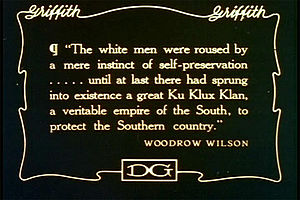 Unfortunately if Griffith hates war, he also seemed in 1915 to hate blacks. Shame on him for engaging so many Afro-Americans only to feature them as extras alongside the white "blackfaces" as gibbering anarchists bent on annihilation of the whites (the loyal servants alone escape censure, but not caricature). Their bold political moves in the south are ridiculed, and in one of many topsy-turvy moments we see white voters being obstructed at the ballot boxes. The turning-point is the "little Colonel" of the Cameron family's bright idea when he sees white children under a sheet frightening the "piccaninnies". Cue the KKK in all its ridiculous, faceless pageantry - did Eisenstein model his fancifully white-clad Teutonic knights in Alexander Nevsky on this? - and a predictable story of the Cameron girl killed in a proto-Virgin Spring sequence trying to flee the clutches of Gus the renegade.
Eureka does its best to lavish a fine print, uniquely so on Blu-Ray, with the context of a substantial booklet and extras including Griffith's earlier shorts about the Civil War. There's a sweet - too sweet? - chamber score from the Mont Alto Motion Picture Orchestra. But when you learn that The Clansman, as it was originally called after Thomas Dixon Junior's novel and play, was still being used as a KKK propaganda tool in the 1970s, you realise it's not all about art. And in the turbulent aftermath of the 1915 release, a white man killed a black teenager. Not much has changed in 100 years.