

London performances of Alfred Schnittke’s Concerto for Choir are like Meaningful Votes: you wait a long time for one, then they come in clusters. After last night’s Vasari Singers performance, there is only three weeks till the London Concord Singers put this choral monster in front of the voting public again. It remains to be seen if John Bercow steps in to prevent even more.
It was still a treat to hear the piece last night in the capable hands of the Vasari Singers. The Concerto for Choir is a challenge on so many fronts: the stamina required for its great length, the need to pronounce lots of Russian, the multiple divisions of the score (the choir is sometimes in more than 24 discrete parts), not to mention the difficulty of simply pitching the notes.
But the real challenge is for the music to take wing in the face of all this. It is a serious piece, shorn of the impish stylistic games of so much Schnittke, a religious meditation on a text by a tenth-century Armenian monk. And the Vasari Singers brought it to life in a committed and sympathetic performance of great vocal skill, often belying the choir’s amateur status.
 The harmony is mostly rooted in rich cluster-chords, which were well-tuned and warm. The choir had an excellent blend throughout, capturing the Russian Orthodox tradition this piece sits in, and making the most of Schnittke’s quasi-orchestral scoring. In particular the low basses were rich and resonant, nowhere more so than in the glistening D major final bars. The hypnotic, repetitive opening to the second movement was another highlight, the overlapping motifs in the upper voices offering a passage of transcendent beauty. I am not a Russian speaker but the pronunciation had clearly been worked at and was convincing enough, if without the complex consonants and dark vowels of the 1994 Russian State Symphonic Cappella recording.
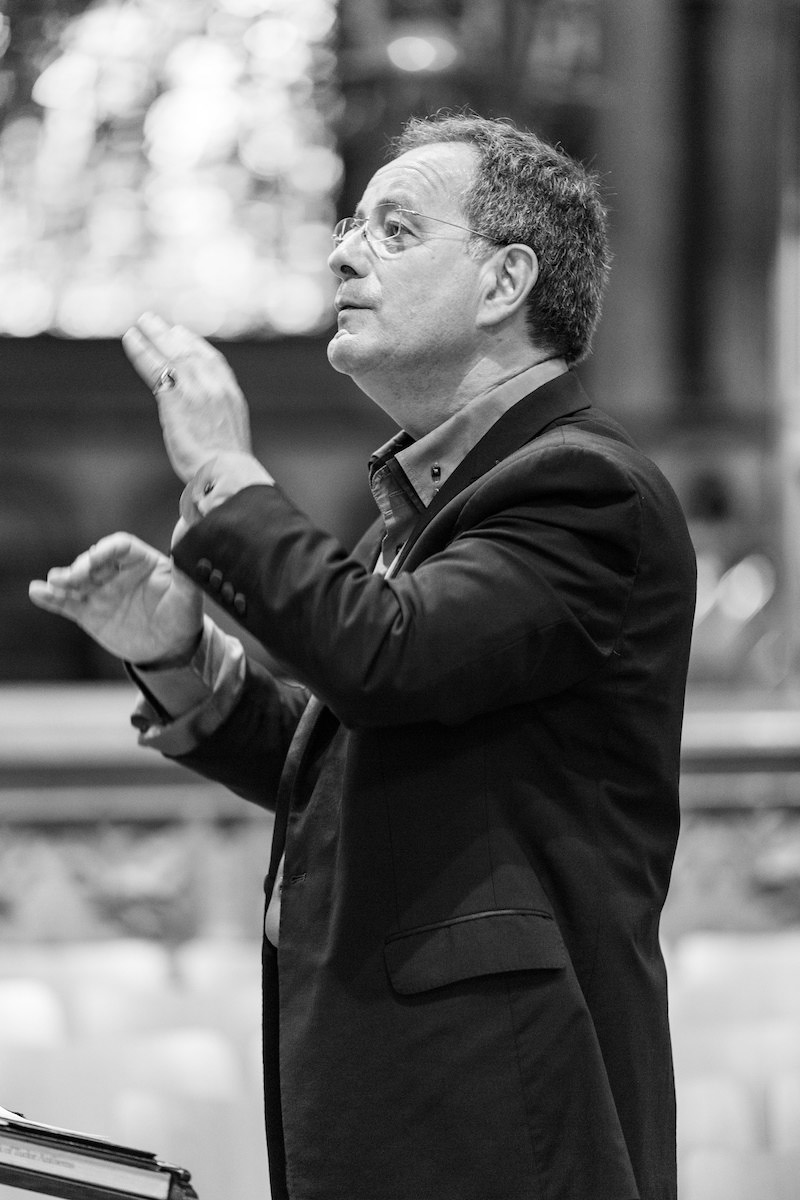
The conductor – and the choir’s founding Music Director – Jeremy Backhouse (pictured above by Matt Pereira) led the performance with the minimum of fuss but a strong sense of pacing and character. The hard work will have been done in rehearsal; in performance he successfully stayed out of the way. This mammoth symphonic epic was sung with an aplomb that overcame occasional and forgivable uncertainties, and credit must go to the soprano soloists Elizabeth Limb, Felicity Rice and Susan Waton.
The Schnittke made up the entire second half and was much the more interesting. The first half’s pieces were similarly religious but not liturgical, fitting with the programme’s theme ‘the path of purity’. John Tavener’s Mother and Child had an ecstatic central section in which the choir competed, not entirely successfully, with organ and a reverberant Hindu temple-gong at full pelt, between passages in Tavener’s signature contemplative style. Jonathan Dove’s Seek him that maketh the seven stars had a wonderfully speckled organ part, played by William Nicholson. Bob Chilcott’s Salisbury Motets were his usual well-crafted, singable fare, with the rhythmically-charged fourth movement, its melody carried well by the lower voices, ending with an arresting unresolved harmony. Only the two pieces by the Latvian Eriks Ešenvalds disappointed, showing that Schnittke-style harmonic saturation without Schnittke’s harmonic imagination can descend into a self-indulgent diatonic mush.




Add comment