Want to learn more about 20th century music in action? Starting tomorrow, you could lose yourself in the labyrinth of the Southbank’s year-long The Rest is Noise festival, and plough your way through Alex Ross’s monumental but partisan study of that name. Or you could learn a lot in a short space of time from John Adams’s mini-residency with the LSO at the Barbican. There’s an even more essential book to read alongside it, the composer’s Hallelujah Junction, following an insider’s path to finding his own voice after encounters with the rigours of the 12-tone system, Cage-style anything-goes and minimalism. Last night’s programme, with Adams’s favourite soprano Dawn Upshaw at its perfumed centre, could not have brought his individuality to life more vividly.
Adams’s Harmonielehre of 1985 is riveting as an idea, and – at least in the first of its three movements, a symphony in itself – a masterpiece in execution. Its title comes from the model textbook Schoenberg wrote in 1911, at around the time when he was turning the very harmonic basis he wrote about on its head. Adams works on the premise that the revolution which ended up hampering freedom of musical expression by the time he was growing up never happened.
Wagner, whose Götterdämmerung hit him with the force of revelation in 1976, and the great composers under his spell meet the methods and rhythms of Minimalism; yet every bar sounds like Adams as we came to know him through Grand Pianola Music, Nixon in China and other blindingly brilliant scores. As the vasty first movement gears up to realise the composer’s dream of an oil tanker eventually rocketing skyward from San Francisco Bay, what flipped the stomach in last night’s performance were not so much the rising, plunging string lines at the movement’s heart, nor the magnesium-flare climaxes incandescent in the hands of a tireless LSO, but those harmonies "constantly morphing" – as he describes Wagner in Hallelujah Junction – to steer us into strange new regions.
 There’s real depth here, and I’m not sure that can be said for the slow movement which most aims for it. The archetypal soul-sick medieval king Anfortas – the title "The Anfortas Wound" sets him apart from the Amfortas of Wagner’s Parsifal, whose despairing theme is quoted in a symphonic movement by Prokofiev – gives rise to a lament which drags itself up to the screaming dissonances of Mahler’s Tenth Symphony. More flight, diaphanously lit like the sunset of Schoenberg’s epic pre-atonal Gurrelieder, leads us to a beaming, horn-rampant E flat major conclusion. Stunning orchestration here, too, but the density of the piece can begin to tire the listener after half an hour, and the sense of moving weightlessly through space has already been given earlier. Had Adams left Harmonielehre at the first movement, I’d have been on my feet with the other standing audience members.
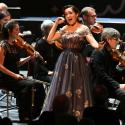
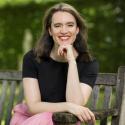
They included the first half’s soloist, the ever-compelling Dawn Upshaw (pictured above by Dario Acosta). It’s nearly 24 years now since Adams first arranged Charles Ives songs for her. As he points out, the way she "threw herself fearlessly" into one of his most complex movements, the "massacre of the innocents" sequence in his millennial oratorio El Niño, "revealed layers of vocal and dramatic power that no-one, not even its composer, had imagined possible." Last night, Upshaw had to rein in the spread that is now beginning to mar the freshness at the top of the range, but she did it, and came word- and tone-clear through Adams’s miraculous orchestration of four Baudelaire settings by Debussy.
Adams brings to Debussy's voice and piano original the sophistication of a fabulous paletteTheir provenance begs another question: where does 20th century music begin? Literally speaking, the Southbank Centre thinks it’s with Elgar’s Dream of Gerontius. But that’s a culmination of the Wagnerian line, whereas Debussy’s songs of 1890 already herald a very 20th century disintegration of form. Adams brings to the voice and piano original the sophistication of a fabulous palette, starting with Straussian forthrightness in the tone-poem of "Le Balcon" and scaling down via the magic cascades of "Le jet d’eau" ("The Fountain") - more Ravel than Debussy in its splashes of xylophone – to the exquisite low sonorities of "Recueillement" ("Meditation"), spooked by a chamber ensemble of solo violas and cellos. Upshaw complemented the near silences in this spellbinding lament, and the final dying of the light made us all hold our breath.
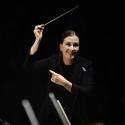
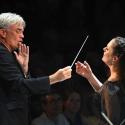
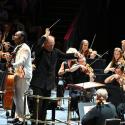
Finally, which in the concert was first and perhaps least consequential, Bartók’s Dance Suite served as a kind of concerto for orchestra to highlight the LSO’s wonderful principals, woodwind especially; bassoonist Rachel Gough’s clarity stood as an emblem for their powers of projection. Although a couple of his ritenutos didn’t feel quite organic, and Bartók’s final tying of the threads came over as a little cautious, Adams is learning to be freer with his baton, less metronomic than the last time I heard him. A great conductor he may not be; but he remains the greatest among that select group of living composers really reaching out to a captivated wider audience.
Listen to the San Francisco premiere recording of Harmonielehre's first movement
- Next in the series are Adams's Shaker Loops and String Quartet at LSO St Luke's on 23 January