

If this time of year should prompt everyone to count their blessings, then one precious musical gift shines brightly over Smith Square Hall this week. For the choral ensemble Polyphony, its director Stephen Layton and the Orchestra of the Age of Enlightenment, it’s just a normal Christmas festival in Westminster: Bach’s Christmas Oratorio last night, Messiah this evening.
Yet I came away from the Bach reflecting that, four decades or so back, period-conscious Baroque music-making of this quality and commitment would still have struck most listeners as a revolution – perhaps a miracle of sorts. Today, such everyday excellence counts as business as usual, even if the financial and institutional base on which it rests often feels, these days, more fragile than ever.
Just a few years older than the music (completed in 1728), Thomas Archer’s now-renamed St John’s hosted the Polyphony/OAE presentation of the Oratorio’s first three parts, bisected by a brief, spirited and punchy seasonal motet by Heinrich Schütz: Hodie Christus natus est. Although a programme that spans all six days of Bach’s mid-1730s Christmas pieces makes for a long evening, I would have preferred to hear at least the final, glorious part as well. Never mind: what we had amounted to a banquet, impeccably served.
From the opening joyful noise of “Jauchzet, frohlocket” onwards, Layton and the 14 Polyphony singers created a mighty sound with an exuberance of tone paired with clarity of diction. David Blackadder and his trio of trumpets blew with utter assurance but no bullying brashness. And Scott Bywater’s thunderous timpani shook the church foundations.
The OAE manage to fuse earthiness and refinement to thrilling effect. In this fine acoustic, the rock-solid continuo group – cellos Jonathan Manson and Andrew Skidmore, bass Cecelia Bruggemeyer, organist Stephen Farr – made their discreetly firm presence felt at every turn. Bach in his most festive and extravagant garb shows off both this outfit’s force, and its finesse.
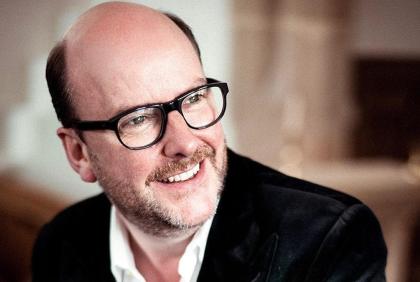
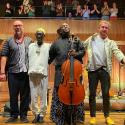
We enjoyed nuanced and expressive vocal storytelling in the Gospel recitatives delivered by tenor James Gilchrist and bass Neal Davies. However familiar, the stories of the shepherds in the fields and the Magi at the manger have to feel like astonishing revelations; both narrators made the old words gleam and dazzle again. Their arias had a range of expression and an ardent attack to match: Davies (pictured above) in the robust fervour of his “Grosser Herr”, Gilchrist in the racing excitement of “Frohe Hirten”.
Soprano Hilary Cronin, celestial but never effete (pictured below), brought an angelic glitter to her duets, especially in the lustrous “Herr, dein Mittleid” with Davies. In such a strong team outing, it seems invidious to pick favourites – but mezzo Helen Charlston, with the alto arias, gave a truly stellar performance. If anyone still hankers after boyish chorister warblers in this work, Harnoncourt-style, they might not have been best pleased. No matter: Charlston gave us a strength and depth of tone and feeling that did not sound cheerily “operatic” but simply, and purely, human.
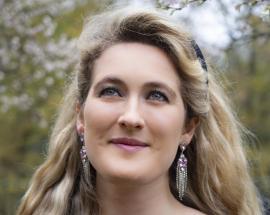
From “Bereite Sich, Zion” through “Schlafe, mein Liebster” to “Schliesse, mein Herze”, each of her sacred showstoppers felt new-minted and freshly experienced. Control and intonation never faltered, as sensitive phrasing and volume matched sound to sense. Some moments might have stopped Herod in his tracks – such as the nerveless crescendo on “Schlafe, mein Liebster”. Hard to go wrong with music as sublime as this? As any Bach-lover knows, it’s not.
Meanwhile, the instrumental parts kept pace with the singers in flair and impact. The ever-present woody warmth of the oboes (Alexandra Bellamy, Sarah Humphrys); Blackadder and his trumpet squad; the flutes (Lisa Beznosiuk, Neil McLaren) and – unforgettably – leader Margaret Faultless’s violin solo for “Schliesse, mein Herze”: all helped weave a sonic carpet that held us close while keeping its colours distinct. In the chorales and choruses, Layton and the singers lent their lines character and contrast, from the near-raucous jubilation of the opening and closing numbers to the relaxed, almost languorous, cradle-song tenderness of “Ach mein herzliebes Jesulein”.
Layton’s carefully judged tempi and dynamics shifts supplied drama enough, but no crude sensation: the story and its meaning took centre-stage. We now take Baroque musicianship of this proficiency and panache almost for granted. We should not. At any time of year, it ought to remain a source of wonder – and gratitude. Count those blessings again.




Add comment