Not every Yuletide fixture need be commercial and routine. Certainly St John’s annual Christmas Festival packs them in, but why wouldn’t it when the voices for the last two events, backed up by no less than the Orchestra of the Age of Enlightenment, are the best you could possibly find for the great monuments of Handel and Bach?
Admittedly, Bach’s cornucopia of celebration isn’t an oratorio like Handel’s Messiah, rather a sequence of six self-contained cantatas, of which last night’s team omitted two which are in no way inferior to the others (indeed, Part Four, with its horns adorning two superb choruses, soprano "echo" number and tenor racing against two violins, is possibly my favourite). The answer, I suppose, is that we’d have to buy their new CD set, warmly praised on theartsdesk by Graham Rickson, to hear what we’d missed.
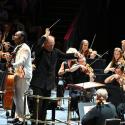
Still, what we did get was generous enough; four demanding cantatas in an evening is more than you'd usually expect. I wondered what we were in for when Stephen Layton launched in with an over-brisk, almost militaristic opening number, the cries of “Jauchzet, frolocket” (“Rejoice, exult!”) delivered by the choristers of Cambridge’s Trinity College with mostly deadpan expressions (one radiant smiler in the front row made the others look inhuman). But this may have been rigid terror at facing the audience without their music to shelter behind, and they soon relaxed to prove themselves every inch a match for the Clare College team I’d heard the night before. Indeed, while the sopranos might not have quite the radiant halo of the Clare sisters, Trinity tenors and basses make a meatier, more mature sound than their rivals. The choir blazed as angels and gave as heartfelt and stylish a shepherds' thanksgiving as you could hope to hear.
 The splendid culmination was the most wayward and original of Bach’s opening choruses, Part Six’s muscular incentive to stand fast against proud foes and fiend. As for the three natural OAE trumpets, led by their authentic king David Blackadder – urged on by Bach to even more exposed feats of virtuosity here – how is it possible, given the superlative work of the previous evening, that London can field six such masters of this usually wayward and split-prone instrument in a single weekend?
There was more modest but equally effortless solo and obbligato work from flautist Lisa Beznosiuk, violinist Margaret Faultless and the team of oboes – two doubling oboe da caccia – that gives Part Two’s shepherds’ idyll its shy and lovely colour. The flawless vocal team was led by James Gilchrist. Younger tenors may make a sweeter sound, but none is, or ever will be, a more vivid or sympathetic exponent of the Evangelist’s role which sets these cantatas apart from many others in its narrative component. There’s a spark of genius in Gilchrist’s colouring (I’m thinking especially of the stilling moment when Luke tells us how “Mary kept all these things and pondered them in her heart”). And his delivery of the defiant last aria was no less vivid: here’s an artist who carries the entire audience with him. As, more coolly, does countertenor Iestyn Davies, shading the clarion notes of Part Two’s cradle song with unearthly beauty and rounding off phrases with consummate artistry.
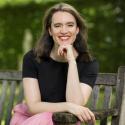
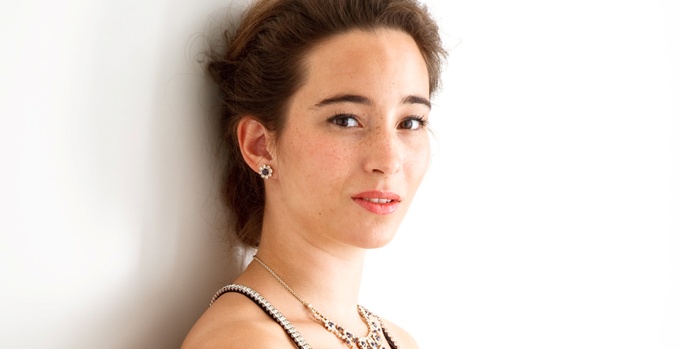
At either end of the quartet we had youth and experience respectively in Katherine Watson (pictured above by Hugo Bernand) and Neal Davies; but Watson applies her lyric warmth to making the same urgent and charming sense of the text as Davies. As this is the solo team down for tonight’s Messiah – which they performed last year to perfection, too – you’d better see if you can’t get hold of a ticket for another guaranteed eve-of-the-eve glory.