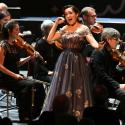
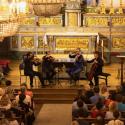
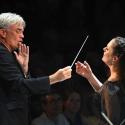
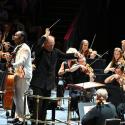
Period instruments demand absolute honesty from their players. Their sound is their personality - candid, quirky, eccentrically beautiful - but their soul is revealed in the spirit of the playing, where beauty is not skin deep and the expressiveness of phrasing in the strings is created in the bow arm and from a truthfulness of intonation that does not hide behind vibrato. Watching and listening to Sir Simon Rattle and the Orchestra of the Age of Enlightenment realise Mozart’s last three symphonies was to experience some sense of their innate fantasy, daring, and sense of theatre but, most importantly, at the time of their inception and not through the romantic haze of hindsight.
Caught out like many others by the earlier start time, I watched Symphony No 39 on a TV monitor in the bar - but whilst the sound was, of course, a tinny abomination of the real thing, the naturalness and movement of phrasing, the urgency of the pacing, the contrasts both in tempo and dynamics still registered boldly. Those shock modulations that Mozart springs with such relish, punctuated and driven to such incisive effect by wooden sticks on small skin-covered period timpani, pushed the excitement levels several notches higher on the Richter scale. Infectious, too, was the good-humoured up-tempo country dancing of the scherzo, with its gracious Ländler trio where bucolic clarinets put on airs above their station.
The way in which the harmony took on a transfiguring dimension proved truly revelatory
Back in the hall, Rattle’s reading of the dramatic G minor Symphony No 40 was set fair to become the highlight of the evening. From the breathlessly furtive vamp of the opening bar and the familiar, indeed ubiquitous, first theme - so agitated in context and offset as it is by violent ripostes from wind and strings - decades of soft-centred, inappropriately well-behaved performances were swept from one’s memory. The stormy development with keening, harmonically distressing oboes dug us deeper into minor key angst, while the fleetingly surreal recapitulation of the theme in the coda momentarily made me wonder if I’d ever noticed it before.
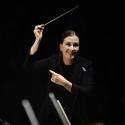
The slow movement was extraordinary. Here indeed was a strange refuge from the turbulence of the first movement, and the way in which the harmony (so transparent in Rattle’s baton-less hands) took on a transfiguring dimension proved truly revelatory. Back in the daylight of the scherzo, rhythms were again sprung from the heels of collected bows and that same keenness of articulation made for a thrilling immediacy in the finale. I’ve not heard a better performance of the piece in years.
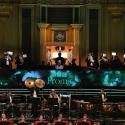
The great Jupiter Symphony was put on hold for a moment or two while Rattle went off to check why all the stage lights weren’t on (“We should have been playing The Creation,” he quipped), but the call to attention with trumpets and drums to the fore quickly established a grander ambition and scale, with the slow movement most notably achieving a loftier serenity.
But it is the great finale of Mozart’s last symphony that remains one of music’s miracles. Was counterpoint ever so exhilarating or exultant? The cut and thrust and fizz of those interplaying lines is in itself something wondrous, but add to that a group of players like those of the OAE rejoicing in the music’s stunning virtuosity and really playing it to the hilt, and you’ve something that turns you from an audience member into an active participant.