Miklós Perényi makes the listener re-think how a cello should sound. Forget the huge tone of the Russians - think Rostropovich or Natalia Gutman, or the attention-grabbing of Americans or even the flamboyance of the French. No floppy hair, no vanity or mannerisms here. Perényi plays with simplicity and accuracy, but with phenomenal craft and musicality. He dosn't force the tone, yet knows exactly how to project right to the back row of the hall. Technique, which is there in abundance, always seems to serve musical ends.
Perényi has been a cello teacher at the Liszt Academy in Budapest since his 20s, and since 1980 has been head of the department, thus the direct heir to David Popper, who founded the Academy's cello department in the 1870's at the instigation of Liszt himself. I am told Perényi teaches in the same room where Popper taught.
Perenyi's bow control and uniformity of tone were phenomenal
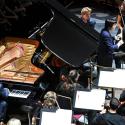
Alongside this career away from the limelight, rooted in his native Hungary, Perényi has performed in a duo for decades with pianist András Schiff. Whereas Schiff, who moved away from his native Hungary at an early stage in his career, now has the cachet in classical music to name whatever duo partner he likes - and probably his price at the same time - this long-standing duo with his slightly older compatriot feels like a genuine partnership of equals. Schiff plays with the lid of the piano up, but never overwhelms.
Perhaps the most surprising moment of the evening was the opening of Brahms's second Cello Sonata in F Major. Where many duos see the oscillating semi-quavers in the piano part as a continuous wash over which the cello line (dynamic marking forte) is pushed out with bombast, what Schiff does is to obey the p dynamic marking in the piano part, ensuring that the texture is spare, that the lines in his part are clearly etched out and delineated. It was one of those moments when a familiar work can suddenly reveal a completely unexpected character.
In the First Brahms Sonata, the last movement's clear allusion to Contrapunctus 13 from the Art of Fugue was not going to escape musicians so thoroughly steeped in Bach as both Schiff and Perényi are. Both men brought out the crystalline purity of the Bachian line. That was special.
In Schubert's Arpeggione Sonata, a telling moment was Perényi's long, held C natural, sustained over more than four whole bars at the end of the slow movement. Perenyi's bow control and uniformity of tone were phenomenal, yet this was less of a high wire act than a gesture to bring out beauty of expression. The calm and stasis of the cello part allowed the darkness and mystery of the deliciously sinking bass line in the left hand of the piano to be heard vividly.
There were also two Hungarian works. Zoltán Kodály's rarely heard Sonatina for cello and piano from 1910 was a work which had a problematic genesis. Rather than strident nationalism, this is Kodály expressing diffidence and delicacy. It received a convincing and idiomatic performance. The encore gave more than full value: Bartók's own arrangement for cello and piano of the First Rhapsody from 1928 was a lively, characterful end to a very fine recital.