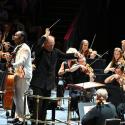
Intellectual rigour and emotional honesty are the rewarding qualities in András Schiff’s Bach playing. Virtuosity comes as standard, too. And you get value for your money – his programme all but filled two-and-a-half hours, and he was as completely in command at the end as he had been at the beginning.
More so, if anything. If Schiff is not entirely satisfied with the way something comes out, he’ll play the whole section of the music again, just to show what it really can be like.
It was the three big pieces (all published or labelled as "Keyboard Practice" by their tongue-in-cheek creator) specifically written for two-manual harpsichord: first the Italian Concerto BWV971, then the French Overture BWV831, and finally the Goldberg Variations BWV988, that he played for this special Bridgewater Hall 21st anniversary recital. That raises an issue of course: why play music designed for the tonal contrasts of two-manual harpsichord construction on the single keyboard of a piano? Why play it on a modern grand piano at all, for that matter?
 There are good answers to those questions. The concert grand can fill the acoustic of a large modern hall much better than any harpsichord; the music itself is remarkably adaptable; and with a great interpreter you can appreciate the textures and the counterpoint without over-emphasis or exaggeration. Schiff is a great interpreter – he allows himself just the tiniest touches of pianistic expressivity (with no una corda and only the most discreet sustaining pedal employed), and occasionally he’ll re-balance the upper and lower registers to make a point, but you can always see why he does it.
In the Italian Concerto first movement, for instance, he brought those ever so slightly whimsical touches just to the two episodes before the return-of-tonic ritornello – enough to heighten the tonal effect but nothing more. He uses a detaché articulation of some bass notes which enables them to speak without dominating (even in that concerto’s slow movement it proved utterly charming and made for a three-timbre effect – in the faster music of the French Overture it was equally effective to give a spring to the rhythms). He can create oases of sweetness and light in the apparently simplest notes by building contrasts with the weightier music that surrounds them – the Gavottes and Bourrées of BWV831 were examples among many.
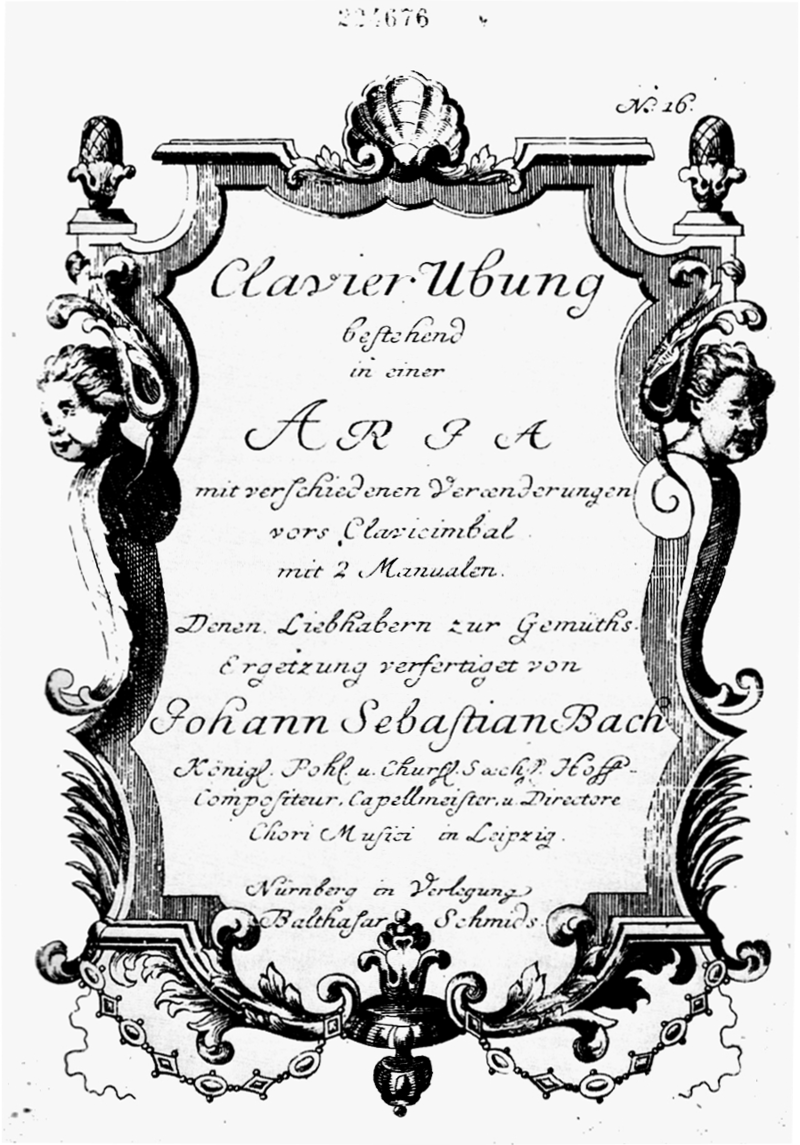
The Goldberg Variations (original title page pictured above) are a journey for him: from serenity to serenity, with highpoints and pauses for contemplation along the way. The brilliance of the technical resources he brought was entirely subservient to the organic growth of the music, and the touches of drama (towards the end of the fugal Variation 10, for instance) knowingly placed.
Again the voicing of the part writing in the two-manual music captured its innate qualities (witness Variations 13 and 15) and wove an uncanny spell. There was fun as well (Variations 17 and 19), and tragedy – the more effective because, as in Variation 25, he keeps the pulse strict while making his effect with the most subtle contrasts of weight. There was lyricism in the most unlikely places (Variation 27’s technical demonstration of trio writing skill, for instance). And then he brought rumbustious jollity to the 30th – the knees-up Quodlibet which almost subverts the whole sequence, before the wistfulness of the return to the aria theme.
Schiff needed no further encores – he had delivered in full.