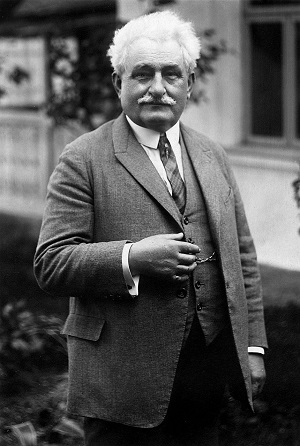
Janáček has been an abiding passion for Thomas Adès. As both composer and performer, Adès revels in the whimsical and the absurd, and he finds both in Janáček’s piano works. This recital presented the complete surviving piano music of Janáček (pictured below), for the most part a miscellany of miniature character pieces, some quirky, others more profound. Adès performed them all with an urbane sophistication, distant from the music’s folk roots, but with many surprises of his own added along the way.
Three major cycles form the basis of Janáček’s piano catalogue, Along an Overgrown Path, the Piano Sonata and In the Mists. These were spaced out with a scant ephemera of four rarely heard miniatures, one early, three late, all presented with character and charm. Along an Overgrown Path came off well for the variety that Adès achieved between the movements and the lyrical, if often erratic, character of each. There are few outright dissonances here, but in the first movement, “Our Evenings”, Adès dwelt on each. He also exaggerated the abrupt halts and stuttering tempo changes, though it all felt well within the spirit of the music. If the weighty climax of “A Leaf Blown Away” felt prosaic, then the movement’s title justified the reserve.
 On the other hand, “The Madonna of Frýdek” sounded surprisingly austere. An insincere reverence perhaps? Some genuine emotion, at last, in “Unutterable Anguish”, Adès maintaining a mood both ethereal and pained. And some grandstanding in the last number of the first book, “The Barn-owl Hasn’t Flown Away”, though always within respectable dynamic limits.
The Piano Sonata poses a challenge for performers: Janáček named the work “1 X. 1905 ‘The Street’”, commemorating an uprising in Bruno of Czechs against the German-speaking ruling classes. He didn’t call it a piano sonata, and while the music’s drama and scale justify the appellation, its erratic structure does not. Adès seemed to take a perverse delight in the sudden changes of texture, the U-turns in the chordal progressions, and the abrupt silences. The ending felt arbitrary and unprepared, but Adès presented this as an open question – a conclusive statement of the composer’s uncertainty.
In the Mists ended the recital. Adès again ignored the title, instead exploring the music on its own terms. So there was little atmosphere, more a patient exploration of the composer’s unique expressive language. Tempos were unusually slow, which emphasised the sudden, erratic outbursts that punctuate the outer movements. Adès slowed and broadened into the final coda, but Janáček’s wayward harmonies ensured that the ending still felt inconclusive – a feeling that Adès continued with two encores of his own, tiny aphorisms, over as soon as they began – Janáček’s spirit distilled into just a handful of notes.