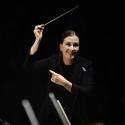
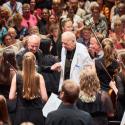
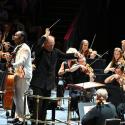
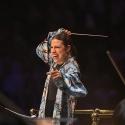
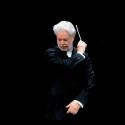
Violins, violas, wind and brass all standing for Schumann: gimmick or gain? As John Eliot Gardiner told the audience with his usual eloquence while chairs were being brought on for the Berlioz in the first half of last night's concert, Mendelssohn set the trend as conductor with Leipzig's Gewandhausorchester - though as I understand it, only the violins stood - and some chamber orchestras of comparable size have adopted the practice. But Gardiner didn't need to reason the need; we'd just heard it at work in Schumann's Genoveva Overture - a brighter, more vibrant sound than usual from the London Symphony Orchestra, more visible interaction between players (especially between the two rows of woodwind players, the first being able to pivot towards the second).
A disclaimer may be necessary here: I interviewed Sir John on this Schumann symphonies project for the orchestra's online filming, so it may look as if I've drunk the Kool-Aid. But from the first work in a totally engaging evening onwards, the entire audience palpably shared the enthusiasm conveyed by players formerly more remarkable for their finesse than any visible delight in their work (that had certainly changed when Rattle conducted the three Stravinsky ballets at the start of his principal conductorship last autumn). And a stone would have melted at one of the most remarkable concert performances I've ever witnessed from a singer, the luminous Swedish mezzo Ann Hallenberg's total collaboration with Gardiner and the LSO in Berlioz's Les nuits d'été.
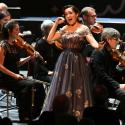
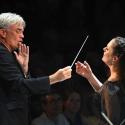
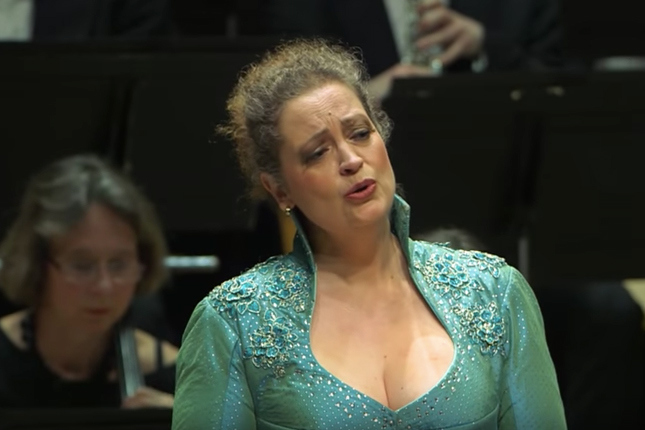 Hallenberg's tonal palette (the singer pictured right last night) is entirely fused both with the orchestra and with the texts by Théophile Gautier, or rather with the hypersensitive, nuanced way Berlioz inflects them. You wondered at first why there were breaks in lines which more often run in long curves; to change hues on a significant word, turned out to be the answer, since when the mezzo needed breath control for expansive climactic phrases, it was at her disposal. Everything counted here, the magic extending over numbers. From the sombre timbres of "Sur les lagunes," a lament for a dead love, to the bittersweet radiance of "Absence" - no more beautiful melodic refrain has ever been captured in song - Hallenberg changed her entire demeanour to reinforce the drama of contrasts She uses hands, eyes and sheer force of personality to make it seem as if you are the one person for whom she's singing. French can be a problem for German and Scandinavian artists - it was the Achilles' heel of Anne Schwanewilms' performance here several years back - but though Hallenberg produced a few odd vowel sounds, there was no doubt of the meaning at any point.
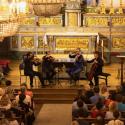
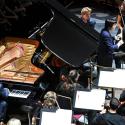
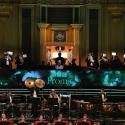
The now-seated LSO gave her the space and the sound halos she needed. Those delicate trills and harmonics in the violins inhabited a fourth dimension; a viola counterpoint and the spangling of harp came as newly exquisite revelations; voice and one clarinet duetted with supernatural beauty. The tonal originality is in a way far removed from Schumann, who in Gardiner's hands makes silvery magic with the entire orchestra sharing the sensibility the composer had, in pre-symphonic days, reserved entirely for the piano. But the Genoveva Overture is not without its magical timbral shifts, engaging the four horns especially in telling shifts of emphasis. 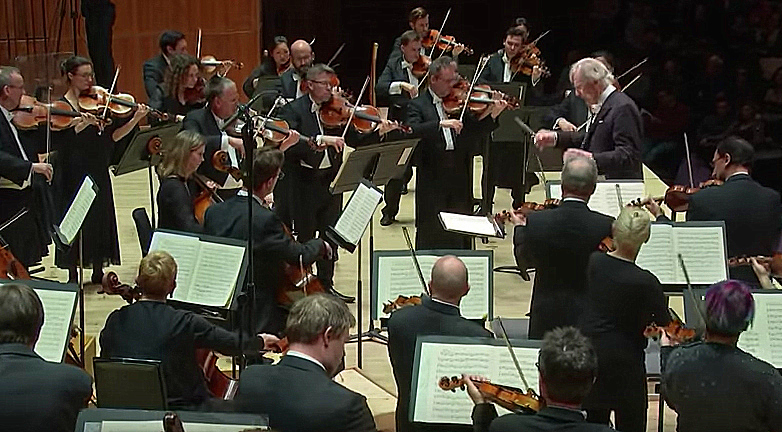 In these hands, as in those of Haitink and the Chamber Orchestra of Europe in a transcendental Prom last summer, the Second Symphony comes across as Schumann's greatest symphonic miracle (last night's performance pictured above). How spare he is with undulating melody in the first movement - just that jaunty little line which bounces out from nowhere at the end of the exposition; how obsessive with the three repetitions of the main idea in the most original of scherzos, second violins adding to the pleasure with their sudden lunges from front of stage right; and how much he extracts from the four-note sighing phrase of the great Adagio espressivo which plumbs the depths, but with lightness of touch.
The finale can sometimes seem to tread water until a new and heart-easing theme appears half way through, always something of an epiphany - Schumann's "Ode to Joy" moment - and never so than in the radiant phrasing of the LSO's peerless principal oboe, Olivier Stankiewicz. Yet Gardiner's way with flickering half lights and his careful rhythmic articulation always save the composer from any hint of squareness. When Haitink and the COE got to the end of the scherzo last summer, I wanted to hear it all again at once and longed for the legendary times unknown to us when applause at the end of movements would sometimes prompt an instant repeat; here we got the last statement and its whirlwind coda even faster by way of encore, sending us out grinning at the end of a concert in a thousand.