

If you’ve had half an eye on BBC Four’s conceptual art week, you’ll have noticed that the old stuff is where it’s at, with Duchamp’s urinal making not one but two appearances, equalled only by Martin Creed, that other well-known, conceptual stalwart (who actually isn’t as old as he looks). The BBC would say that this is because 2016 marks the centenary of Dada, the anarchic, absurdist art movement (if a movement is what it was) that saw artists begin routinely to challenge and ridicule accepted ideas about art – what it is, why it is and what it’s for.
The other reason, as demonstrated in Tate Britain’s disastrous Conceptual Art in Britain: 1964-1979 show earlier this year, is that if you take away the lavatorial mischief-making of Duchamp’s urinal and Manzoni’s tinned shit, the discussion of conceptual art can all too easily slip into beard-stroking self-parody.
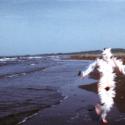
 Certainly Vic Reeves (or Jim Moir as he was tonight, although what the difference is who knows) did a good job of persuading us that Dada is at the root of everything subversive, silly and conceptual in the 20th century and beyond, with his own brand of humour anticipated in the nonsense-language performances at Zurich’s Cabaret Voltaire. A stunned audience looked on as Moir donned a cardboard costume to re-enact Hugo Ball's Magical Bishop speech of 1916: it was pure Vic & Bob and bizarre proof that there really is nothing new under the sun.
Martin Creed, an artist as barmy as he is delightful, served as a sort of living embodiment of Dada, not least because no-one, including Moir, can ever tell whether he’s taking the mick or not. Having sparked tabloid outrage with Dadaesque installations like Work No. 227: The Lights Going On and Off, 2000, Creed greeted with amused interest the news that his installation Work No. 200: Half the Air in a Given Space, 1998, had in fact been done by Man Ray in the 1920s.
Likewise, animator Terry Gilliam revealed that an early review had described him as “a product of Max Ernst”, whose collages he had in fact never seen. Shown a film by Hans Richter featuring the silly walks that have since become a Monty Python trademark, he, like Creed, was unperturbed, preferring to see these much earlier incarnations as evidence of the continued vigour of Dada. As they saw it, Dada was a sort of continuous revolution, relevant today but born out of the horror of the First World War, when one form of madness was offered as a response to another.
Short of a sidekick to banter with, Moir’s relentless hilarity needed a focus, brilliantly provided by Martin Creed who was more than a match for him in the silliness stakes, throwing down the gauntlet by casually revealing the neatly dismantled Fiat Panda in his spare room. If that brought back memories of undergraduate high jinks, the essentially Dadaist sensibility of the student jape was taken as an excuse for Reeves, accompanied by a game Cornelia Parker, to rather lamely stick balaclavas on the Bond Street statues of Roosevelt and Churchill.
Like much of Vic Reeves’s work it was an acquired taste that fluctuated wildly between overdone funniness and more subtle humour that delivered moments of insight. For some, the presence of Jim Moir will no doubt smack of “dumbing down”, but really, this just isn't the case: who better to talk about Dada than someone who has spent his entire working life in a Dadaist mindset?







Add comment