

In the world of contemporary classical music, it takes confidence to launch your seasonal programme with an 18-year-old performer, and no hint of the repertoire. But Ryan Wang’s opening concert for the 2026 Bold Tendencies (BT) season filled every one of the 300 or so plastic bucket seats clustered around a gleaming Steinway grand.
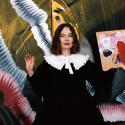
Inspired by this year’s Euphoria theme, Wang (pictured below) picked three pieces that most would have avoided for fear of overfamiliarity: Mozart’s Variations on “Ah vous dirais-je, Maman” (aka Twinkle, Twinkle, Little Star); four Schubert Impromptus; and Mussorgsky’s Pictures at an Exhibition.
But we were spellbound throughout. With the Mozart, he wrought so much light and clarity out of each note, each phrase, it was the aural equivalent of watching a skilled craftsman polishing diamonds. He also belied his youth in the intense delivery of the darker, more romantic and tumultuous Schubert and Mussorgsky pieces. He returned for three encores, starting with the perfect palette cleanser: the Aria from Bach’s Goldberg Variations.
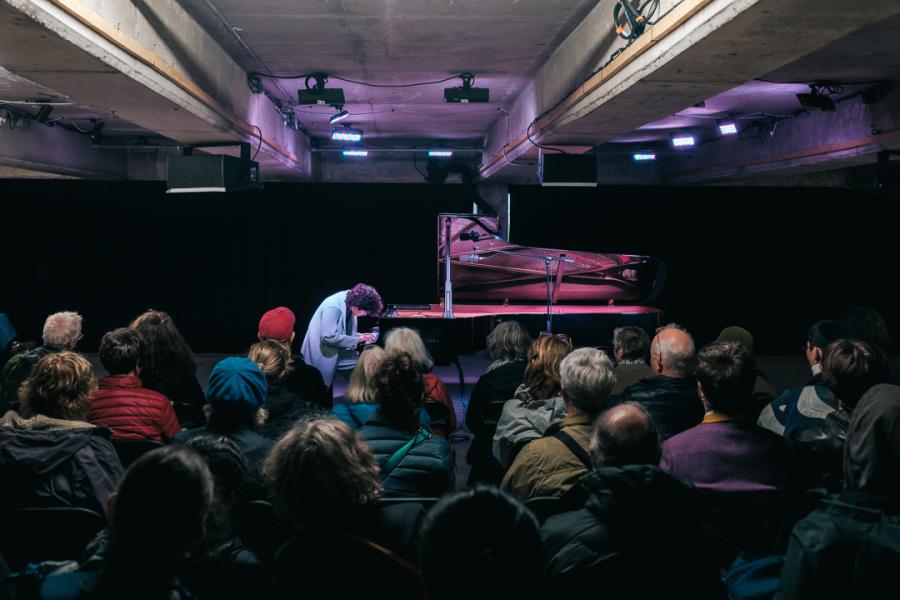
Ambient intrusions are a given, from trains roaring into Peckham Rye station to police sirens. That night we also had an impromptu “fly through” of a startled pigeon. And yet the sound quality within that space is more than equal to the task, (thanks to a folding timber acoustic wall, plus thick, woollen acoustic curtains and skilled tinkering from sound engineers). The rewards of this free range setting include intimate proximity to performers, plus tickets priced from £10 to £25.
The live programme is the youngest part of this proud landmark in Peckham’s cultural calendar; it began in 2011, with a two piano performance of The Rite of Spring, but has been run at its current intensity since 2018. BT was first launched by Peckham gallerist Hannah Barry in 2007 as a one-off outdoor sculpture show, on the roof of Southwark Council’s offices at Sumner House. The next year she was given permission to do the same on the top floors of the car park– then an eyesore scheduled for demolition. The year after, BT commissioned a distinctive food and drink offer, Frank’s Bar, along with its impactful but simple structure conjured from railway-sleepers and red tarpaulin by Practice Architecture. In 2023 it was voted Europe’s best rooftop bar (by Big 7 Travel).
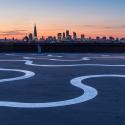
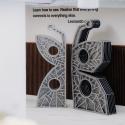
The art offer has varied wildly, but grown consistently more appealing since Richard Wentworth adorned the roofscape with a pirouetting snail trail of silver tape in 2015. Called Agora (main picture), it is one of several permanent works, and somehow draws the whole rooftop into a coherent place, providing an other-worldly shimmer even on the greyest of days. “He called it a bread basket”, says Barry, still at the helm, as artistic director and chief executive. If he meant that it works equally with chicken, chips, or indeed a sliced baguette, he’s right. Almost everything looks interesting against this backdrop.
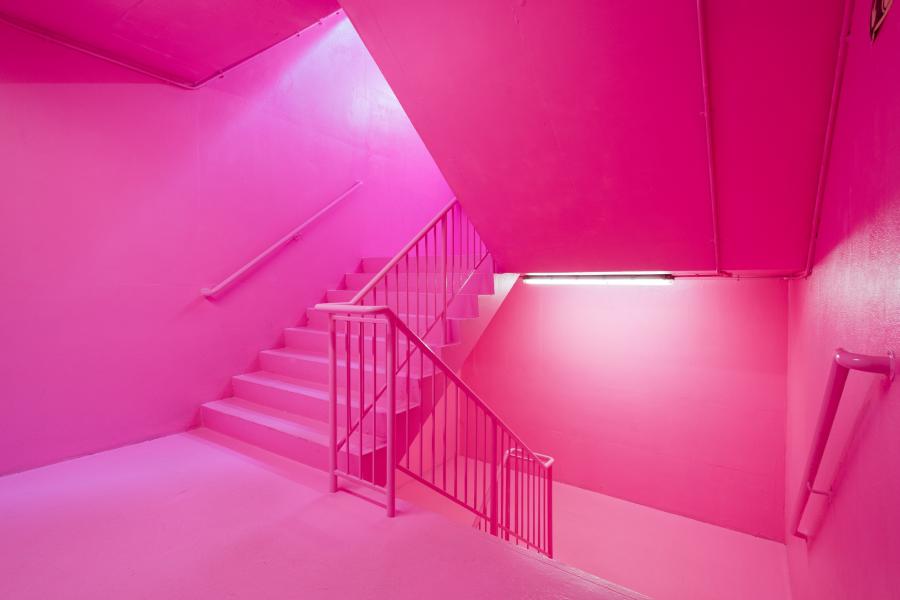
Hi boo, I love you, by Simon Whybray, in 2016, was another seminal commission, drenching the entire staircase in Pepto-Bismol bright pink paint (pictured above). An Instagram meme was born. There has been a big name in every recent iteration (Jenny Holzer, Gillian Wearing, Andreas Gursky). For many others it has been a decided career booster (Rene Matić, Camille Henrot, Anthea Hamilton, Michael Dean, Abbas Zahedi). Choice of artist has never been about profile or star power, Barry says: “It was always about welcoming a wide range of approaches, practices, ways of making sculpture. We wanted each artist to be able to do something that was interesting for them as much as the people who came to see it. That’s why it was always a commissioning programme.”
For the Euphoria edition, we have Gursky’s large scale photographic collage of Berlin ravers; Emma Hart’s Last Chance Saloon – an inhabited sculpture that can double up as a snug – and Tarek Lakhrissie’s glowing, space age chrysalis. A perennial delight is the Derek Jarman garden, devised in 2013 by Dan Bristow. A tribute to Jarman’s Dungeness planting, its grassy tussocks go some way to filtering the scent of the rooftop’s compostable toilets.
Though the programme features many classical/contemporary greats, Barry resists that definition: “That’s not what I’m programming. It’s live events. That’s a very intentional term. It has an aliveness to it and a beginning and an ending, and in that way it can scoop up practically any discipline.” This year Messiaen (Turangalîla-Symphonie, 20 June), Mozart and Reich are in the mix. Musicians include seasoned concert hall bill-toppers, alongside talented ensembles of London music students and graduates (the Trinity Laban Symphony Orchestra delivers the Messiaen this year). The homegrown Multi-Story Orchestra, formed after music students Kate Whitley and Christopher Stark approached Barry to see if they might play in the car park in 2011, is now a pioneering youth-led orchestra, “amplifying unheard voices”; both they and the car park were featured in The Proms in 2017. (They are playing Dreamer, on 13 and 14 August). The Philharmonia and the London Symphony Orchestra have also sat beneath its coffered ceiling. The Kanneh-Masons are regular favourites.
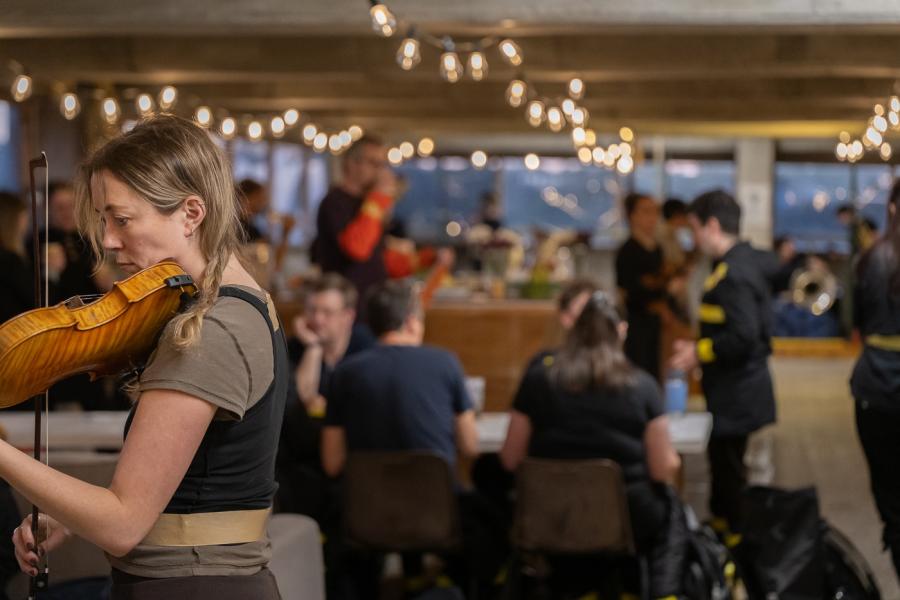
This year we can look forward to a repeat of last year’s ground-breaking Garland, commissioned from composer Oliver Leith (12 and 13 June), which weaves chorus, musicians and even a horse around the space (pictured above: last year's performance of Garland). Steve Reich fans should catch the Colin Currie group playing Drumming. The dance component is always riveting (Oona Doherty performs three different pieces on 22, 23 and 25 July). And there is literature, including a performance by Ben Okri of The Magic Lamp (18 July). Mozart’s Great Mass in C Minor concludes the programme on 12 September.
As tickets for live shows in London go stratospheric, its accessible pricing is hugely appreciated – and hard won, through year round fundraising. Every event is subsidised by an average of 80%.
And there is community enrichment woven throughout. In a part of London still rife with deprivation, the creative learning programme launched in 2014, and it has grown increasingly integral to the project. It works with around 30 local schools, colleges and community groups, and last year conducted 68 sessions and 78 distinct activities with 1,947 participants within a mile radius, from artist placements and creative workshops to backstage passes. The reason for this huge investment in time and energy? Says Barry: “To ultimately make it better for the constituents that it serves and the artists who take part.”
The future looks brighter since a plan to build a 20-storey apartment block on the adjacent supermarket site was thrown out of court in May 2026 – it would have killed that stunning view. In the summer of 2020, when it was one of few venues allowed to stage live performances in London, it secured its place in a shifting cultural landscape. Given the decimation of the arts in state education, the vital role that it plays in community cohesion and wellbeing, and Londoners’ dwindling funds for participating, it is now more necessary and precious than ever.

Add comment