Art should reflect its times, but after a preview week dominated by the controversial participation of Russia and Israel, the 61st Venice Biennale felt in pressing need of distraction and delight. Instead, across 99 national pavilions and 31 “collateral” events, the mood is end of days, from the Bulgarian pavilion’s dispatches from the near future, to Florentina Holzinger’s sewage and nudity extravaganza in the Austrian pavilion.
A gloomy title, In Minor Keys, set the tone in advance, and the main exhibition, tasked with setting the Biennale agenda, follows suit: overstocked with the sort of thing that might work in one of the superyachts moored nearby, it is a reminder that in the age of the oligarchs, money can buy everything but taste.
For its curator, Biennale director Koyo Kouoh, who died prematurely last year, the exhibition is no gilded legacy. Posthumously realised by her team, it announces trends for expensive production, often involving big sound systems and olfactory experiences, the peddling of cod wisdom, and a reliance on neo "primitivist" tropes. No less grating is the exhibition’s ostentatiously “sustainable” corrugated cardboard display materials, a gesture as empty as fitting a jumbo jet with a catalytic converter.
Perhaps it’s meant to signal a growing awareness of the overconsumption, pollution, waste and inequality that dogs the art world at least as much as any other field. But in the closed loop of the Biennale art world exceptionalism is at its most acute: the belief in art’s unarguable virtue is so immovable that you can see people unironically carrying tote bags that read “Art is a habit-forming drug”.
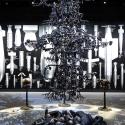
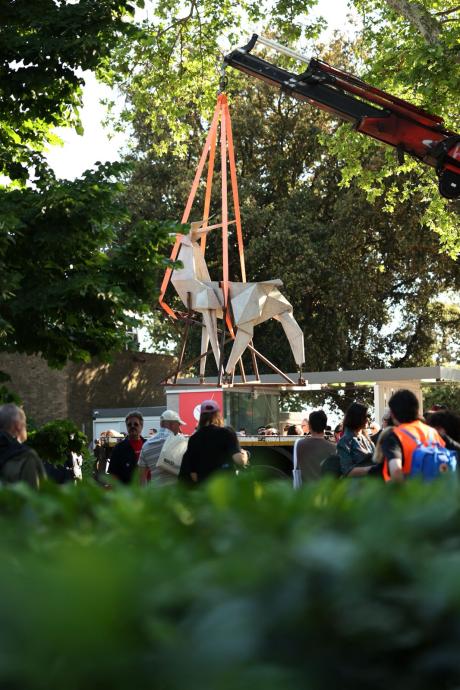
The art world is stuck in its ways, but across the Biennale art itself is presented as an agent of change, nowhere more forcefully than at the gates of the Giardini, where suspended from the back of a truck, The Origami Deer embodies its state of exile from the Ukrainian city of Pokrovsk (pictured above right).
War, and the possibility of peace and tolerance provide the subject of a grim but ultimately perhaps optimistic installation by art collective Nonument Group in the Slovenian pavilion. Soundtrack for an Invisible House is an evocation of a now ruined mosque, built by the Austro-Hungarian army to serve Bosnian Muslim soldiers during World War One. Made from waste materials from last year’s Architecture Biennale, the scene of the ruin is accompanied by a soundtrack of songs, speech and laughter.
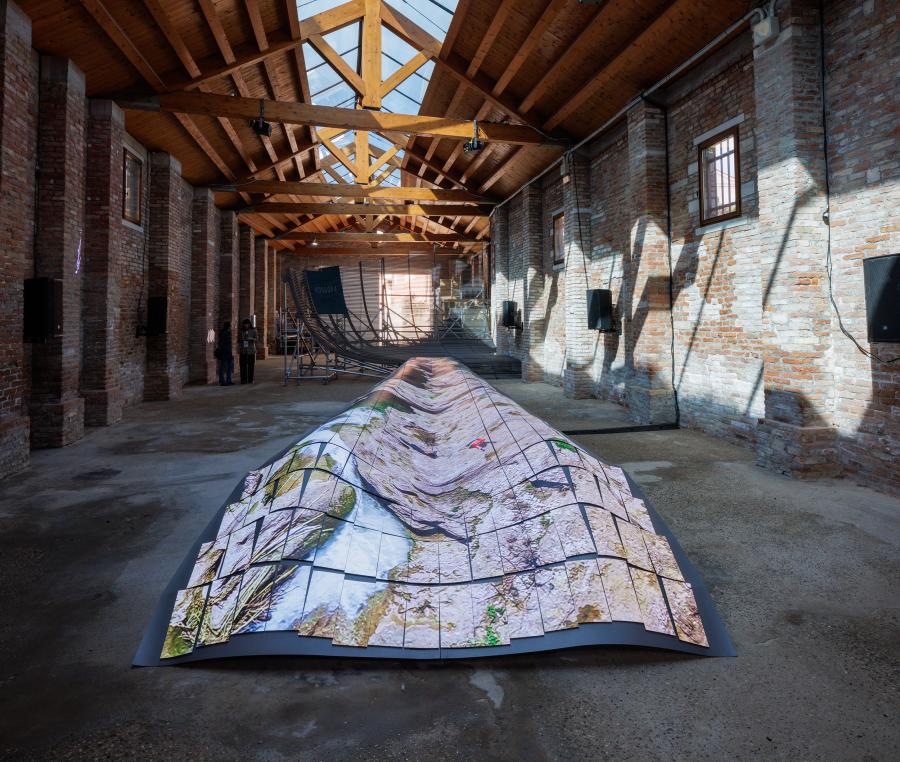
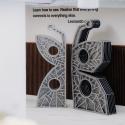
The sweep of history informs Claudia Pagès Rabal, representing Catalonia with her installation Paper Tears (pictured above), which centres on a boatlike bank of LED screens showing maps that flow like water, while paper watermarks are projected on the wall. Round the corner at the Scottish pavilion, historical methods of social control are the subject of Shame Parade by Glasgow drag queens and artist duo Davide Bugarin and Angel Cohn Castle. At its heart is the film Submit to Sound, a five-channel installation in which a trans woman undergoes voice coaching to feminise her voice. “Are you discreet?” is repeated like a mantra as a ratchetting sense of menace makes clear the potential consequences of not “passing”.
You might question whether radio counts as art, but as the station of Bergamo’s Galleria d'Arte Moderna e Contemporanea, Radio GAMeC is undeniably art adjacent. For the duration of the Biennale, Radio GAMeC will broadcast from the studios of Radio Vanessa, founded in Venice as a pirate station in 1978 and still on FM to this day. Its Pedagogy of Hope season runs parallel to the museum’s current programme, involving figures from across the art world including many artists participating in the Biennale. Posing questions such as “What knowledge and skills are needed to understand and transform contemporary reality?” Radio GAMeC takes the rigorously interrogative, dialectical approach that feels so characteristic of this Biennale.
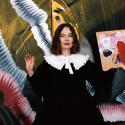
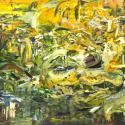
Characteristic, but not invariably so: for something more poetic, the Estonian pavilion, another “off site” production in a church that has been converted to a basketball court, stands out. The space has been taken over by Merike Estna (main picture) for her exhibition The House of Leaking Sky, a large scale installation that combines performance, painting and a floor covered with handpainted tiles. Unlike every other presentation in the Biennale, Estna’s work has still to be made, and she arrived in Venice with 22 blank canvases, which she will fill over the course of the next six months. She paints in public each day, wearing a series of dresses by Estonian designer Lilli Jahilo, inspired by artist women of the past, from Lavinia Fontana to Paula Modersohn-Becker. It’s a meditation on women’s work, and creativity, and in order to do it, Estna has brought her young family to Venice with her, combining childcare and painting in a living tribute to artists past and present.
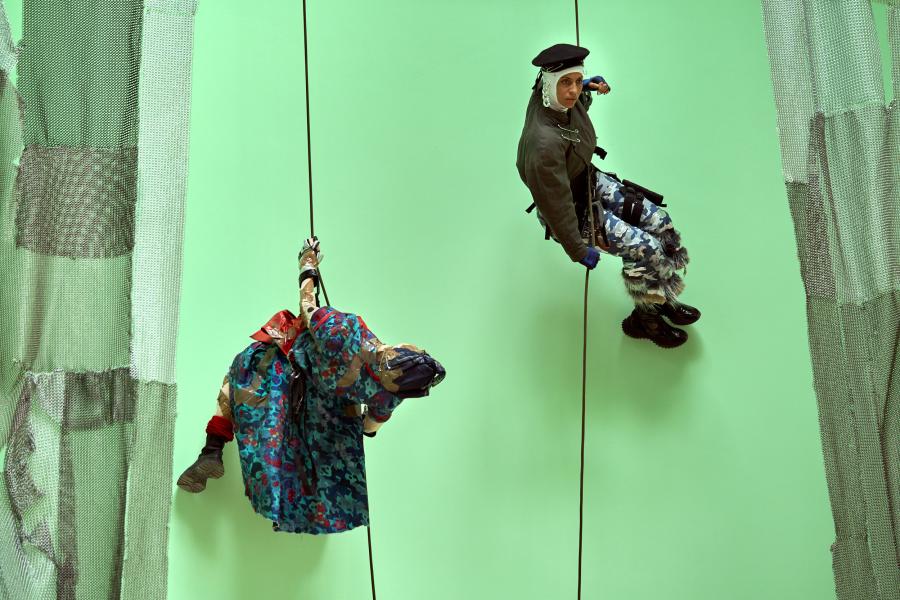
The German pavilion is similarly multifaceted and ambitious, combining performance and sculptural installations by Sung Tieu and the late Henrike Naumann in an exploration of German history, in which the Nazi-era pavilion serves as a metaphor for the lingering edifice of the past. The building has been subject to interventions before – but by covering it in tiny mosaic tiles that recast it as an East German apartment block, Sung Tieu seems to prefer acceptance, and the passage of time, over acts of destruction and avoidance carried out in previous years.
Inside, Naumann measures out the inevitable march of history in a timeline of 20th century chair designs, the home, with all its furnishings and trinkets as laden with political meaning as a slogan or banner. Periodically the installation is animated by a “vertical dance group”, whose performance, titled Trümmerfrau, refers to the German and Austrian women who cleared the rubble after World War Two. Moving, transporting, but utterly of the moment, the German pavilion is one that will be remembered in years to come, and for all the right reasons.