

“Do we really need another Anish Kapoor exhibition?” I asked myself on hearing of the Hayward Gallery’s plan to show the sculptor a second time. (He exhibited there in 1998 and has also had major shows at the Royal Academy and Tate Modern along with numerous Lisson Gallery exhibitions, while his Orbit Tower continues to overlook the Olympic Park in Stratford.)
Having just visited the exhibition, though, the answer is a resounding “YES”! I’m still buzzing with delight at Kapoor’s majestic take-over – the show is more like an occupation than an exhibition. On entering, for instance, your way is blocked by a gigantic red inflatable that fills the space completely.
All of Nothing (main picture) is a load of hot air that unashamedly celebrates chutzpah on a grand scale. Anarchic, funny and rebellious, it feels like an act of resistance – a kick in the teeth to those who increasingly police our every move and limit our freedoms. “That’s my naughty schoolboy attitude,” Kapoor told Guardian correspondent Dale Berning Sawa. “It’s really important,” he says. “Disobedience sits alongside invention. It is radical, and I think it is vital.”
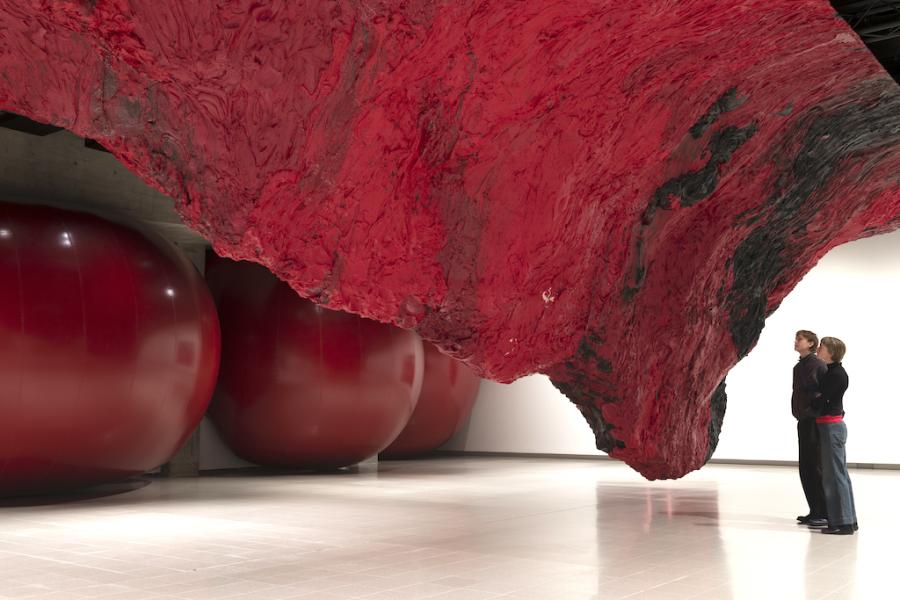
Another monstrous intrusion has invaded the upstairs gallery. Mount Moriah at the Gate of the Ghetto 2022 (pictured above: installation shot by David Morgan) hangs from the ceiling like an upside down mountain. Whereas the smooth skin of the inflatable conjures playful associations, the inverted peak seduces in a darker, more problematic way. Resembling a vast hunk of raw meat juicy with fresh blood, it attracts and repels in equal measure.
According to the Old Testament, Mount Moriah is the place where God ordered Abraham to sacrifice his son, Isaac. At the last minute, a ram took Isaac’s place in the bloody ritual and Kapoor’s sculpture reflects the moral ambiguity of the Biblical story. The faithful might see Abraham’s willingness to murder his son as a testament to his devotion while, for others, it exemplifies the dangers of unquestioning belief.
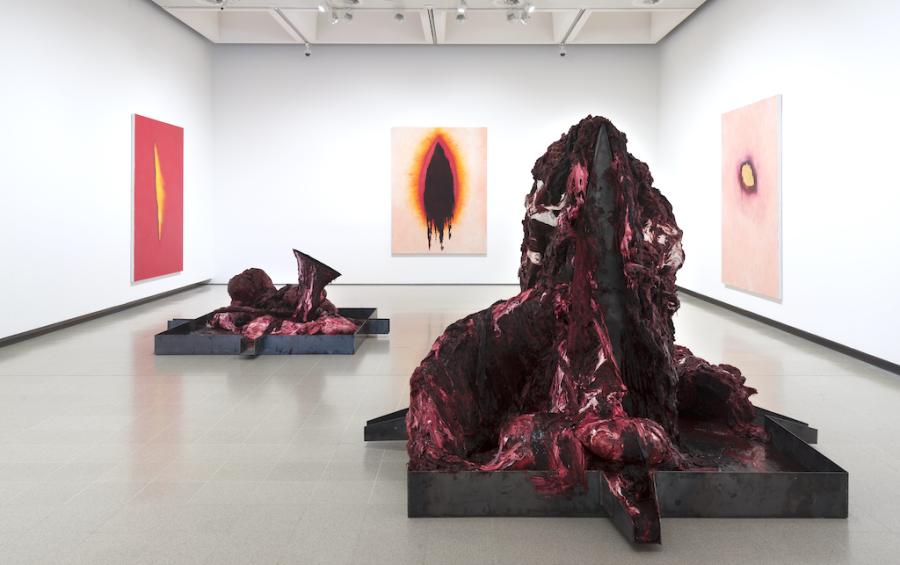
Hanging alongside the installation are three visceral reliefs. These Plastic Sacrifices 2026 are like great chunks of flesh; but whereas the mountain is fully exposed to view, they come wrapped in PVC as though ready for display in the supermarket. Neat packaging helps customers forget the butchery involved in the production of meat, while also extending its shelf life. And Kapoor similarly sterilises the encounter while also exploiting our morbid fascination with slaughter.
Exploring regions of experience that verge on the taboo is bound to produce the occasional failure, and not every piece is equally successful. A series of sculptures titled Ritual Expiation, 2025 (pictured above in installation shot by David Morgan) address the ubiquity of ritual sacrifice in ancient cultures – or our bloodlust. Resembling giant heaps of intestines recently dragged from the body of some poor creature, they are far too literal to invite reflection. Instead, they simply make you want to turn away in disgust.
Ha Makom 2026 (pictured below: photo David Morgan) spreads across the floor of the upstairs gallery like a bright red coral reef. It would come as no surprise if a shoal of gaily coloured fish were to dart around this maze of fantastical rocks and disappear into the mysterious doorway at its heart. The Hebrew title translates as The Place – suggesting the presence of the divine. But the sculpture seems more playful than spiritual, while the doorway is more like the entrance to an Aladdin’s cave than the threshold of a shrine or sanctuary.

The large sculptures are the undoubted stars of the show, but there are many other memorable encounters to enjoy. There’s a magical painting titled Ritual Expiation 2025. The image is very simple, yet profoundly mysterious. A blaze of yellow emanates from a single line that looks like a slit in a field of intense red. It resembles one of Lucio Fontana’s slashed canvases in which, miraculously, the gash is emanating golden light.
I’ve never warmed to Kapoor’s concave mirrors, which employ the same optical tricks as a funfair hall of mirrors, but Burple to Red 2024 draws your eye into its bowl where a mesmerising haze of reflections in dark plum and purple seduce you into a languid sense of calm.
Kapoor’s long-standing interest in the void also continues to bear fruit. In 1992, he chiselled a rectangular recess from a large block of sandstone and painted the interior black. Resembling a shrine or a tomb, this handsome sculpture now stands sentinel alongside more recent explorations of darkness (pictured below: installation shot by David Morgan). Niches shaped like an ellipse, a square and a vagina have been cut from the gallery walls and lined with Vantablack, a synthetic coating that absorbs more than 99% of available light. Kapoor describes the almost total darkness it creates as “a space full of what doesn’t exist”.
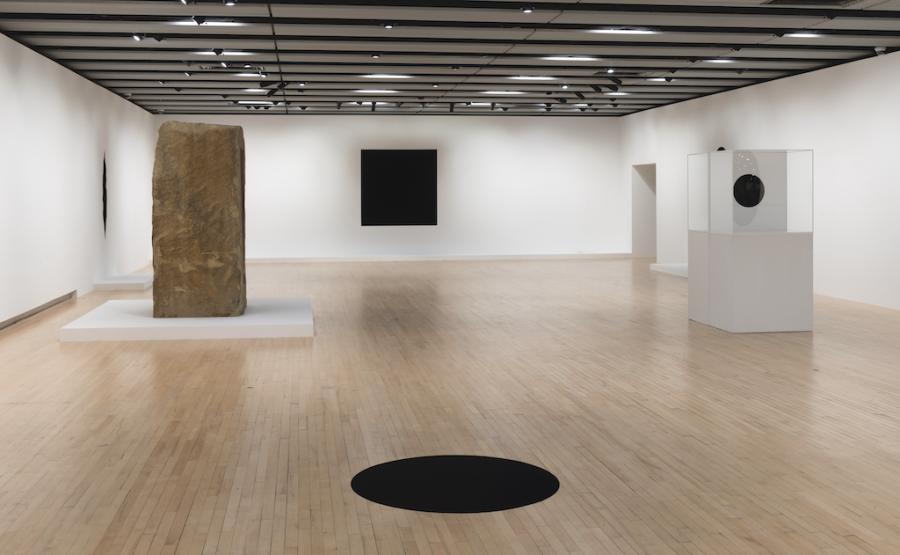
Descent into Limbo (pictured above) is a similarly enigmatic black hole. I first saw it in 1992 at Documenta, Kassel. Cut from the floor of a concrete cube the size of a building was a cylinder lined with Vantablack. Rarely has a work of art induced genuine fear, but peering into the inky depths of that seemingly bottomless pit felt like confronting death itself. But in the Hayward Gallery the magic is destroyed. The circle looks more like a tasteful rug resting on the wooden floor than an opening that descends all the way to Hades.
But the delights of the show far outweigh the blips. Most of the time the sculptures dominate the space – joyouslyl – so much so that I came away feeling energised, uplifted and empowered. Wow!

Add comment