

The advantage of basing drama on real events, particularly emotive ones like the 2005 London bombings, is that they have inbuilt resonance; the disadvantage, all too apparent in 2013 play Warde Street, is that it can be challenging to articulate a revelatory view. Familiarity with the arguments and sentiments expressed in this 80-minute piece vastly lessens its impact, and a burst of late tension (chiefly earned via the shortcut of a firearm) is further diminished by dubious use of reverse chronology. It’s a short play with grand ambition, sadly unfulfilled.
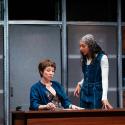
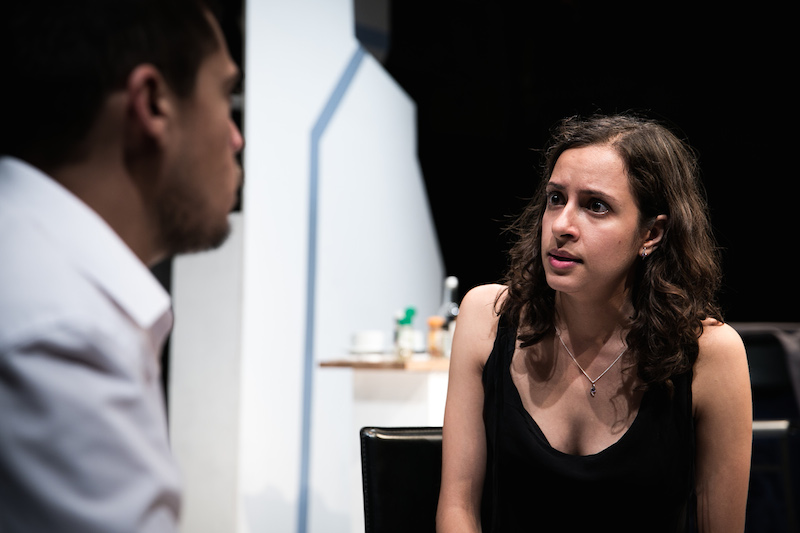 Writer Damien Tracey focuses not on the attack itself, but a sensationalist version of its aftermath – this is less Alecky Blythe, more EastEnders. Politician David (Tracey), caught in a media firestorm after leaving his wife for colleague Samiya (Avita Jay, pictured right with Omar Ibrahim), faces another scandal when her brother-in-law, Ash (Ibrahim), is accused of killing the man who shot his wife Yasmeenah (Maya Saroya) in their Manchester shop. That man, Eddie (Shane Noone), is the widower of a 7/7 victim, making this a highly sensitive scenario for image-conscious David.
The notion of spinning your way out of a story involving suicide bombers and racially charged revenge killing – which might flummox even the redoubtable Malcolm Tucker – promises cynical reflections on the selective morality of press and politicians, but a repetitive, tonally inconsistent first half frustrates: it’s too brief to properly address the issues raised, too long to function as tantalising trailer. It doesn’t help that Tracey and Jay never convince as lovers who’ve made enormous sacrifices to be together, and their laboured bickering irks.
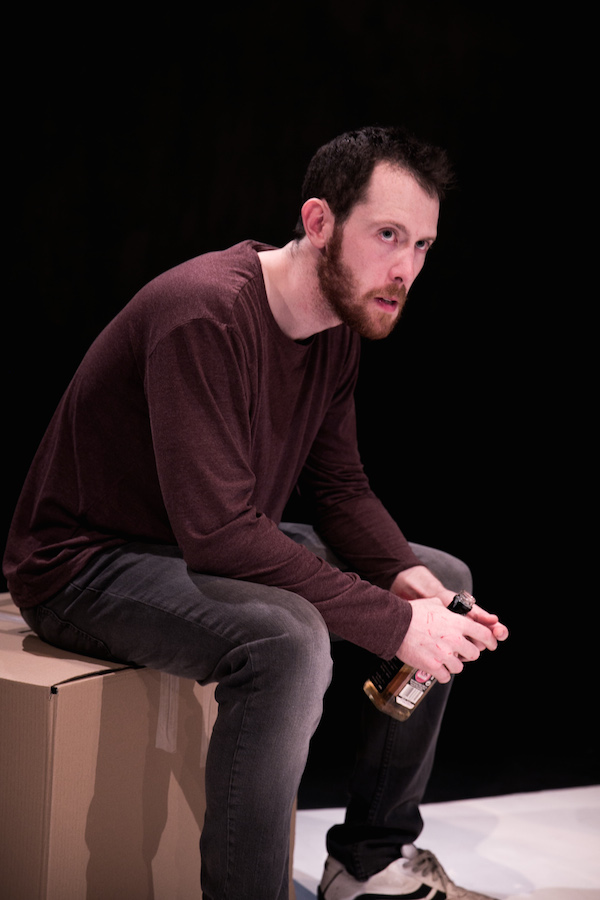 The second half is a marginal improvement, offering the cheap but undeniable thrill of a fraught hostage situation, though director Jenny Eastop struggles with the irrefutable fact that Tracey’s characters do not operate within the bounds of logic; why, when faced with an unstable armed man threatening your life and the lives of your family, would you belligerently enrage him with inflammatory rhetoric? However, a strong trio sells the passion of the situation, if not the sense: Ibrahim and Saroya juggle fear, defensiveness and empathy, while Noone (pictured left) is riveting as the jittery gunman whose bewildered grief leaves him physically and psychologically shattered.
The conflicts are less compelling, dipping into stale generalisations about hate preachers, marginalisation of ethnic minorities and assumed correlation between Muslim faith and terrorist sympathies. The sole surprising disclosure is that Ash was once a self-destructive party animal, whose renewed committment to Islam may have saved his life but has also – in Eddie’s mind – suppressed a key part of his identity. Should we be suspicious of the transformative power of organised religion, even if that transformation is seemingly positive, and how much should an outside force define us?
Warde Street is too mired in melodrama to give such questions considered attention, and, unlike the Vertical Hour revival playing at the same venue, fails to make a case for its relevance in current discourse. Instead, it’s reminiscent of Chris Thompson’s similarly troubled Albion, making more of an impact with choice of subject matter than dramatic treatment of it.






Add comment