

It's a bold move by Regent's Park Open Air Theatre to tackle Frances Hodgson Burnett's children's classic, a story that's been notably adapted into films that pile on the visual beauty of its magical settings. This enterprising venue may be surrounded by trees and foliage, but it offers essentially a big bare stage with few frills.
So it's no surprise that the story's main location, Misselthwaite Manor, is going to be represented by a tall blank wall, in which niches hold lights. There's no sign of ivied walls hiding the little door of a secret garden. It soon becomes clear that feats of imagination are going to be required, and the text, in a version by Holly Robinson, is going to be especially crucial.
Robinson deploys some of the now familiar techniques popularised by the RSC's 1980 Nicholas Nickleby, where the narrative is in the hands of the whole cast, who multitask as individual characters but also group together to deliver unison exposition or chorus-like commentary. They are usually wiser than the individuals they play, often somewhat sardonic, regularly pointing out where somebody almost spilled a secret or a private thought, and approvingly noting when wayward people start behaving better, like a collective of nannies.
Into this group comes 10-year-old Mary Lennox (Hannah Khalique-Brown), orphaned when cholera struck her household in India, and her party-loving parents, even her ayah, died. She is shipped off to live with her uncle, Archibald Craven, deep in the Yorkshire "muirs", as they are pronounced here, a widower with an invalid son who shut up the secret garden to die when its owner did. Khalique-Brown does a fine turn as "difficult" Mary, clever and coltish, but also slightly shrewish and unused to handling people who don't consider themselves her devoted slaves.
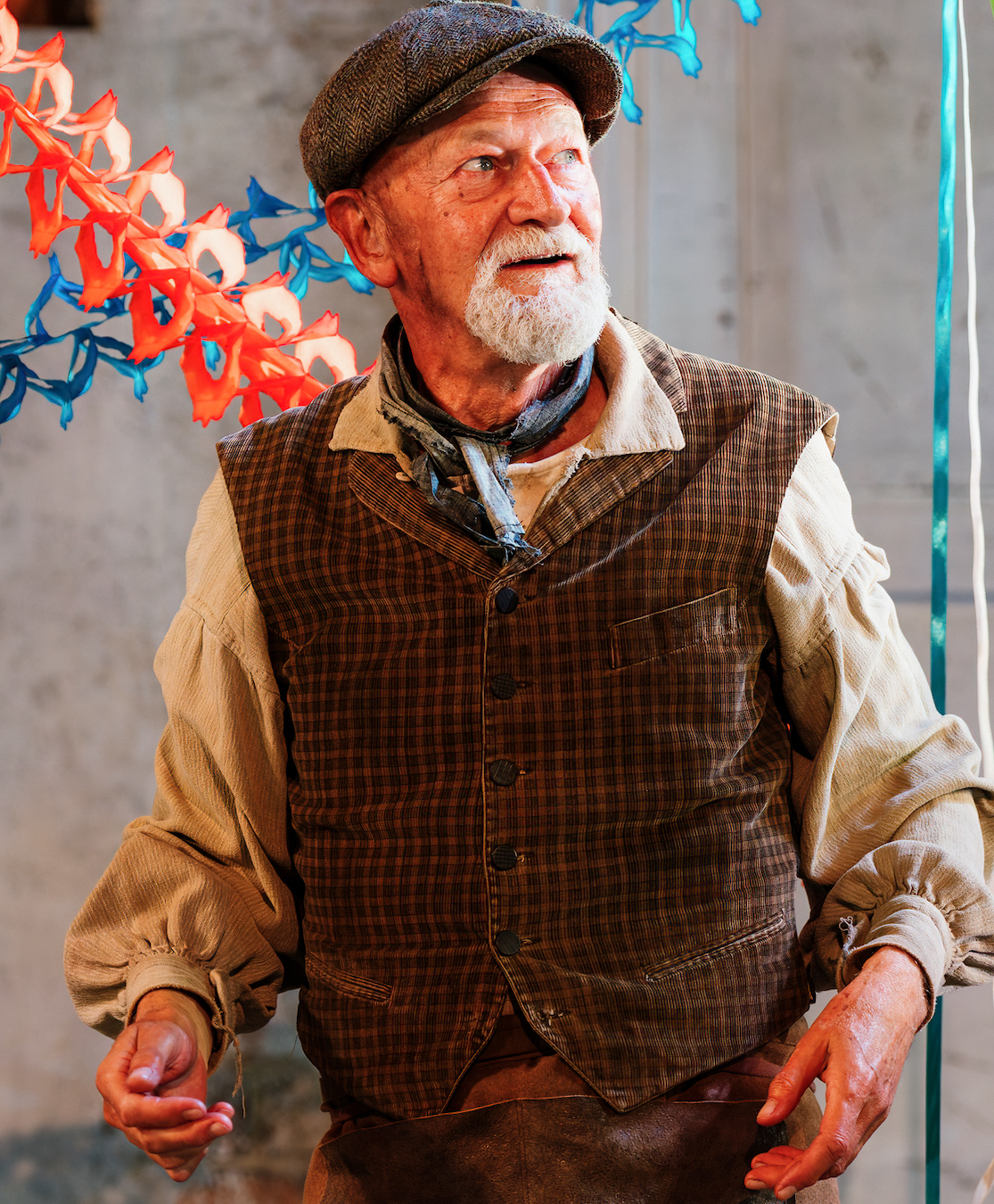
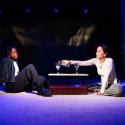
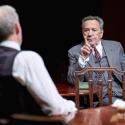
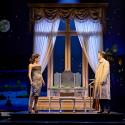
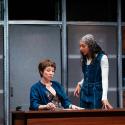
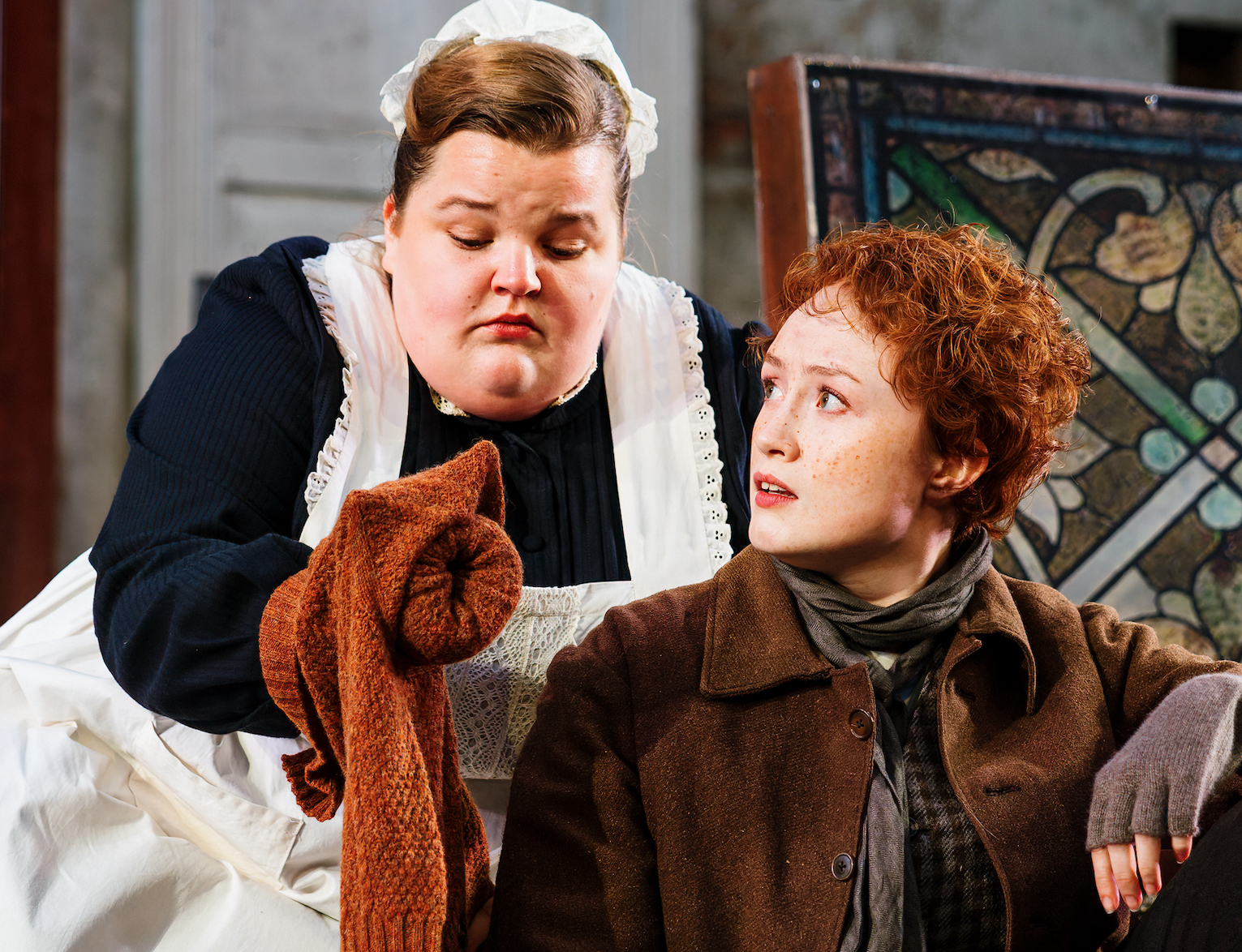 Chief among these is Martha, the maid – an impressive big-house debut by Molly Hewitt-Richards (pictured left with Brydie Service), who has a firm comic touch and a natural ease onstage. The house roars when she hitches up her voluminous skirts and shows Mary how to use a skipping rope; she and Khalique-Brown also create moments of genuine comedy when Martha tutors Mary in how to speak "Yarkshire". Another role that shines is Richard Clews's Ben (pictured below), the gruff old gardener, whose crustiness conceals a man on a mission to restore the natural beauty of the secret garden.
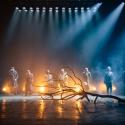
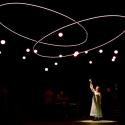
But how is the designer to do that on this barren platform? Leslie Travers's answer is to dispense with any kind of realism. "Plants" are green ribbons pulled out of the ground and hung up on tall hooks; paper decorations stand in for vegetation. Key scenery and props arrive on dollies (invalid Colin under a mosquito net too); and to suggest the Victoriana of the mansion, a large wooden drawer serves as Mary's bed, its lid a stained glass window.
Benefitting from this minimalist approach is the depiction of the animals tamed by Martha's brother Dickon (Brydie Service). A scrunched up brown jumper becomes a little fox; a black fringed shawl, a crow, whose handler caws as she moves around; a squeaking squirrel is created out of an elegant lady's fur tippet. (Puppetry is by Laura Cubitt.) Crucially, the production draws on its Indian elements for the key character of the Robin, whose language Dickon can understand, Mary too eventually. Sharan Phull plays her as a lively young woman (the reincarnation of Colin's mother Lata, several characters suggest), who flits around singing to a sitar-like accompaniment, her hand coming to rest and held up, pulsing, to show the red oval on its palm.
 As the action proceeds, though, the piece's jolly preachiness begins to cloy. Mary, who has swapped her navy dress and hoyden boots for a pink frock, black heeled shoes and white stockings, learns to cry and be nice (I much preferred her crabby). And a crucial source of sympathy, embittered, fearful Colin, is MIA. Theo Angel may, as he is supposed to, look like his cousin Mary, but he plays Colin like a junior Caligula, the vulnerable boy behind his spoilt tantrums rarely discernible. Angel has a robust voice, which will serve him well in other roles, but not so much here. When he is reunited with his mostly absent father, both of them now much nicer people – "socialised", the text calls it – it's hardly a tearjerker.
The emotional locus of the play emerges as the orange that has mysteriously grown in the secret garden. Mary, now a dedicated democrat, suggests sharing it so all can have a part, rather than giving it to one person (Colin's proposal). She has freed her imagination and connected with nature, performing wildly inaccurate incantations as she once saw shamans in India do. Natural goodness has surfaced, just as nature has returned to the secret garden, its powers all the magic that's needed ...
It's at this stage, where all is sweetness and light, that the grown ups in the audience have to concede that this is a play pitched at younger audiences. As dusk encroaches and night falls, the stage lighting kicks in and the atmosphere finally become more mysterious. But even if director Anna Himali Howard can't quite muster the magic the story requires, its edifying messages about communality and green values should appeal to other 10-year-olds, if not to their more world-weary walkers.
- The Secret Garden at Regent's Park Open Air Theatre unti July 20
- More theatre reviews on theartsdesk


Add comment