Within its own aspirations, Orpheus is a complete triumph. “Monteverdi reimagined”, as Opera North subtitled it from the start, is an attempt to unite (and contrast, and compare, and cross-fertilise) early baroque opera with South Asian classical music.
That’s a big ambition, as the two might seem to have little in common. But Anna Himali Howard’s simple production concept of a marriage celebration, where Orpheus is a white British guy and Eurydice an Asian girl, set in the back garden of a semi-detached house – probably in Leeds – is a symbol of the whole enterprise.
The design (Leslie Travers) is enchanting from the start: full of colour and gloriously detailed. There must be few opera productions to have had a credit for the “Head Gardener” in their programme book.
We see the respective friends and family gathered, dressed in their best for such an occasion, and the musicians (who, in South Asian traditions, perform seated) are all on stage, as part of the gathering. The guiding principle is set from the start, as Monteverdi and Striggio’s prologue, “La Musica” is cheerfully shared between the bride and bridegroom’s mothers (Deepa Nair Rasiya and Amy Freston – the latter the only cast member to be repeating a role from when Opera North last essayed L'Orfeo, 15 years ago). 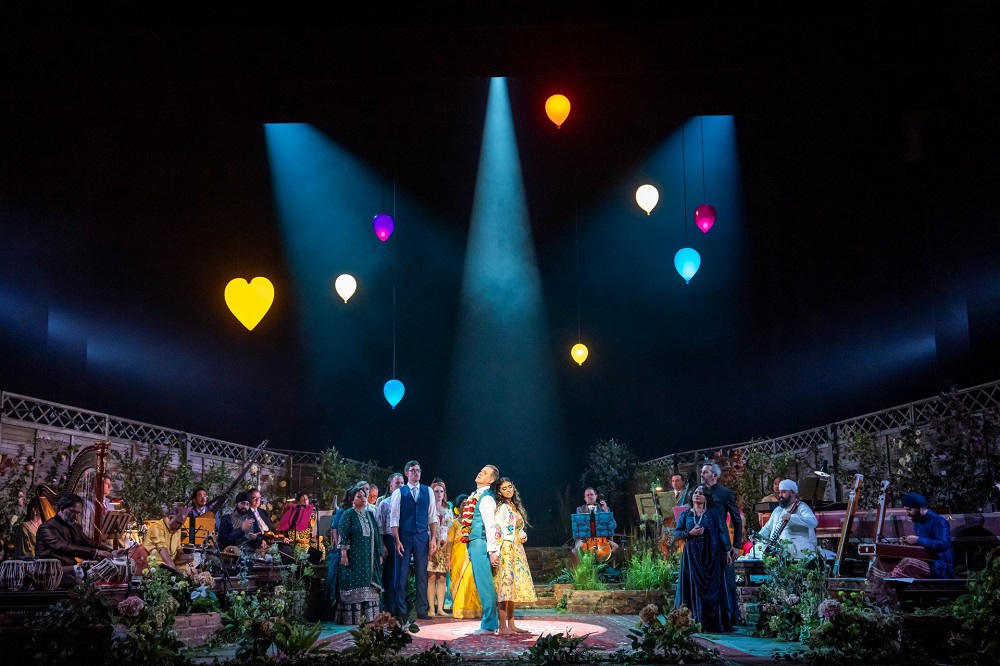 The whole of Acts One and Two show festivities in the garden, and mid-way Orpheus and Eurydice go to the temple to offer prayers. She, following the original story, dies before she can return, and the journey to the underworld and back is shown as a kind of dream sequence in which visual realism gives way to fantasy, and the singers formerly part of the happy gathering become the gods and figures of the myth.
How does the musical marriage work? In the same way as the wedding guests enjoy each other’s company and share their social behaviours – with much respect and admiration, some cautious imitation of respective traditions, and optimistic moments of togetherness.
At the outset, there’s Monteverdi’s music played straight, but with its phrases heard in alternation with re-interpretations of the same material in South Asian musical style. The two do have some common ground in the primacy of melody against simple accompaniment, and complex decoration of melodic line and rhythmic subtlety. Jasdeep Singh Degun, who shares the music directorship with Laurence Cummings (and both are on-stage as performer-singers, too) has written a considerable amount of new music to share some of the text and carry other parts on its own, and there are musical arrangements by Ashok Gupta.
Translations of much of the original text into several languages are used, and everything is visible in English surtitles at the sides of the stage, so a multi-lingual aspect of the production matches its multi-culturalism. The shared-language choreography is by Urja Desai Thakore. 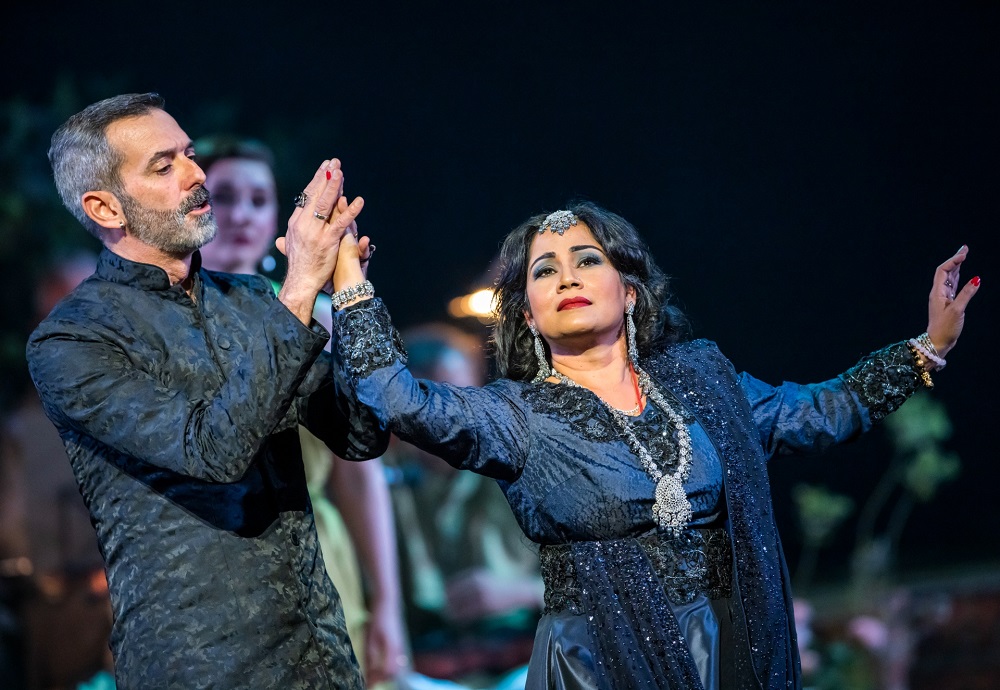 Respectful alternation of different languages is the main principle at work throughout in regard to the musical content, but as the work proceeds the musicians begin to borrow from each other’s methods, with the imitation and improvisatory style of the Asian tradition added to some of the Monteverdi music, and the Western instruments underpinning the sounds of the Eastern world. The overall effect is of relaxation and harmony: there are no buzzing regals, whining cornetts or imperious sackbuts in the instrumental combination, and the Eastern music is in its nature leisurely and repetitive. But drama has its place, too, and the piece is frequently moved along with attack and vehemence. Overall the performance runs for two hours 50 minutes (including interval), which is rather more than straight Monteverdi would be.
There’s a large cast of performer-singers: South Asian Arts-uk, a Leeds-based centre of excellence in Indian classical music, has worked with Opera North to provide the most highly accomplished soloists from the UK, and the operatic singers include Nicholas Watts as Orpheus and Dean Robinson as Pluto. Ashnaa Sasikaran (pictured), both singer and dancer, is the beautiful Eurydice, while Chiranjeeb Chakraborty and Vijay Rajput almost stole the show in their duetting role in the wedding celebration, with the ever-increasing complexity of their lines brought to a magnificent highpoint. Chandra Chakraborty, as Proserpina to Dean Robinson’s Pluto (pictured above), was also outstanding.
As an experiment in combining and intertwining two different kinds of music, this is an ingenious and well accomplished success. The Asian singers may not have begun with a practice of operatic acting and vocal projection in their experience, but in many respects they were at home with the stylised pattern of gestures of baroque theatre, which fitted well with Monteverdi’s world.
There remains the question of whether the experiment might be repeated: could there be a new genre of cross-cultural opera performance in the making here? I’m inclined to think the answer is no, but as a one-off this was a fascinating night.
- Further performances at Leeds Grand Theatre, and touring to Newcastle, Nottingham and Salford
- More opera reviews on theartsdesk