

Time is a terrifying force in Romeo & Juliet, and Robert Icke's headlong production never lets playgoers forget that fact. Returning to a tragedy he first directed for Headlong touring company 14 years ago, Icke reprises many of the conceits deployed first time round, this time wedded to a starry company headed by Sadie Sink and Noah Jupe that, in the first act at least, gives pride of place to his supporting players.
Some may resist the apparent tricksiness of devices that include repetitions or reprises of scenes, as often as not accompanied by searing flashes of light separating out what might have happened (if, say, Friar Laurence's letter had not gone AWOL) as opposed to what in fact does. But as was true of the clock ominously on view in his devastating Oedipus, which just finished its Broadway transfer, Icke makes clear that time waits for no one. Small wonder that Juliet famously exhorts nightfall to "gallop apace" so that she can be with Romeo once again: this is a play whose title characters are undone by a velocity of feeling they can't control, no matter how many others - Juliet's parents, the Nurse, Friar Laurence - try to impose their will on time's wanton ways.
I admit to approaching the production feeling somewhat wrung out by this very title, which has had five major London productions within the last four years, including Jamie Lloyd's comparably starry one, with Tom Holland, two years ago. Young actors are clearly eager to cut their teeth on this particular text, the long arm of Baz Luhrmann's 1996 film continuing to sweep up today's aspirational stars in its far-reaching shadow. And so we have Sadie Sink, a Tony nominee last year for the very play (John Proctor is the Villain) that has itself just arrived in London, as an antic, flustered, fast-talking Juliet. Small wonder that we first see her in bed, centre-stage, adrift in a fevered field of dreams: she will soon leap excitably into the air in erotic anticipation, but a hallucinatory ending brings home to bruising effect a reminder of what this young girl is tragically denied. By that point, the bed might as well be an embryonic tomb, the sense of loss in no way allayed by Juliet in this version being nearly 16, as opposed to the 13-year-old indicated in the text. (The gifted Sink for her part soon turns 24.)
Indeed, Icke's production foregrounds the extent to which Juliet seems, however unwittingly, to anticipate the doom to come. "I should kill thee with much cherishing," she quasi-prophetically remarks, having previously remarked that, were Romeo to be married, "my grave is like to be my wedding bed" - which turns out to be true regardless. Her thoughts "ten times faster glide" in sympathy with Romeo's utter takeover of her emotions, and Sink's gestural performance - similar in that regard to Jude Law's onetime West End and Broadway Hamlet - accompanies Juliet's ramped-up state of being with one's sense of a body losing control: Jupe's sweet-faced Romeo - the likeable Hamnet actor first seen poking out the base of Juliet's bed - is a cornerstone of calm by comparison.
Hildegard Bechtler's fleet design allows actual sliding panels to bring home Icke's points of reference, and morphs after the interval into what one might call mausoleum chic. Jon Clark's shadowy lighting conjoins with Giles Thomas's sound design to convey a sense of ghostly imminence - while the soundscape shifts from Vivaldi's Gloria to the Boomtown Rats in accordance with a contemporaneity to the storytelling that typifies Icke's approach to the classics.
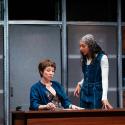
It won't surprise devotees of this play to find that Eden Epstein's compelling Lady Capulet would seem to have some degree of the hots for her nephew Tybalt (Aruna Jalloh). The death of Juliet's cousin at Romeo's hand finds a bloodstained Jupe taking to bed in the clothes of carnage: violence encroaching ever closer on the central characters' rapture.
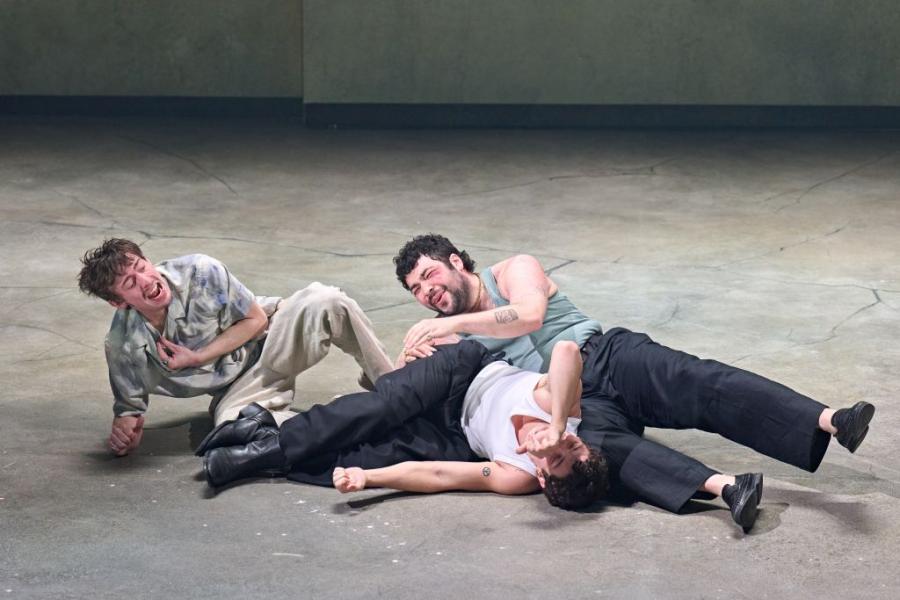
You listen anew to the Nurse's swagger when she remarks that she will "take down (how modern is that?) anyone who speaks against her, and Clare Perkins's sassy way with that gift of a role has the desired scene-stealing effect. For myself, I was especially taken with the three-way bromance - or is it? - between Romeo, his cousin Benvolio (in Dylan Corbett-Bader's expert performance, this play's Horatio), and the luxuriantly spoken, if madcap, Mercutio. The fast-rising Kasper Hilton-Hille brings to that part a bottom-baring insolence that takes the character's devil-may-care insouciance to extremes. One minute, he's a mewling cat dumping ice cream on Tybalt's head, only soon after to learn that play-acting comes at a grievous price: I can't remember the last time Mercutio's departure from the play moved me as greatly as it does here. (Hilton-Hille, Corbett-Bader and Jupe pictured above)
The departures that we know will follow register in due course, too, and probably would even if we weren't privy to images of Juliet as a mum or in old age. You're reminded afresh in Icke's empathic vision of the play that its collective emphasis on banishment might as well be a more polite way of referencing death. And as the digital clock on view winds down, so we bid goodbye to the shards of light interlaced throughout, these visual grenades replaced by the primordial blackness that is Juliet and Romeo's - as the play's ending orders them - actual groom and bride.








Add comment