

Are Oscar Wilde's plays comedies of manners or just mannered comedies? Can they be kept afloat for today's audiences if they stick more or less to the period setting (this one does; the Lyric Hammersmith version reviewed, also today, by Helen Hawkins, doesn't)? An Ideal Husband offers Wilde's richest dramatic pickings, its timeless tale of political and personal corruption laced with an artifice that gives way to reveal the jungle beasts beneath the sharp, barbed facades.
In its racy, trippy entr'actes, Irish-Catalonian director Marc Atkinson Borrull's Gate Theatre production seems to take its cue from the National Theatre's The importance of Being Earnest - which was unforgettable in its first incarnation with Sharon D Clarke gloriously Jamaicanising Lady Bracknell (keep reading, and you'll find she has equals here). While this looks undeniably lower-budget in Kat Heath's set designs and James McGlynn Seaver's costumes, both of which get better in the second and third acts, the energy of the acting keeps a long evening mostly buoyant.
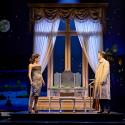
The accents here are pure Victorian London society, no mean feat for a mostly Irish cast. There are no weak links, though the way Wilde has slanted it means that the standouts are not the nominal leads, politician with a guilty secret in his past Robert Chiltern as played by Richard Flood and his loving wife, a naive charmer who develops a backbone as revelations accrue in Ayoola Smart's charming performance (Flood and Smart pictured below).
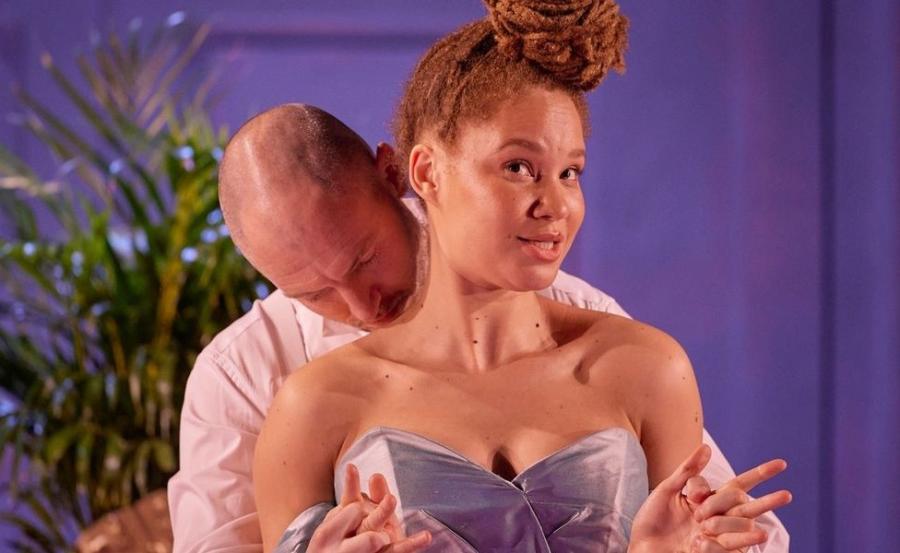
The scene stealer of the play should always be Robert's loyal friend, Viscount Goring, a masquerader with more than a whiff of Wilde himself, but here he's not the only one. There can't be a performance these days which doesn't accentuate the eligible bachelor's camp and his fluid sexuality, but Matthew Malone excels in being all things to all men and women: the encyclopedia of facial tics and grimaces puts him in the major league of actors already, while the delivery of the lines is unceasingly energetic. Malone and Caitríona Ennis were standouts in smaller roles among the uneven cast of the Abbey Theatre's The Plough and the Stars; here they play dazzling variations on Beatrice and Benedick.
Mrs Cheveley, Ennis's wonderfully wrought character, starts out seeming to be a stagey vamp, but it turns out that seduction is not what she's come for. This is a strong woman who in different circumstances would excel as a gamer, constricted in this society to run rackety rings around characters who frankly deserve it.
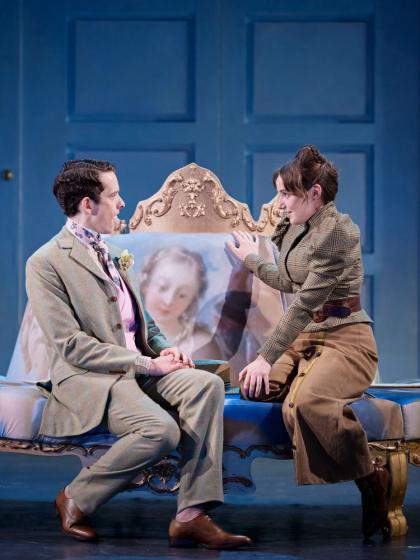
Malone and Ennis take the third act confrontation to dazzling heights. But there's a third adept player who makes a plausible shot at wooing and winning this Viscount: Claire O'Leary's Mabel Chiltern matches them for quirky vitality (pictured left with Malone). The fourth standout is veteran Nick Dunning as Goring's crusty, conservative father, the Earl of Caversham. Your concentration will never flag when any of these performers are on stage. It probably isn't Ingrid Craigie's fault that Lady Markby outstays her welcome in Act Two when we're longing for the tigers to let rip; Craigie slightly underplays the epigrammatic-old-lady role, so I, at least, breathed a sigh of relief when she made her exit (to applause, it must be admitted).
Kicking off the air of society intrigue and malice, Wren Dennehy as a vocally very wide-ranging Lady Basildon and Sadhbha Odufuwa-Bolger's Mrs Marchmont raise hopes that are never disappointed. And Atkinson Borrull clearly doesn't share Wilde's apparent caving in to what a good wife should be, suggesting all will not be well with Lady Chiltern's concession to her husband's career. What a superb cast; what an impressive, timeless play.



Add comment