In the 70s, a science-inclined schoolboy like me was directed to young adult oriented biographies of Thomas Edison, of which there were many. They left out the more problematic aspects of his life, the dubious business practices and some of his more Victorian approaches to demonstrating the power of electricity (don’t Google it). Instead, they favoured the legend of a lone genius beating the odds to, quite literally, enlighten the world.
The iconography of his story runs deep in the human soul. But there’s always an Icarus to warn us of the dangers of hubris, lurking on our left shoulder and not short of cheerleaders. The lesson is that if you want to play this game and find your own place in the mythos, you must first make a myth of yourself, steeling your self-belief against the naysayers.
And that’s really the emotional hook that draws you into the blog-then-book-then-film and now musical, The Boy Who Harnessed The Wind. It’s not that our hero, 13-year-old William Kamkwamba, pushes back the boundaries of science, nor that he is a bona fide engineering pioneer, it’s the odds that he overcame to realise his vision, to do good in a world desperately in need of it and in his willingness to act as a role model for young people everywhere. In other words, it’s the very stuff of Musical Theatre.
Black Africans invented irrigation thousands of years ago in the Nile Delta, and we owe the small matter of human civilisation to them. Fast-forward to the end of the 20th century, and the environmental degradation caused by multinationals clearing forests for cash crops has been exacerbated by incipient climate change. Roll in corruption in the political leadership of Malawi and the meagre resources available to invest in technology, and William’s village is teetering on the point of starvation. It’s hard not to feel increasing sympathy for some form of post-colonial reparations when you see this, but that’s a passing aside - for now.
The bright boy has long been fascinated by radios and batteries salvaged from the rubbish tip, but he's struggling to keep up with school because his family cannot pay the fees. Nevertheless, he understands a key truth that can save his village. He knows that the wind can drive a shaft that can spin a turbine that can generate electricity that can power a water pump that can irrigate the land. And so, his people might eat. But his father wants him to work alongside him hacking at the hard dry ground, his schoolmates ridicule the efforts of the wannabe boffin, and where can he get the parts he needs for his turbine?
Right from the start, with the cast swapping jokes with the audience, director, Lynette Linton, invites us into the village, Oliver Fenwick providing a flat, harsh African sun. That opener also gives more licence than is usually the case for the audience to respond directly to events on stage, which certainly spices up a somewhat predictable love story subplot between William’s sister (Tsemaye Bob-Egbe) and his teacher (Owen Chaponda).
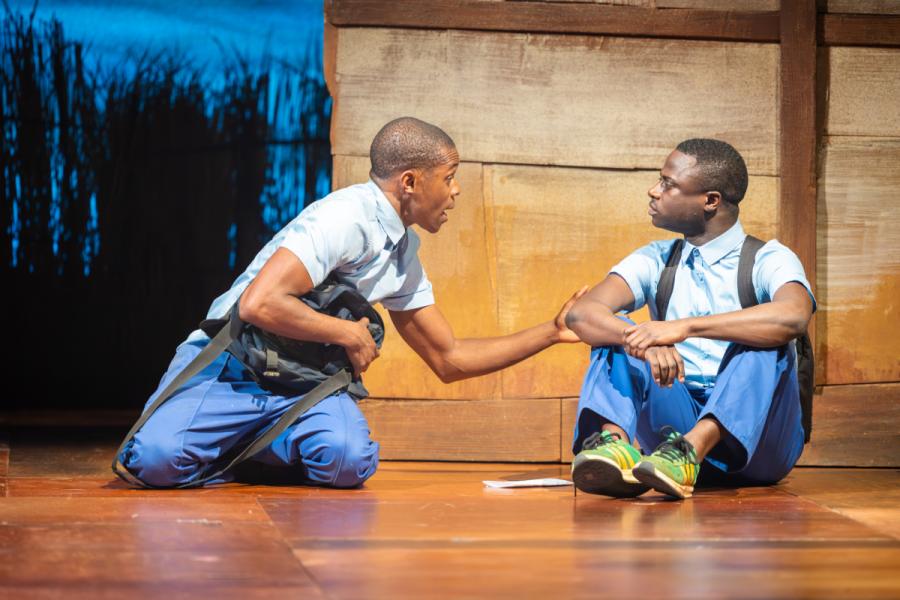
Alastair Nwachukwu (pictured above with Idriss Kargbo) is a winning William, the quiet type who can stand up for himself but prefers to stick to his studies and pursue his dreams, even against all odds. He does have a lot of knockabout laughs with his best buddy, Gilbert (a lovable and very funny Idriss Kargbo), so there’s never a chance that he will be reduced to a stereotype nerd by Richey Hughes’s sensitive book.
Much of the emotional weight of navigating the dilemma between the risks inherent on relying on the old traditions, prioritising subsistence farming and the risks of gambling on a technological and a socially less hierarchical future, are given to Sifiso Mazibuko and Madeline Appiah as William’s parents. They also get the two best songs, the anthemic “This I know” and the jaunty paean to female emancipation, “The Girl In The Marketplace” and they sing them very well indeed.
Tim Sutton’s score blends more traditional African rhythms with 21st century tunes, but that's not so much of a flex, as the influence of the music of the region is so embedded in Western sensibilities these days. More clearly indebted to Malawi is Shelley Maxwell’s spectacular choreography, often filling the thrust stage with energy, providing a different kind of electricity from the version that William seeks.
The flaw in the show is that, for all the feelgood vibes, there is no jeopardy in the tale. William’s story is truly remarkable, but it’s well known and, even in the unlikely event that someone buying a ticket is unaware of the ending, there’s no show if his project fails - so it doesn't. Running nearly three hours, choosing to give the game away in the title is no recipe for sustained suspense.
Not that many cared on press night and, frankly, neither did I, on my feet and applauding as loudly as I could when the real William appeared at the curtain call, unequivocally a hero in a time desperately short of them. But my applause was also for a show that presents a very different view of Africa and, I’d contend, a necessary one to those long runners (and fine musicals) elsewhere on Broadway and in the West End, The Lion King, The Book of Mormon and the more recent Just For One Day.
This is an Africa largely shorn of its exotic otherness, of its perceived need for white saviours, of its chaotic feuding warlords. William’s intelligence and spirit allied to his fierce determination demonstrates true independence, not that found in pageantry and wars, but in families and home. It is indeed, Tomorrow.