After Barber Shop Chronicles comes a female slice of pan-African life, set in Harlem in July 2019, at the fag end of Donald J Trump’s first presidency. Playwright Jocelyn Bioh never mentions him by name, but his shadow looms over the lives of the braiders, all aiming to become US citizens.
At least, his shadow looms over them now. Bioh’s tweaking of the text for the London run has added topical plot points from the second Trump presidency to give this bouncy Tony-nominated comedy a real sting in its tail.
For most of its 90 minutes, though, it’s a fast-talking joy. We spend a 12-hour working day with the women in the shop (an evocative set by Paul Wills on a simple revolve). The women’s families are originally from various countries in west Africa and have that distinctive singsong delivery with emphatic consonants that lends itself so well to sharp repartee, peppered with distinctive “eh-eh"s and hand gestures. They are by turns quarrelsome, joshing, nostalgic, angry with their partners, crabby with each other. And very funny. It's territory where a bum is a boom boom, and all is done fast-fast and nice-nice.
The most “American” among them is the youngest, Marie (Sewa Zamba), in charge of the shop that day. Marie is the 18-year-old daughter of Jaja and a US resident since she was four. She longs to be a writer, but her mother is desperate for her to achieve professional status and has sent her to private schools. Jaja herself, a largely unseen presence who is off preparing for her wedding that day to a white building supervisor, is equally intent on securing her own future with the legal papers that marrying Steven will bring. Into this steamy microcosm where the aircon is faltering comes a stream of braiders, customers and street sellers, 10 of them played by three actors (Demmy Ladipo, Renee Bailey and Dani Moseley).
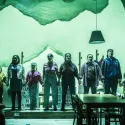
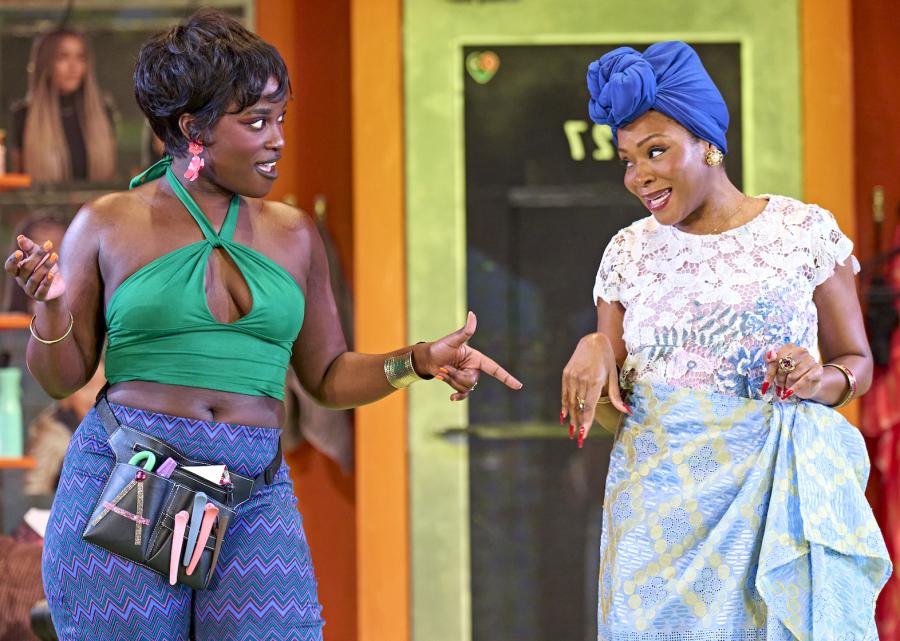
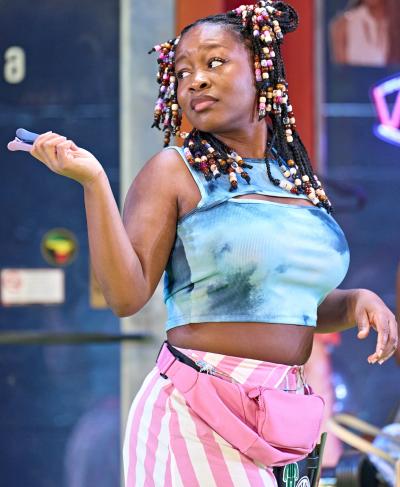
On Jaja’s staff are her oldest collaborator, Bea (Dolapo Oni, pictured above, right, with babirye bukilwa, left), a four-times-married gossipy Ghanaian, who resents not having her own business; and her newest, Ndidi (Bola Akeju, pictured below right), a savvy Nigerian with beaded braids who’s been given a temporary chair.
Bea also spars with Aminata (babiyre bukilwa), a voluptuous Senegalese woman with a feckless husband who seems to channel her discontent into dancing and twerking. Like Chaucer's Prioress, she has a large jewelled A hanging at her waist, though in her life Amor has not conquered all. More optimistic and working hard to bring her five-year-old daughter over from Sierra Leone is Miriam (Jadesola Odunjo), a guileless young woman in love with a rising-star singer.
Those of us with no experience of hair-braiding won’t be surprised to know that there are countless different styles, some traceable back to a time when braids were a royals-only accessory. You don’t need to know what “micros” are to register that the older workers here all find other things to do when a customer arrives who announces she wants them. It’s left to sweet Miriam to spend all 12 hours of her working day on Jennifer’s micros while her client taps away on a smart laptop.
Jennifer is an editorial assistant on some kind of publication who’s keen to get out in the field — “Which field?” asks Miriam, innocently. Even grander is Radia, an intern on Vanity Fair thanks to her father’s connections, who’s just off to Milan as part of her training, then enrolling at Dartmouth. Marie is known to Radia as “Kelly”, her cousin’s name, whose papers Jaja has made Marie use. The name is a marker of the distance between her assumed US identity and her heritage. Fully working the stereotypes of her background, though, is Sheila, a super-loud customer who assumes a bossy-sassy “Black" identity over the phone with her colleague, whom she addresses as “GIRL”, while subdued and polite when talking to the braiders.
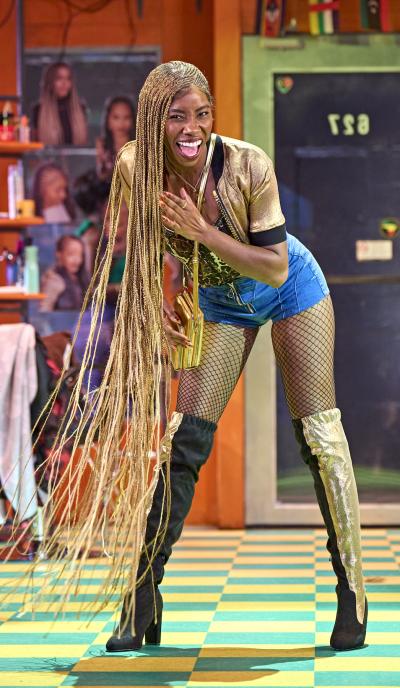
For lighter relief there are the trio of customers played by Dani Moseley (pictured left as Chrissy): Michelle, the nervous regular who has dared to switch braiders (and is reading a book titled Anxiety); Chrissy, the bubblehead who wants to look like the blonde Beyoncé of Lemonade, with braIds literally down to her ankles; and Laniece, whose ‘do makes her look like a pink-tinted poodle. There’s also a standout turn from Bola Akeju’s Ndidi, who lipsynchs all the characters, men included, in a melodramatic scene from her favourite Black soap.
Bioh weaves these strands together with the nimble fingers of a braider, keeping the flow of customers coming, mixed in with bursts of Afrobeat and rap from the shop TV's YouTube videos and visits from the sock-sellers, the jewellery-hawker, the knock-off DVD man. We can sense the hierarchies in this world clearly: the heights the characters aspire to, the midway stage where life is a constant struggle to rise that far, and the lowest rungs of the social ladder most of the women have been on, cleaning houses for white people, looking after their children. For Bea, sent outside by Marie to calm down after a spat with Ndidi over a “stolen” customer, “street duty” – accosting potential customers outside – is a wounding loss of status.
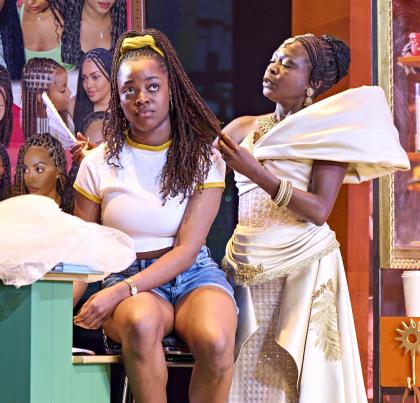
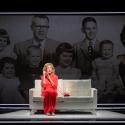
All the women are looking over their shoulders at the men in charge. For the worldly-wisest of the bunch, Bea, these men are invariably white – she gives Jaja’s marriage to one two months and has it on good authority he’s a cheater. So when Jaja (Zainab Jah, pictured right, with Sewa Zamba, left) finally appears to flaunt her dress, all sparkles and mad flounces, it’s impossible not to assume that her bubbly happiness is misplaced.
Under Monique Touko, who also directed the Lyric’s excellent School Girls; Or, The African Mean Girls Play, the cast hit just the right energy levels, vibrant without being anarchic, effortlessly funny but leaving space for the sadness in their lives. The dénouement unites them in a heartening way. Nice-nice.
- Jaja’s African Hair Braiding at the Lyric Hammersmith until 25 April
- More theatre reviews on theartsdesk