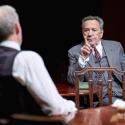
Beckett's Krapp's Last Tape had its world premiere in 1958, with Patrick Magee, at the Royal Court. That same venue happens to be the site of Gary Oldman's last stage appearance in Caryl Churchill's Serious Money in 1987 – which I saw back in the day.
So it's a genuine occasion to welcome both the play and its current performer back to this address as part of a heavy-hitting lineup of work across the year to celebrate the Court's 70th year. Devotees of this past and present powerhouse of a venue will surely recall Harold Pinter nearly 20 years ago delivering a now-canonical monologue in a motorised wheelchair. His performance had a searing intensity, inflected as it was by Pinter's awareness of his own diminishing life: he died two years later.
The current iteration doesn't possess the same scorched-earth, charred feel; Oldman cuts a lank-haired, baggier presence as the ruminative Krapp, whom we encounter munching bananas prior to obsessively playing back a recording of himself, age 39, from his perspective three decades on. (Pinter's mercilessly pared-back approach dispensed with the bananas indicated in the text.)
Speaking in a high-pitched, querulous register, Oldman brings a shambolic sense of discovery to the battle Krapp undergoes with the reel-to-reel tape recorder that contains his life: think of the machine, ungainly by contemporary standards, as the Smartphone of its day. Weaving his way amidst a cluttered environment – the actor, tripling as his own designer and director, pays visual homage of sorts to his TV triumph in Slow Horses – Krapp reflects on love and loss but without the slightest nostalgia.
"I wouldn't want them back," he says of the years that have now vanished, "not with the fire in me now" – "all that old misery" his on-the-nose summary of the romances he let slip away, as often as not replaced by the silence of the "uninhabited" earth amid which he is trying to make what room for himself he can.
Oldman tried out this part last year at the Theatre Royal in York and communicates a renewed delight in live performance, letting a word like "spool" waft across the auditorium in this performer's deliberately exaggerated speaking of it. If the net result didn't floor me emotionally, as I have been in the past by such Krapps as Pinter and also Michael Gambon, that may be due to a feeling of psychic evasion where this text matters most. As with all Beckett, Krapp's Last Tape describes in essence a peering into the void, and Oldman skirts the difficult confrontation with mortality that others have met head on. At the same time, those determined to star spot will find their attention rewarded, and then some. Let's hope it isn't 40 years before Oldman – one year younger than his current character – treads the boards again.
Often performed as a curtain-raiser, Beckett's prismatic masterpiece has here been programmed to follow a new play, Godot's To-Do List, from a 19-year-old writer, Leo Simpe-Asante, who won this playhouse's Young Playwright's Award for his 20-minute amuse-bouche. (Both shows together clock in at 75 minutes or so.)
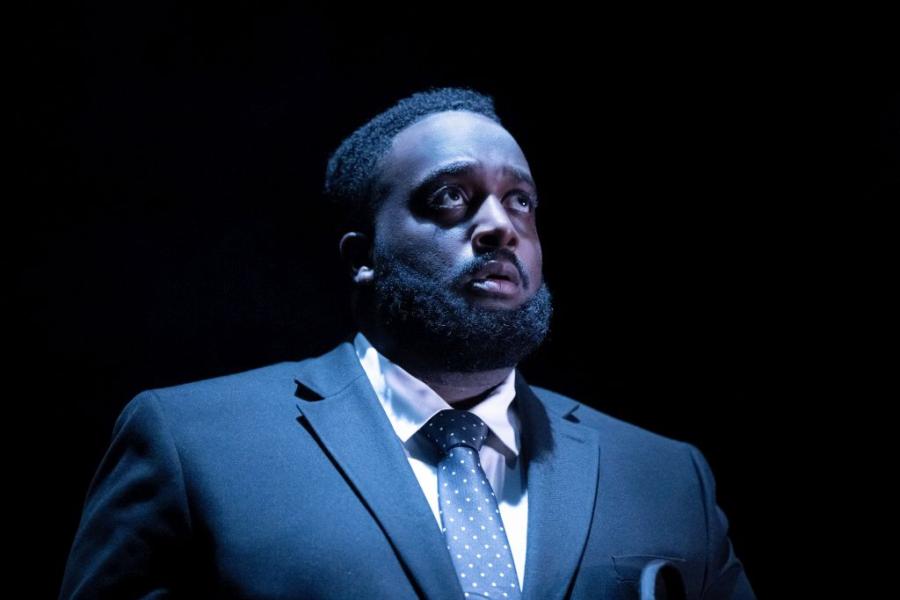
Giving off the vibe of a collegiate jape, this Beckett-adjacent offering finds performer Shakeel Haakim (pictured above, photo c. Camilla Greenwell) responding to a series of tasks ordered up by an offstage voice that turns out to be Flora Ashton. Marking her own professional stage debut, Ashton takes a bow at the end alongside Haakim.
The governing conceit will land best with those who think of Godot, in Beckett's best-known play, as an actual person who for whatever reason remains absent from view. If you instead regard this titular presence as an emblem of meaning (or, for some, religion) in a universe allowing scant room for either, Simpe-Asante has traveled boldly up a blind alley.
No matter: the source of course remains to beguile generations of artists and audiences anew. In the meantime, we are granted both a cheeky and chastening glimpse of the world courtesy renewed acquaintance with a playwright-poet-philosopher in Beckett who thought of entertainment as one way of passing the time – "it would have passed in any case," we're told in Godot – en route to inevitable extinction.
- Krapp's Last Tape/Godot's To-Do List at the Royal Court to 30 May
- More theatre reviews on theartsdesk