Anybody who relished the blistering family rows of Bad Jews or Admissions might be surprised by what their author, Joshua Harmon, wrote next: a three-hander still based on a warring family, but this time one closely resembling his own.
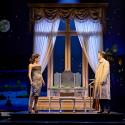
Hampstead Theatre has sensibly staged We Had a World in its Downstairs space, where the intimacy of its content plays directly to the onlooker. The audience here, more overtly than is usual in the theatre, plays judge and jury for what the younger version of Harmon, Joshua (Ryan Kopel), stages as a recreation of his past, aided by his “cast”: his brisk lawyer mother Ellen (Anna Francolini, pictured below) and his naughty grandmother Renee played by Suzanne Bertish, known as Nana.
The three of them put the previous three decades of their lives, 1988-2018, through their paces, charting what each thought his or her relationship with the others was. Just as important, they map out the place in their affections of the people we don’t see – Ellen’s sister Susan, to whom she no longer speaks; Nana’s long-suffering husband Leonard; Joshua’s boyfriend Nick.
Josh the budding playwright, a cappella singer and lover of all things New York, serves as a kind of dramaturg in all this, and also a referee, especially as the event turns into something of a slugfest between his mother and grandmother. But it’s clear none of them has the whole picture of the family dynamic, and equally clear that this is entirely natural and true of all families. They are the “world” of the title, but also representatives of a way of life that the US has all but lost now, along with its government's neglect of the environment.

The playing area is a wide empty space with just a low coffee table, an upholstered stool and a chair. The only prop is an ornately carved wooden box in which Josh keeps memorabilia, items you could loosely describe as research. But there is another item onstage: a waist-high plinth, on top of which sits a big white cube. As the action proceeds, the nature of this cube becomes clear. It’s a solid block of ice that slowly melts and keels over on its side. Josh is environmentally aware from a very early age, concerned in later life about not having children so he won't have to subject them to the horrors of climate change. But the melting block also serves as a kind of wry commentary on the family it shares space with, whose icy hostilities show signs of defrosting too.
The main source of their internecine battles is Nana (pictured below with Ryan Kopel), a Hungarian Jewish emigrée with a French grandmother who, much to Josh’s delight, lives in actual New York City, not a suburb, as he does. Nana, we discover, has led a racy life, once dropping off her three young children in Switzerland to learn French as if it were a local school run, before bunking off to Paris and a degree of freedom she didn’t enjoy at home. It’s no fun for the children, but Nana returns home with heightened savoir faire and joie de vivre, plus various items of antique furniture.
She seems the model granny, taking young Josh on cultural outings, even if they are way beyond his ken (Dances with Wolves at seven, a Robert Mapplethorpe show at nine, Diana Rigg’s Medea at 10). She even gets them tickets for Blue Man Group – not predictable fare for a seventy-something – but they don’t make it because she retires home, ill. Not ill, exactly, but drunk, something she had sworn to Ellen she would not be again in front of Josh.
Slowly, the "ugly stuff" is dragged out of cupboards and the sources of the familial fractures become clearer – why there was such a fuss over one particular Rosh Hashana dinner, why Ellen is miffed at not finishing Cry the Beloved Country for her book club, why Nana poured a bottle of ketchup over Susan’s daughter’s lamb chops. It’s the mundane fuel of family rows everywhere, delivered as a glorious bitching contest that’s laugh-out-loud funny at times, in which Ellen emerges as arguably the strongest personality there, if not the most colourful.
Director Josh Seymour marshals terrific performances from this superb trio. Anna Francolini, who goes hilariously Brooklynese when she gets animated, gives Ellen a finely tuned steeliness verging on tetchiness, her deep-seated unhappiness like a walking bass-line behind the litany of her complaints, most of them all too familiar to working women. When she flips, it’s volcanic. In her perfect-for-work trouser-suits, her hair an ungoverned frizz, she is outwardly the opposite of her soignée mother, who can make even a plain white nightgown look chic.

Bertish’s Nana is the ideal antagonist, a leonine creature whose wilful behaviour takes their battles into a different dimension from most mother-daughter wrangles. But Nana is also wonderfully curious about the world around her, even if she asks any passing stranger – waiters, typically – questions about things she doesn’t understand, in a faux-English posh accent. Bertish does all these different voices, plus a very amusing Sicilian landlady, brilliantly. She’s tough but oddly childlike at times, and often deadly funny. Did she nurture Josh, the budding playwright? Or did he create himself, as his mother insists, typically not wishing to credit Nana with such agency?
Kopel’s Joshua isn’t upstaged by these two strong women. He becomes a self-motivated credit to them both, equally funny and determined, and, as one of his letters shows, sensible enough not to want to be collateral damage in the family feuding. Harmon could have made his stage self more of a know-all who can now diagnose all his relatives’ weaknesses and stand to one side of them, but he emerges here as a playwright who’s generous to all his characters and unwilling to turn them into shrink-wrapped cliches. As Nana predicts to Joshua in the very first scene, ”I’ve got your next play here in the apartment.” He took the material and ran with it, as have the Hampstead team.