The psychological masterstroke of this quietly devastating work is to portray it from the point of view of an elderly woman who is convinced that she should not be in an old people’s home. Like the vast majority of us, Joan – played with spiky elegance by Linda Bassett – cannot see why she should relinquish her independence to be surrounded by people who seem, in different ways, to be losing their minds.
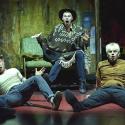
On Rosana Vize’s rigorously naturalistic set – with its formulaic framed paintings and armchairs set in a forlorn semi-circle – we watch Joan’s initial encounters with the home’s residents as she protests she is only here for a short stay. Diana Payan’s Paula does little except to bellow the word “Retreat” while raising her walking stick like a sword, Ann Mitchell’s Agnes twitters about otter conservation, and Hayley Carmichael’s truculent Simone delivers obscenities that suggest she is suffering from early-onset dementia.
The title Care is a fascinating translation from the original French name for an earlier version of this play, which was Une Mort Dans La Familie, or A Death In The Family. The word Care comprises so many meanings here: the system of careworkers assigned to look after Joan, her daughter’s conflicted emotions about putting her in a home, the brief moments of intimacy Joan eventually forms with other residents. Where, in the past, writer and director Alexander Zeldin has used his productions to highlight those made invisible by society – such as zero-hours workers or families living in temporary accommodation – this feels more reflective than political. No surprise, perhaps, given that it’s inspired by his own life experience of losing his father and grandmother in quick succession.
This was my first Zeldin production, and – one day on, as images from it continue to haunt me – I can testify that his reputation as a great maker of naturalistic theatre is deserved. He has rejected comparisons to Ken Loach, arguing that his plays are not just about social issues, but “about human beings that are living stories of our time”. Strangely – given that Care is marked by many long silences – it makes sense that he learned his craft by directing opera at St Petersburg’s Mariinsky Theatre. In the production’s two hours and ten minutes, much of the dialogue – because of the characters’ dementia – seems random, yet it has the subtle coherence, logic, and emotional impact of a piece of music.
Bassett – famous to many as Nurse Phyllis in Call The Midwife – delivers a performance that is as touching as it is emotionally raw, as her assertions increasingly reveal that she herself is losing her memory. We realise that her dignity and self-possession stem in no small part from the awareness that for some time she has been the linchpin in her daughter’s family, helping to look after her grandsons following the death of their father. That makes the gradual fracturing of her sense of self seem all the more brutal. She has led her life dutifully and diligently, and this is her payback.
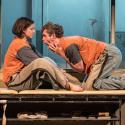
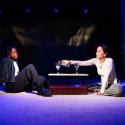
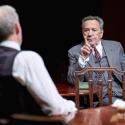
As her decline advances, and she falls out with her family, she starts to live for rare moments of connection with other people. In one of the most poignant moments, she clearly derives a quiet happiness from the moment when Richard Durden’s John (pictured below) shakily removes most of his clothes and embraces her, believing her to be his dead wife. At another point, close to the end, we witness the solace Joan gains from having a blanket bath. Moments like these bring a sense of redemption to a situation that might otherwise seem unremittingly bleak.
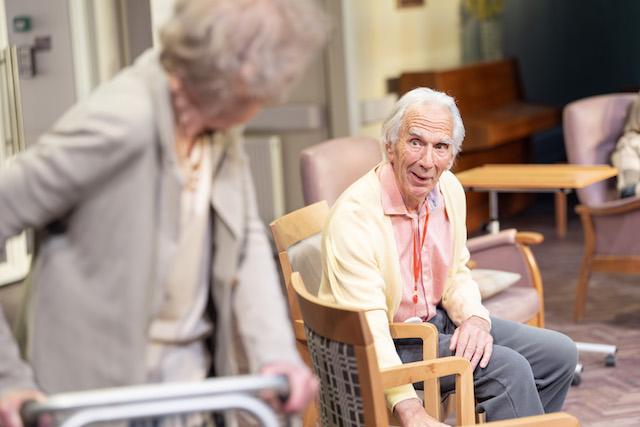
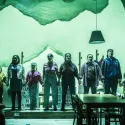
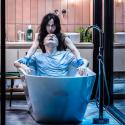
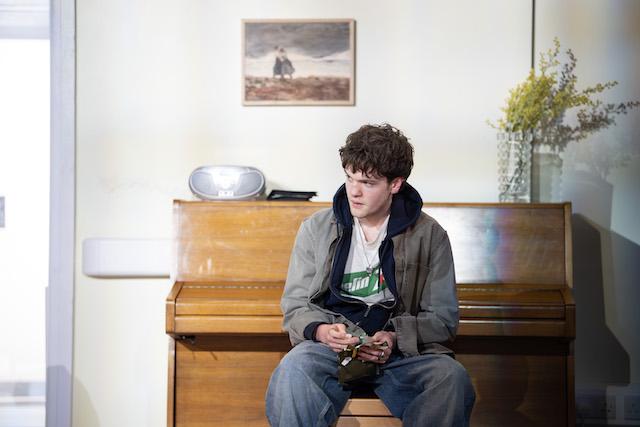
Rosie Cavaliero convincingly conveys the frustration and guilt that her daughter Lynn feels, though the way her character is written means we get very little sense of her hinterland. As Joan’s 16-year-old grandson, Laurie, William Lawlor (pictured above in the central photo) dynamically encapsulates the inarticulate confusion and rage he feels as the death of his father is succeeded by the looming death of his grandmother.
In the one non-naturalistic touch, each time a character dies, they rise up and walk into the theatre stalls to join the audience. The characters watching over them stay staring at the place where they breathed their last. It’s a simple manoeuvre which emphasises that while all of our deaths will be different, we are united in the fact that we cannot escape our mortality. The huge power is in the simplicity of the way in which it’s expressed in a work that’s as profoundly sobering as it’s strangely uplifting.