For a master dramatist - even for a tyro really - The Price is a strangely uneven play, brilliant psychological insights diluted by clunking structural issues. You wonder what it would be like in the hands of a less talented cast, a less experienced director, performed on a less convincing set - it could unravel very quickly. It was something of a surprise to find that amongst the credits in the programme, its weakest link proved to be its writer, Arthur Miller.
We open on a middle-aged NYPD cop rooting through a treasure trove of stuff that you might find presented at an Antiques Roadshow stop in Guildford. It’s a hotchpotch of objects that speak to a comfortable middle-class life between the wars, but one that seems to have stopped, its materials piled up haphazardly in an attic, cobwebs not visible, but there, mice likely to be found in dark corners. This theme of stuckness leading to neglect and decline, is to be reflected in the characters.
The cop, Victor, is shaken out of his reverie by the arrival of his wife, Esther, handsome in a chic suit, and we learn that the mishmash of items is to be sold since the house is scheduled for demolition. Esther immediately starts to berate her husband about his procrastination over his upcoming retirement plans. He’s nearly 50, so he’ll soon get some pension if he wants it and the time and money he’s never enjoyed. She’s also keen to get as much cash as she can for the goods and to use that as a platform to shake Victor out of his stasis, a wife in 1968 very much limited by her husband’s attitudes.
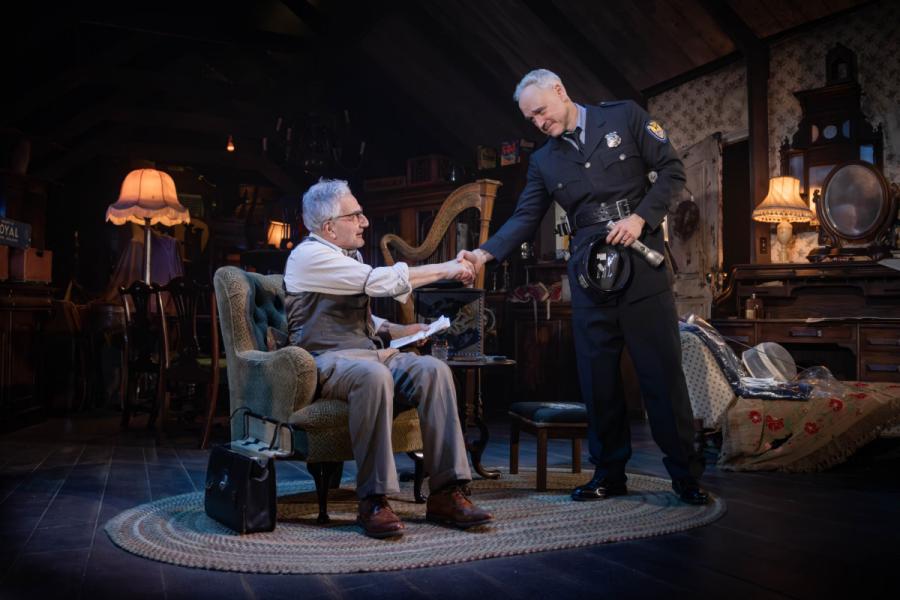
An appraiser, Gregory Solomon, wheezes up the staircase and is met with some relief by Victor, and a very wary eye by Esther. In a broad New York accent (they matter in this production) inflected with Yiddish vowels and slang, he’s all charm and stories (possibly) too good to be true, the wisdom of nearly 90 years spent rolling with the punches underpinning his many, many words. Suddenly Victor’s brother, Walter, turns up unexpectedly, the two estranged for 16 years, and "The Price" takes on more meanings than the $1100 on which Victor and Solomon had all but settled.
It’s Henry Goodman’s Solomon (pictured above with Elliot Cowan) who is on the posters and one can see why. He’s a marvellous creation, the patter perfect, the gestures just so and, crucially, the wisdom he imparts neither condescending nor irrelevant. His past, which includes real tragedy and does actually haunt him, can nevertheless be boxed up and catalogued like occasional furniture, accessible as and when he wants it. At 89, he’s relishing the prospect of being back in the game, ducking and diving, one last time. Not just a survivor, a thriver and, in Goodman’s hands, mercifully stopping just short of a caricature.
Elliot Cowan has a much tougher, less showy, job that he delivers with no little skill. He gives Victor a melancholy, a regret about his life choices that proves a comfort as much as anything else, vindicating, to himself if nobody else his lowly financial and social position, proud incorruptibility on the job and past dedication to his ailing father his greatest achievements. That currency is getting softer and softer in a world in which abstract values are being swiftly swept aside by concrete metrics like money in the bank and consumer products in the home. Solomon is almost cruel in his illustration and embrace of this new world, one in which Victor can find no place. He missed the bus when he dropped out of college, without the turning on and tuning in, to nurse his depressed and destitute post-Wall Street Crash father.
Faye Castelow’s Esther is more than a vulgar social climber, as she almost certainly would be were this play English. She loves her husband and respects his decency, but she’s desperate for things to change, for this hinge moment in their lives not to conclude with the door slammed shut yet again. That said, Miller is far less interested in her than he is in the men, rather dating the play.
John Hopkins speaks with an archetypal WASP voice, a successful surgeon and administrator who presents Walter as a Sherman McCoy-like Master of the Universe. Cowan’s body language, initially visually shrivelling in the face of his brother’s manifestation of the success he could have had, is wonderfully well observed. It's later reflected (at least in part) by Hopkins, as we learn that his life has been a professional success, but a failure in almost all other respects.
None of it works to bring them together though, as the resentment that both brothers know is eating them up keeps bubbling to the surface, the long dead father’s manipulation of each son revealed like an onion’s skin - and it makes both cry. His empty chair becomes the focal point of their unwillingness to let bygones be bygones, to stop blaming and start living. As ever within families, fraternal forgiveness appears to be an act of unearned charity given by a sibling willing to reconcile, but it’s really an act of necessary self-preservation.
All this takes place on Jon Bausor’s splendid utterly convincing set, on which director, Jonathan Munby, often lines his actors up parallel to the house. With Victor’s old foil from his fencing days one of the few heirlooms in which he takes an interest, that unusual blocking suggests an invisible piste on which duels take place, hemming them in, no escape until enough hits are made to define a winner and a loser. It also means that the actors, like their characters, cannot see each other, unless they pivot - but, of course, they’re stuck psychologically, so they can’t.
If Miller’s aperçus on the vulnerability of men and the fragility of families are as vivid as ever, the play’s problematic structure too often barges into the narrative. How did Solomon and Walter get through the front door? Why doesn’t Esther stay to observe, even lead, the negotiations with Solomon? Why is Solomon, a man very keen on gossip and protecting his position, so often conveniently absent in the adjacent bedroom while Victor and Walter argue over the past? Why does the first half play out in second gear and the second half shift into fifth?
Those flaws may account for the play’s infrequent revivals (by Miller’s standard, anyway) but the ideas still poke your own sensibilities and invites, no, compels you to look at your own roads not taken and the impact such decisions had on your arrival to this place, right here, right now.
You reflect on the way home that one should do all one can to avoid the destructive fates of Victor and Walter, and instead follow the wisdom of Solomon.