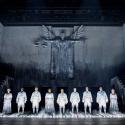
Can you go home again? That's the question that will be hanging over the Royal Shakespeare Company's first residency at the Roundhouse since their "History Play" cycle stormed north London over two years ago, reminding those lucky enough to catch it of the loss to the capital ever since the RSC opted out of a London base of operations. Now that they have one - this current 10-week season of eight plays initials an ongoing collaboration with the Camden Town venue - the more pressing interest pertains to the work, especially given the frequency with which the Donmar and National (not to mention, self-evidently, Shakespeare's Globe) turn to this particular canon, rendering the RSC one Bardic player among many.
The happy news is that Rupert Goold's transfer of his Romeo and Juliet, first seen in Stratford-upon-Avon this past March, boasts two truly thrilling performances from Sam Troughton and Mariah Gale in the title roles, which are here taken with a singular ferocity and intelligence not encountered in this play in some time. And if some of the directorial flourishes are either silly or unnecessary, in turn allowing for the odd supporting performance or two whose eccentricities quickly pall, all cavils fall away faced with the central players. The ongoing interest, of course, will lie in seeing how the other stagings stack up (Antony and Cleopatra, starring Kathryn Hunter, is up next), not to mention how the productions fare upon transferring to New York next summer.
You'll doubtless have heard by now of Goold's conceit, which is to dress his titular duo in contemporary garb (a hoodie for him, jeans and trainers for her), keeping the rest of the ensemble in period dress up until a grievous finale that finds the entire assemblage attired as if for the here and now, so as to speak to an age that understands Shakespeare's tale of tribal warfare with or without West Side Story or the likes of Baz Luhrmann to move the references on. Romeo starts the play tapping into Shakespeare's Prologue via an audio guide and, later, whizzes on and off by means of a bicycle: precisely the sorts of Goold-isms that will in no way surprise followers of this director over the years.
What is startling is the joint reinvention of both leading roles, starting with Troughton's appealing, likeable Romeo, a young swain miles removed from the decidedly wet egotist that this part has become over time - not least because Romeo is quite possibly the greatest solipsist of any Shakespeare lover. (Even in death, his final words read: "Thus with a kiss I die." That's to say, Juliet who?) Gale, blessed with easily the richer part, is a genuine sensation, a child-woman who visibly matures over the course of three-plus hours - so much for the "two hours' traffic of our stage" erroneously promised by the author - on the way to a reckoning with her actual groom, namely death, that seems ripped from far within the gut. Rarely have I felt Juliet's world so fully closing down around her - one, she informs us, "past hope, past care, past help", whereby suicide comes to seem her only source of empowerment.
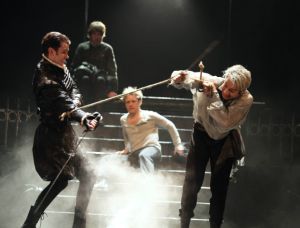 I could have done without Forbes Masson's effortful Friar Laurence, the open-toed sandals suggesting a refugee from Godspell, and Jonjo O'Neill (pictured right in duelling mode) makes a flouncy, irksome hash out of the foolproof (or so one has always thought) role of Mercutio, the Queen Mab speech here so mannered that a paean to poetic invention and linguistic extravagance becomes an invitation to switch off. The physical production, too, could tone down the lapping flames that project a Hammer Horror feel on to Tom Scutt's multileveled design, Howard Harrison's funereal lighting doubtless taking its cue from the Prince's closing adjective, "glooming", that I have yet to encounter elsewhere.
And yet, the staging is smart where it counts most and sustains interest in a time-honoured text that remains far more robust, dense and deeply nihilistic than Romeo and Juliet is often credited with being. ("Leave me to myself tonight," requests Juliet, as if solitude were in fact her default state of being.) Perhaps the ultimate accolade rests with the held silence - an idiot nut-chomper over the aisle from me notwithstanding - with which a noticeably young audience lapped up proceedings throughout. In the end, it's as if Shakespeare trumps any trickery Goold can throw at him, leaving the play to hurtle ever-forward towards its characters' collective date with destiny. Death, where is thy sting? For the next month or so, look no further than the Roundhouse.