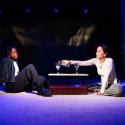
Russia’s Shakespeare, Alexander Pushkin, has enjoyed imaginative treatment on the British stage and screen. Brighton Theatre’s now-legendary Vanity conjured the world of the verse-novel Eugene Onegin vividly with three actors and minimal props. More folk will remember the cinematic Queen of Spades, with Anton Walbrook’s crazed gambler terrorising the ancient Countess of Edith Evans to death for her secret of three winning cards. Could this sparest of tales, zooming between irony and fright, work equally well on a small stage?
Well, yes, but only by forgetting the special qualities of Pushkin's original. Having worked his way through lofty poetics to more realistic rhyming couplets, the poet turned his hand to the sparest prose for one of the most haunting short stories in any language, one where, according to Dostoyevsky, the fantastical is "so close to reality that you are forced almost to believe it". That happens at times in Tchaikovsky's grand operatic treatment, which alternates musically splendid spectacle with faithful music-theatre. Raymond Blankenhorn's reinvention for the wide-ranging Fusebox Productions - its motto "a new theatre of colour, sound and motion" - almost throws the singular baby out with the bathwater.
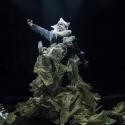
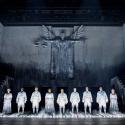
The script rhymes like the original Onegin, Pushkin's epic masterpiece, with similarly deliberate slides into bathos; it has none of the crisper irony of his own Queen of Spades. And Max Hoehn's production takes almost as long as Tchaikovsky's opera to get to page one of the original text, but it does it splendidly with mime, lighting (Edmund Sutton's on designer Valentina Ricci's mountains of white sheets, which could be the old woman's "snows of yesteryear") and musical collage.
The stakes are raised in the last two scenes as all the ingredients Fusebox prides itself on do indeed fuse
The latter is a superb piece of work from young composer Daniel Saleeb, starting with patches of Offenbach's Tales of Hoffmann heard dream-like in the middle of orchestral tuning-up and progressing with silent-film piano scoring, tinkling music boxes and chiming bells. A leaf may have been taken out of David Sawer's work for Richard Jones's Government Inspector, but a different world is created here. The crucial sense of time past and present is loose: are we up to date, and are the scenes of the Countess's racy past when she visited Jewish mage Count St Germain supposed to be the 1920s?
It doesn't matter too much, and even helps with some of the best lines of dramatic poetry, like those in the interpolated scene where ward Liza, here only mildly tyrannised by her far from mysterious old patroness, tries to read her War and Peace - undreamed of, naturally, in Pushkin's time - and gets the sharp edge of the Countess's tongue for misery-mongering as soon as she reaches the word "unhappy".
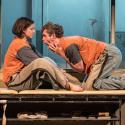
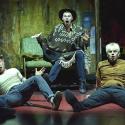
Jen Holt as a surprisingly energetic object of this Hermann's manipulation to get at her mistress strikes the freshest note. Both she and Benjamin Way excel at making the audience complicit in the narrative, which shifts from one to the other in the first two "deals" of this three-hander. Way catches a fair amount of Hermann's Hoffmannesque absurdity, though I'm not sure we really get Pushkin's message about his mix of Germanic precision and Russian inner chaos, nor the last degree of scary mania: he doesn't really frighten the Countess to death at all, and oddly the one scene in the novel which implies nearly all mime, at least on the victim's part - and gets it, hauntingly, in Tchaikovsky's opera - is taken up with more Oneginesque banter quick-fired by the determinedly ordinary cheer of Norma Cohen.
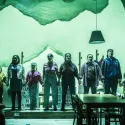
She turns that to good use as a rather frisky ghost. The stakes are raised in the last two scenes as all the ingredients Fusebox prides itself on do indeed fuse: the gambling scene on a rocking table, with queasy suggestions of modern poker games in the sound-score, is suitably neurasthenic, and Hermann's madness strikes a final note of total theatre bringing all three "cards", in this case the actors, together, the women holding the aces. An odd gamble, then, but a unique and often compelling one.
- Fusebox Productions' The Queen of Spades at the Arcola Theatre until 12 November