Decades are never neat: they don’t simply go from 1 to 10, or 0 to 9. So it is with the Swinging Sixties, which actually began – like sexual intercourse for poet Philip Larkin – in 1963, the year of the Profumo Scandal, Kim Philby’s defection and the satire boom, all of which signaled the end of deference. Oh, almost forgot, and this is when the Beatles’ first LP, Please Please Me was released, an album whose title has been borrowed by Tom Wright for his play about the band’s manager Brian Epstein. Staged at the Kiln theatre, it is directed by the venue’s boss Amit Sharma.
Epstein’s story is well known. It goes from his Liverpudlian beginnings as quite an uncool, but keen, music salesman, in his father’s furniture store, to discovering the Beatles at a lunchtime gig at the Cavern Club, to becoming their manager and touring during the era of Beatlemania, to trying to cope with their huge fame – a life which ends tragically in an overdose of barbiturates in 1967 when he was only 32. In this version, Wright concentrates on the way that the band awoke his ambitions, broadened his horizons and fired up his love for pop culture. Specifically, he charts his relationship with John Lennon, the only band member who appears here, and ends on his decline into substance abuse.
At the start, this is a rather pedestrian retelling of familiar features from the biography of a Jewish gay man who feels like an outsider. At a time when homosexual acts were illegal, and anti-Semitism rife, Epstein was a target for police harassment, threats of blackmail and violence. If this is ploddingly recounted, with occasional bright quips about Elvis and Little Richard, the introduction of young Cilla Black and the Cavern Club offers a much-needed mix of humanity, humour and rock music. Except that, for contractual reasons, there are no Beatles songs so there’s a big hole in story, with composer David Shrubsole having to substitute generic guitar chords, drum rolls and solo twangs reminiscent of the Fab Four.
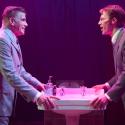
Things do pick up in 1963, when during a holiday in Torremolinos, Brian and John share a room, Lennon having left his wife Cynthia behind with their newborn son Julian. Remembering that the title song of the Beatles’ debut studio album is about a man telling a woman how he pleases her, but that she never even tries to please him, this scene, the most intensely dramatic in the play, shows that Brian is in love with John, but unable to seduce him. Instead, it is the Beatle – confident, provocative and knowing – who initiates the kissing. Of course, Lennon denied rumours of a gay affair, and, frankly, it really doesn’t really matter if they had sex or not.
The point is that both Brian and John have a strong emotional bond. Brian’s infatuation, or growing love, is overtaken by the massive explosion of Beatlemania, with its highs and lows, concerts full of screaming girls, and John’s comment in 1966 that the band are “more popular than Jesus”. Here John is shown grudgingly taking Brian’s advice to publicly apologise for the Jesus comment, as well as violently attacking a mate who suggests he is gay. Neither man seems able to openheartedly please the other; each has to manage the other’s ambitions and expectations. If Brian overdosed because he was disappointed in love this is never made clear.
In fact, much of the play’s second half represents the pressures of international fame, with Brian struggling to cope, and using compulsive sex and drugs to blot out his unhappiness. Very little of this, however, is clear in a docu-drama that skips about on the surface, with incidents involving John’s Aunt Mimi, Cynthia and Cilla, Brian’s friend Peter, his lawyer Geoffrey and a couple of pick ups. What’s missing is any profound insight into the mind of Epstein, it’s a life of Brian told from the outside. Likewise, we don’t really get inside the thoughts and feelings of John, so much so that I would have preferred a two-hander which concentrated only on their relationship, and delved deeper.
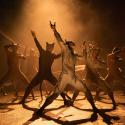
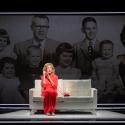
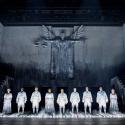
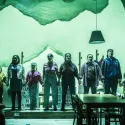
As it is, Sharma’s production is efficient, but except for a couple of strong scenes, rather dullsville. Tom Piper’s set conveys the atmospheric darkness of the Cavern Club better than the flamboyant colour of the mid-1960s, and the scene changes involve a lot of very clumsy furniture moving. The lack of Beatles music feels like a real omission, yet despite all this the two main actors do deliver captivating performances: Calam Lynch’s Brian goes on an affecting journey from mild and anxious shop worker to music biz bigshot, loud mouthed and druggy, while Noah Ritter make his stage debut as John with a real energy, catching the Beatle’s Scouse sarkiness, contempt and anger. My main regret is that there’s so little about his music.
The rest of the cast are a bit overshadowed by the Brian-John dynamic, and each actor has to play several roles. Still, there is good support from Eleanor Worthington-Cox, who plays Aunt Mimi, Cynthia and Cilla, Arthur Wilson as Geoffrey and Epstein senior, and William Robinson as Peter, as well as the casual pick ups. Yet despite the occasional moments of chemistry in the cast, this is only a partly told story, one of those shows which, the more you think about it, the less satisfying it feels. But true Fab Four fans might enjoy discussing the story’s minutiae.