If rock is magic, then what about its creators? Are they wonderful magicians, or empty charlatans? Infused by the spirit of the Patti Smith song of the same name, playwright Simon Stephens’s new play puts a rock star centre stage — and then lets him implode. Given that he is played by Andrew Scott, one of the most charismatic actors of the British stage, the result is often compelling. Add to the mix some beautifully sculpted visual effects, care of Carrie Cracknell, who directed the award-winning A Doll’s House, and the result is certainly memorable.
But is it as good as it could be? At first, I was uncertain. Here comes the rock god, a guy called Paul, who asks fellow band member Johnny to get him a peach. Since he likes to eat local produce, and the band are in Moscow, this is a nice jokey start to the evening, and Paul rapidly grows into a monster of egoistic desire in front of our rather unsurprised eyes. The object of the adoration of thousands of fans, on tour with his band, his backstage life is an orgy of exotic foods, mountains of drugs and lakes of alcohol.
This is a fantasia, not a piece of journalism
Yes, he’s pretty addled. And he behaves as badly as anyone who has ever been knocked sideways by success and wealth beyond their wildest dreams. Paul is selfish, rude, unbearable. Like an overgrown child, he makes mischief wherever he can. His lustful appetites are no respecter of persons and even his closest friends are not immune to his predatory charms. When he goes too far, and Johnny’s girlfriend Marnie ends up dead, I knew what to expect: a downward spiral.
So far so predictable. But Stephens’s account of personal cruelty still has quite a way to go as Paul picks up a waitress, discards hangers on, gives dreadful interviews to the press, torments casual acquaintances, visits Marnie’s parents and generally conducts a masterclass in the well-known genre of rock star behaving badly, very badly. By now, I was getting a little itchy. I mean, isn’t all this stuff a bit too well known, too banal, too familiar? Where's the excitement, the wicked wildness of rock?
As Scott turns in a finely tuned and tightly wired performance, the themes of the play come at you with their flies undone. All money corrupts, but a massive shedload of money corrupts, well, massively. While the laconically unpredictable Paul, who never leaves the stage, girates from one manipulation to another betrayal, his praise of the power of money rings hollow in the halls of right and truth. As I watched morality trampled under his dancing feet, I realized that, of course, this is a fantasia, not a piece of journalism.
 Stephens has a written a Continental play for an English stage. It feels more like a fancy than a piece of reportage; more like a dream gone sour than a realistic story. For my taste, it lacks drama. Instead, it has an inertness that this car-crash of a rock biography simply doesn’t deserve. What’s missing is a sense of life. Of vitality. Of something at stake. I wanted to care, but I really didn’t. The ideas that lightly litter the text like a sprinkling of some faded confetti are just too thin to nourish me. I left the theatre with a taste of disappointment on my tongue.
Thinking about the experience, the penny finally dropped. Not all of the writing is bad: there's a marvellously chilling passage about the feeling of being dead, for example. What's really missing here is a powerful metaphor. After all, Patti Smith's 'Birdland' gasps and oozes and screams with imagery: the belly of a ship, the white opal eyes, the helium raven, even "the shape of a tortured woman". All conjure up the vivid sense of loss, and the idea of inhumanity. Of desperation. Somehow these kinds of images are missing from Stephens's play (although his previous work abounds in them).
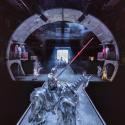
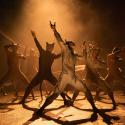
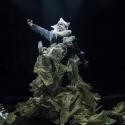
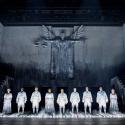
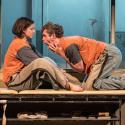
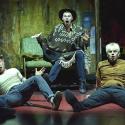
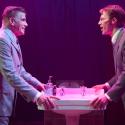
But it is hard to fault the production. Cracknell’s direction throws the naturalistic bible out of the fifteenth-floor hotel-suite window, and her staging is brimming with good visual pictures. The final scenes blossom like a kind of evil bloom as a vile liquid seeps onto the stage, a chilly sensation of deathliness. And although Scott dominates the stage, injecting the energy of malignity into every encounter, he gets great support from Alex Price as Johnny, Yolanda Kettle as Marnie and Nikki Amuka-Bird as the star-struck waitress. Daniel Cerqueira plays both Paul's manager and his father. Plastic seats abound (pictured above). Yes, all right, it’s all very experimental; no, it’s not very inspiring. At home, I listened to the dark, dark poetry of Patti Smith with relief.