

Who would have thought, when Phyllida Lloyd's Donmar Julius Caesar opened to justified fanfare, that two more Shakespeare masterpieces would be sustained no less powerfully within the women's-prison context over the following years? Faced with the "which of the three did you like best?" question – and I saw them all on a single day at the King's Cross makeshift theatre – the answer would have to be "each one at the time I saw it". So it's good to relive the first as screened on BBC Four – Henry IV and The Tempest are already available on the BBC iPlayer – which is as compelling, keenly paced and beautifully spoken a delivery of the first Roman tragedy as any you'll see, no less magnificent on the screen.
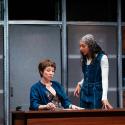
Lloyd is experienced as a director for film, starting with her selective version of the Britten Gloriana she directed for Opera North. Camerawork is dizzying when it needs to be, in the scenes of explosive violence, there are some strong overhead shots and closeups bring home the truthful brilliance of the performances. The prison context is reinforced at key points; it starts with the women being led to the "gym" which is the in-the-round setting, and a speech from Jade Anouka's "outer" character. Each play focuses on a specific prisoner; it's only in The Tempest that we learn about Harriet Walter's "Hannah", who joins the march back to lock-up in despair at the ongoing state of the power dynamics wrecking the world as depicted in the play. 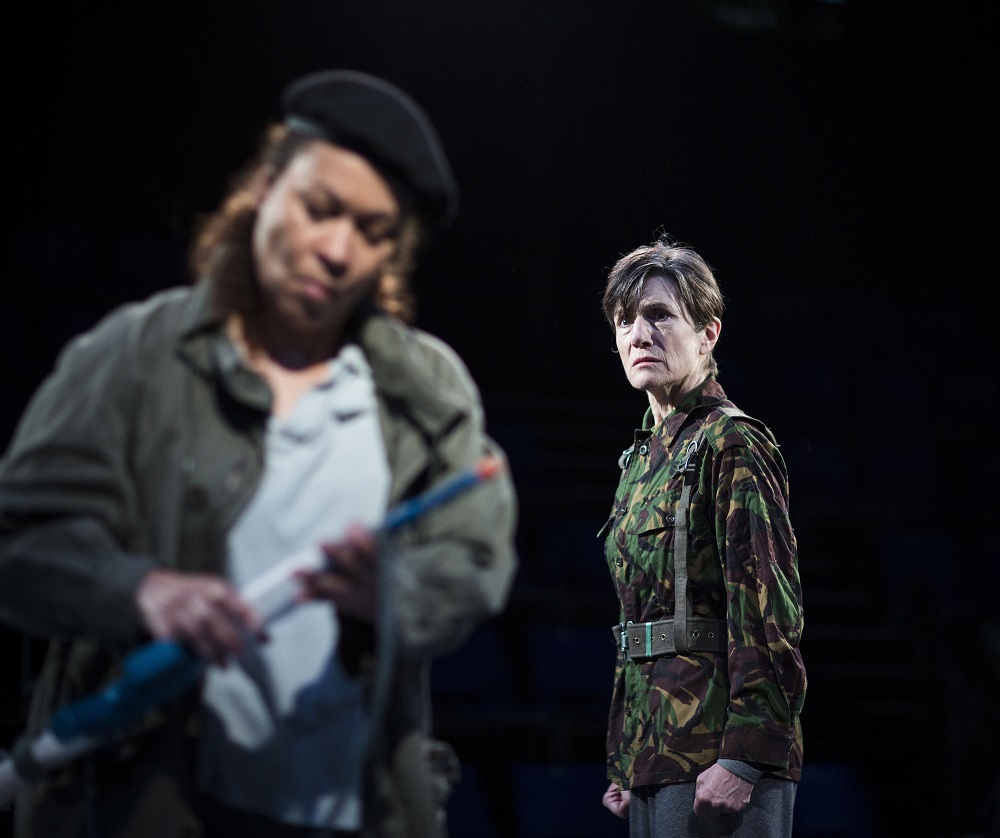 Walter's ravaged, conscience-stricken, perhaps self deceiving Brutus (pictured above with Martina Laird's Cassius) and Jade Anouka's Antony are the opposite poles around which the drama revolves. Most radical, perhaps, is how Anouka, who will go on to break our hearts as firebrand Hotspur in Henry IV, is asked to characterise Caesar's loyal friend. The trajectory here is from a youth in fear of his life to a brilliant manipulator of the mob violence which is very nearly the end of him when he declaims "Friends, Romans, countrymen" from a prone position in the central circle (pictured below) where the corpse of Jackie Clune's charismatic Caesar has just been lying. Goosebumps accumulate from the point where Anouka lets rip with Antony's real feelings in the "O pardon me" speech.
There is equal definition from Martina Laird's Cassius, the restlessness expressed by an encyclopedic range of hand and body gestures which inform the text – Lloyd is so good at this – and from Karen Dunbar's Casca, verging on the comic (those skills will come to the fore in The Tempest). Every cast member fulfils her role with strong characterisation, and the ensemble work is brilliant, backed up by ingenious use of whatever props the "prisoners" can lay their hands on (red rubber gloves, a plastic bowl filled with ribena for the wine toasting, donuts from Caesar to keep the majority from any "lean and hungry" dangerousness). 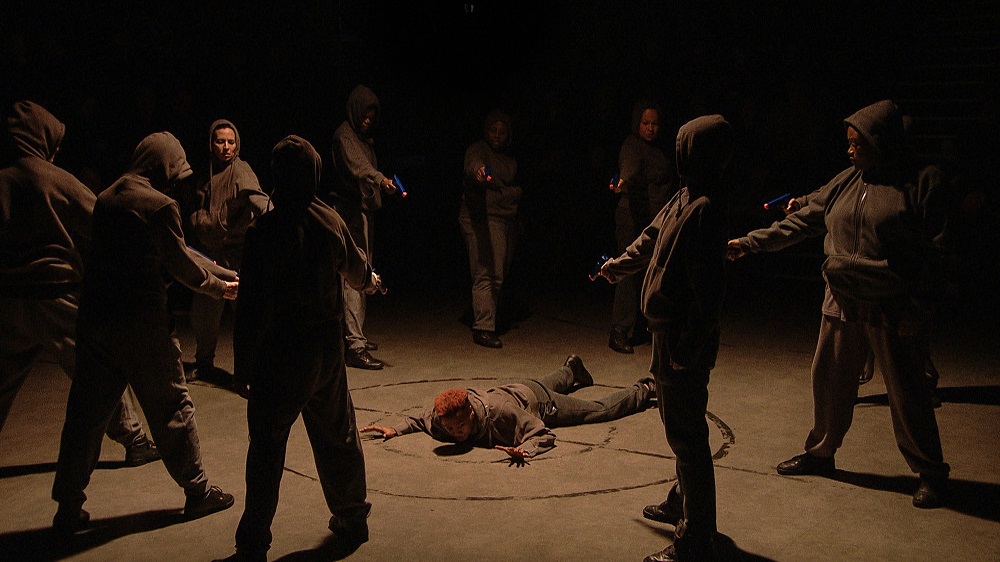 James Farncombe's lighting does the rest of the professional work, especially atmospheric in the early night-to-dawn scenes. The music, its original portions by the excellent Gary Yershon, is timely and only obtrusive when it needs to be, with some phenomenal drumming to kick off the battles. It comes as no surprise that when this team took the plays to schools in the East End, the results were electrifying. Along with the Globe's all-male Twelfth Night with Mark Rylance as Olivia and Ivo van Hove's Roman Tragedies, this is the most vivid Shakespeare to have hit London stages in my experience. Everyone, of any age, should see all three plays; thanks to the Donmar's leaguing with BBC Four, that's now possible.


Add comment