

It feels fitting that this latest revival of Copenhagen should open so soon after Arcadia at the Old Vic. These masterworks by, respectively, Michael Frayn and Tom Stoppard have much in common, as highly sophisticated marriages of ideas, moral inquiry and human drama, wrapped in mystery.
With wars currently waging around the globe, and the threat of greater escalation, this production of the nuclear-themed Copenhagen, which plays around the decisions and tricks of the mind that can determine mass destruction, or not, is an apt reminder of the play’s calibre and resonance. It really is a phenomenal piece.
Frayn takes as his starting point a real and much debated meeting, in Nazi-occupied Copenhagen in 1941, between the theoretical physicists Niels Bohr and Werner Heisenberg, a Danish Jew and a German, former mentor and protégé. Heisenberg, when head of the Nazi nuclear energy programme, contrived this difficult visit, for purposes that remain vague; the subsequent conversation would also become the subject of much speculation, fuelled by each man’s very different versions.
It's this conundrum that Frayn offers, as Bohm (Richard Schiff), his wife Margrethe (Alex Kingston) and Heisenberg (Damien Molony) trawl over the why and the what of this encounter, again and again, round and round, investigating every possibility, challenging each other’s claims. Was Heisenberg trying to persuade Bohr to influence the Americans towards peace – encouraging scientists on each side to convince their political masters of the impossibility of a bomb? Or was he trying to pick his friend and mentor’s brains about the US plans, obtain valuable intel for the Nazis, even mine some useful data that would get his bomb over the line?
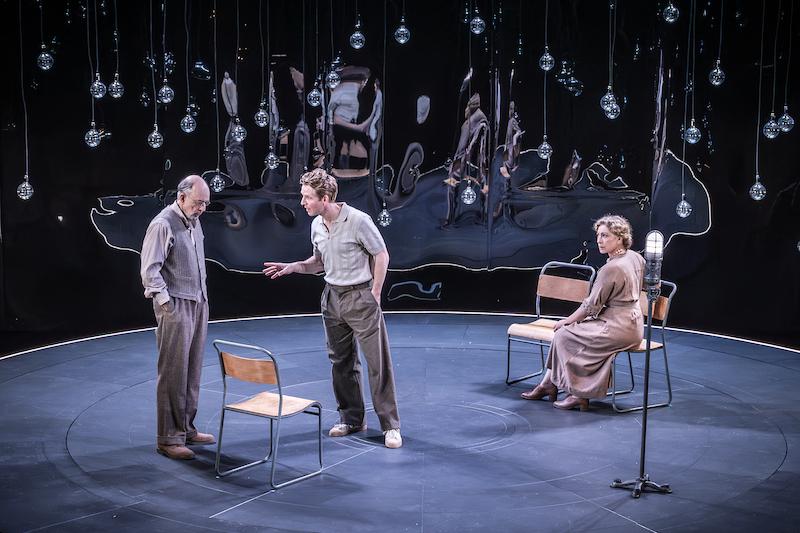
Since Frayn presents these characters as ghosts, “dead and gone”, the investigation has an added, retrospective dimension. The now dead Heisenberg earnestly desires to clear his name after the decades of doubt and ostracism that followed the meeting; he was a hero, he says, not a villain. But then, his ghostly companions try yet another option, that the German is merely trying to understand why he failed to make the Nazi nuke that he so desperately wanted to drop on London, or Paris, or Copenhagen.
At a time, now, when truth has been roundly devalued, and people can go from fame to cancellation in the time it takes to make one misjudged remark, this maze of speculation is utterly compelling; even when the scientific talk that is these characters’ vocabulary of choice can be a lot to deal with. Frayn reports that he had around 50 books on his reading list, simply to understand quantum physics, nuclear fission, atomic weapons and the associated mind-boggling ideas that fuel these conversations; but the context is everything here, lending fibre and stimulus to the personal and moral questioning, just as mathematics and landscape gardening (among much else) do in Arcadia.
There’s also a metaphorical spin at play: one of Heisenberg’s achievements was his uncertainty principle, which asserted a limit to the precision in certain scientistic observations; and uncertainty exists everywhere in this very human experiment in memory.
I must say, too, that Frayn’s dissemination of these ideas is much clearer and more potent than that achieved by the otherwise commendable Oppenheimer.
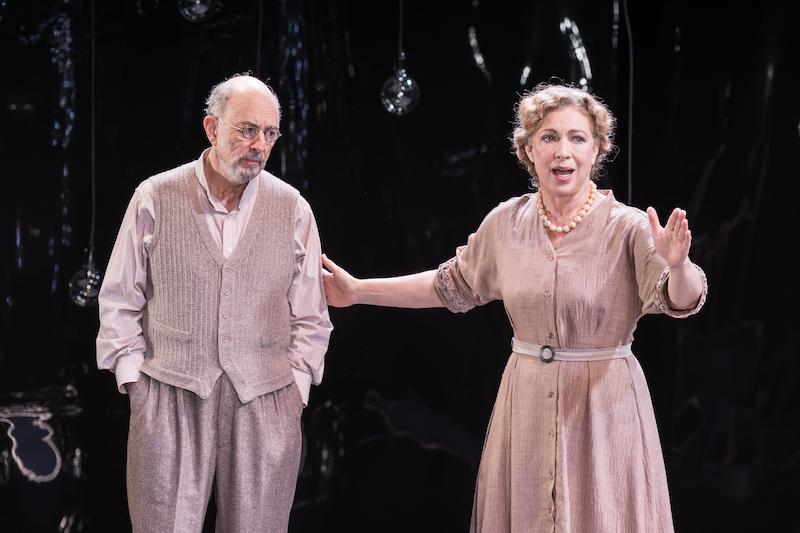
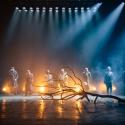
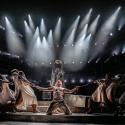
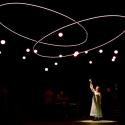
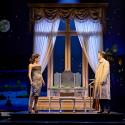
Director Michael Longhurst and his designers offer an elegant and very effective presentation of the play. The stage is comprised of concentric circles, the outer rim revolving around the centre; to the back, an array of lanterns; around the outside a pool of dark water; on stage nothing but three chairs. When the actors enter, their forms are shrouded in specs of light, giving them the appearance of holograms, or atoms sparking into life. It’s a brilliant effect, which speaks both to the spectral setting but also to the scientific debate; at one point Molony moves a chair from the centre to the water and, when he returns it, shakes the water as though removing some alien substance.
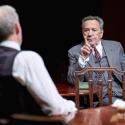
Within this setting, the characters are sent literally in circles around each other, embroiled in a fractious inquiry that is tempered only by the remembered affection between the two men and the protective blanket that Margrethe wraps around her husband (Alex Kingston, pictured above with Richard Schiff). “You were angry” she recalls. “I was remarkably calm,” he insists; except that, given this is Schiff, best known as press secretary Toby Ziegler from The West Wing, a tempestuous eruption is not far away.
The West Wing is also evoked when Bohm and Heisenberg return to their favourite pastime: “walk and talk”, something which epitomised Aaron Sorkin’s White House drama. As with that show, the ideas and the moral conundrums here are, for the most part, completely absorbing.
The spell is only broken, in fact, by the actors. Despite his experience with Sorkin’s famously dialogue-heavy scripts, for characters smarter than anyone we’ve ever met, Schiff doesn’t seem entirely comfortable. On opening night he stumbled quite a few times, almost always over the science-speak; and his transitions between warm, almost naïve old scientist and rage don’t always work.
Kingston starts off in a slightly too melodramatic register, just a bit too blunt, though she does come into her own as Margrethe becomes a more prominent intermediary in the second half. And both of those actors have plenty of charisma to keep us on board, even when not giving their A game. In the meantime, Molony really shines, offering a glowing centre to the piece while capturing the shifting personalities of his enigmatic character: now the puppyish former student, now a desperate idealist trying to do the right thing, now the ambitious scientist frustrated by his failure.
One striking takeaway of an absorbing evening is this strange contradiction: that a man who failed to build a bomb, and killed no-one, is vilified by history, whereas the man who left Copenhagen for the Manhattan Project, and in some way contributed to the death of thousands, is not.




Add comment