You know to expect a crazy ride, especially when Gerald Barry, greatest living Wildean and wild one among composers, has flagged up his very unStraussian take on Salome with "I didn't want her to dance, so I thought...not "dance", but "type' "(there are three typewriters of varying ages at the front of the concert platform). Right at the start, with deliberately unwieldy unison galumphings, mostly strings and lower brass, you also know it's him by the style. But you can never second-guess the extraordinary turns, both funny and dark, often both at the same time, this utterly original riff on a nasty story is going to take.
Part of the supremely enterprising New Music Dublin, this Irish premiere - Dublin beating London to it - riveted from start to finish, even when certain sequences like that pompous, very tonal opening with its jerks and pauses and a later, screamy vocal ensemble, seem to go on for ever (part of the Barry ethos, I suspect, rather than spinning it out to fulfil commission length). National Symphony Orchestra Ireland played it all with conspicuous enthusiasm under Jérôme Kuhn, who also conducted the first staging, in Magdeburg.
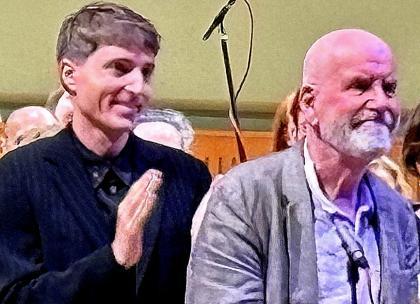
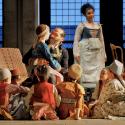
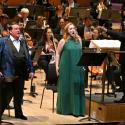
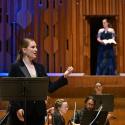
We start more or less where Wilde and Richard Strauss do, with an anything-but-young Syrian (Stefan Sevenich) unfolding the semi-robotic vocal declamation in misalliance with a soldier (David Howes). Barry tends to use quite a lot of Wilde that Strauss didn't, and more besides. Salome, a role originally conceived for Barbara Hannigan, taken with light soprano aplomb and the right stillness by Alison Scherzer, pitches unaccompanied all over the place in her fascination with "The Prisoner" (Jokanaan, of course, but nobody other than the eponymous princess has a name here). He half-sings, half-speaks in mellifluous French (great idea, since the others claim they can't understand him), giving Salome a singing lesson; the role is taken with eerie fixity by Vincent Casagrande (pictured above left with the composer).
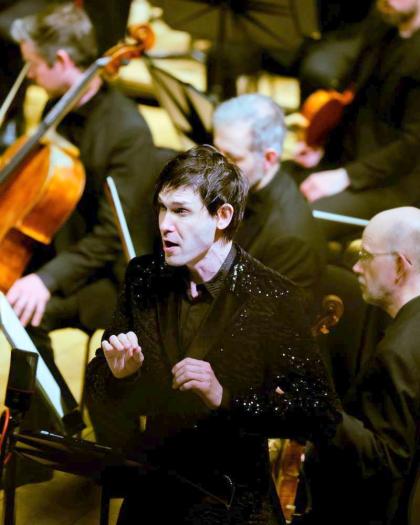
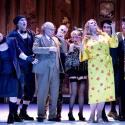
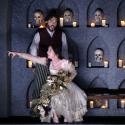
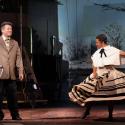
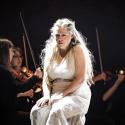
Like Strauss, Barry turns the screw with the arrival of the horrible Herods (here King and Queen). Timur (pictured right by Molly Keane), a Los Angeles sensation who also has a band, draws focus with virtuoso tics and mad non-sequiturs, but doesn't for a moment overshadow his Queen, the superb Amy Ní Fhearraigh, already a world-class soprano, who made a huge impression in the Rosemary Kennedy opera Least Like the Other. Her vocalise-hysteria was one of the most haunting sequences in a savage parade, and though her voice is more opulent than Scherzer's, you feel that she could sing the title role too (or both, though ensembles would make that a problem).
We know we're not going to get the dance, though preliminary citings of "the Beautiful Blue Danube" with no-more than an oom-pah-pah suggesting Johann Strauss the Younger, offer a kind of interlude-alternative. Then, of course, it's "type for me, Salome", as the girl takes dictation from her controlling stepfather; he recites lines from De Profundis, complete with colons and full stops. A bizarre, endless ensemble makes you worry that Barry is going to stop before she gets the head of "The Prisoner", but no, Herod having offered bizarre alternatives to her request - and some mad trumpet writing - there's a Frankenstein sequence of body parts. Though Salome's Liebestod is short, it's suddenly sweet; divided strings alone support her nostalgia for what might have been. This is Barry in 18th century pastiche mode. In its own weird way, it's as much a catharsis as Strauss's dizzying release, and capped - of course - by a rapid-fire Handel chorus before we can reach Herod's final order ("kill that woman").
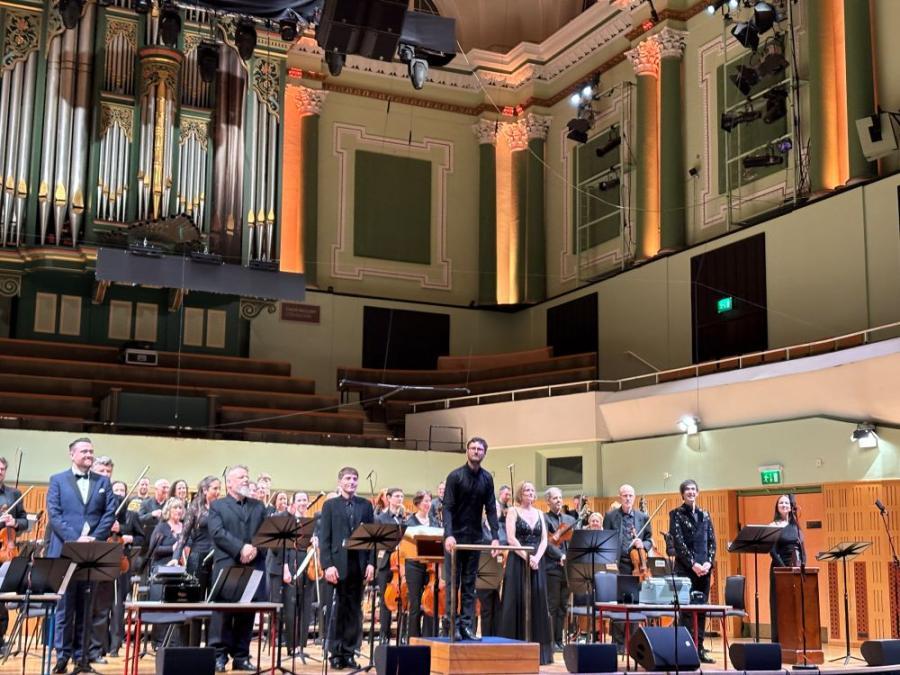
Happy ending? Not exactly: I came out feeling shaken and slightly mad myself. There was a late-night New Music Dublin event featuring scenes from another opera, saxophonist / composer Patrick Zimmerli’s Lucia Joyce; but the impact of this discombobulating premiere was too much to permit taking in anything else. If there was a drawback, it had to be balances in the National Concert Hall, reverberant when not full (Dublin's loss, and of course the LA performance had been sold out); mikes would have helped at times, but they bravely did without. I'd still like to see the work staged, and in a drier space. But no doubt about it: Salome sits alongside The Importance of Being Earnest and Alice's Adventures Under Ground as a major Barry achievement, and an equally compelling operatic experience.