

Even by Stanley Kubrick’s standards, Dr Strangelove went through an extraordinary evolutionary process. After starting it off as a serious film about nuclear war based on the 1958 novel Two Hours to Doom, he decided to turn it into a comedy with the help of porn-obsessed satirist Terry Southern.
The distinctive result – as remarkable for its futuristic War Room design as its weapons-grade humour – brazenly evoked the madness of a world on the brink. It’s not hard to see why – when human self-destructivity is breaking records on the Doomsday Clock – Sean Foley and Armando Iannucci thought this would be the right moment to recreate the film for the stage.
Yet theatre’s a fickle beast, and though this looks like a fantastic proposition – not least because Iannucci’s long-term collaborator Steve Coogan plays all four roles intended for Peter Sellers in the film – the humour doesn’t always detonate in the way it should. Coogan is brilliant as Strangelove – when he first appears on a “live” video link from NASA, which he clearly struggles not to pronounce as NAZI, the audience is mesmerised by his verbal tics and lizard-like eye movements. But as hapless British RAF exchange officer, Lionel Mandrake, he is less magnetic.
True, it’s intrinsic to the comedy of who Mandrake is that he’s more understated; a repressed underdog to John Hopkins’ volcanically psychotic General Jack D Ripper who’s hellbent on blowing up the world. Yet where Sellers – possibly helped by having done a stint, largely in entertainment, in the RAF – turned his repression into a brilliant parody of the British officer class at the time, Coogan’s Mandrake seems more genuinely at a loss. His genius as a physical comedian kicks in later in the evening, when he’s dodging bullets as the US authorities try to bring Ripper down. Yet his initially one-dimensional wariness means this early scene lacks crucial force.
Iannucci has written, rightly, that this stage adaptation is not a straight tribute to the film. Certainly there’s plenty of fun with contemporary references whether they’re evoking the Russian president’s penchant for assassinations, or Ripper’s Trump-style word salads. However, when Hildegaard Bechtler’s design, especially, is so closely inspired by Ken Adam’s iconic design from the film, it’s difficult not to ask precisely what the relationship should be. Coogan is stronger as the waffling President Merkin Muffley, yet Sellers’ performance gained resonance from the fact that he was imitating Adlai Stevenson II, UN Ambassador at the time of the Cuban Missile crisis. In our age of greater extremes should Coogan be finding his own parallels, or is it enough for him to extract all the humour from the character’s tepid prevarications?
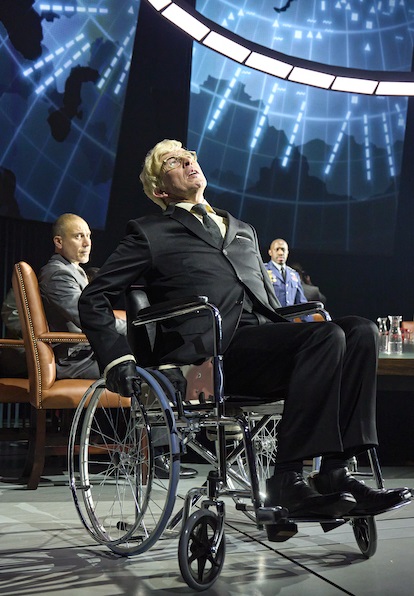 Foley – who directs as well as being a co-adaptor – has successfully brought many films to the stage including Withnail & I and most notably The Ladykillers. Adapting Kubrick however seems of an altogether different order however, not least because of the obsessiveness with which Kubrick used to realise his vision. On one level the film is a savage satire, on another it’s a love-letter to technology to the extent that the machines and devices almost become like characters. Take the suggestive sequence at the start in which one US military plane refuels another or the scene in which we first see Mandrake besieged by a bank of IBM computers.
Bechtler’s design certainly conveys the futuristic elegance of the film, yet for the most part the technology just feels like a part of the backdrop which – strangely, it must be admitted – seems to take a dimension away from the storytelling. The point at which this shifts is in the second half when Coogan reveals his fourth incarnation as Major TJ Kong, the B-52 commander who famously rides a nuclear missile like a bucking bronco as it’s deployed into Russia. Sellers had been nervous about recreating the character’s accent and in the end got out of playing him because of a leg injury. Here, however, Coogan is fully at his ease as the Texan in Bechtler’s dramatic recreation of a B-52 cockpit, complete with Akhila Krishnan’s projection of the landscape of Arctic Russia as Kong and his men head towards their target.
This is then – rather like Dr Strangelove with his rebellious prosthetic limbs – an evening of different parts, some functioning better than others. And whether you’re going for retro Cold War entertainment, for the combined talents of Iannucci and Coogan, or both, what’s indisputable is the way that Coogan carries the whole production as its title character. As the evening progresses he piles up the sinister layers of Strangelove’s psychology, each line of dialogue treading a sharper edge between what’s acceptable and what’s not. It’s in this danger zone that he truly takes off. Maybe – given the abundance of contemporary inspiration – he, Foley and Iannucci should think of a 21st century sequel.






Add comment