Identity is thorny business. This was the parting thought of Anna X, the play that marked Emma Corrin’s West End debut in the summer of 2021. The same credo governs Corrin’s return to London theatre with Orlando, in Neil Bartlett’s adaptation of Virginia Woolf’s 1928 novel about a larger-than-life character hellbent on defying time, sex, and convention.
Once again, Corrin blazes on stage – and across the centuries – with a central performance that is both lucid and layered. It’s a shame, then, that Michael Grandage’s breezy production doesn’t quite make the most of that great asset, not to mention its source text.
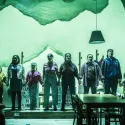
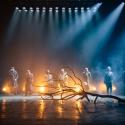
Bartlett’s adaptation extracts from Woolf’s ingeniously eccentric novel its bare bones and puts them on stage with the help of a chorus of Woolf surrogates. So, a nine-actor ensemble of identically dressed Woolfs at once narrates the outlines of Orlando’s life from the court of Elizabeth I to the post-war London of 1928, and comments on its self-consciously theatrical realisation before our eyes. Further – and much welcome – aid comes from Orlando’s housekeeper and dresser Mrs Grimsditch, who, in Deborah Findlay’s brilliantly warm rendering, literally pushes Orlando forward in time by helping change her costumes.
The feminine pronoun in the previous sentence, however, is not entirely appropriate. For Orlando starts life and makes it to age 30 as a male, but then undergoes a mysterious sex change when serving as an ambassador in 17th century Constantinople. Change, in fact, is the only constant in her tale: in a life that spans five centuries, multiple love interests, and countless twists and turns, she keeps asking urgent but difficult questions about her identity. Can she – or should she – ever be one thing? How many words would she need to describe herself? How can any one word do justice to the multitudes she so clearly contains?
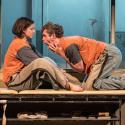
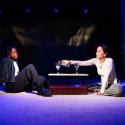
Surfing through these reversals and dilemmas, Corrin’s portrayal of Orlando retains a charming sense of affable inquisitiveness increasingly alloyed with confidence. Whether addressing the audience with tongue-in-cheek quips or trying to adjust to a novel setting, they deftly embody the fluidity that is part and parcel of the character. They receive commendable support, too, from members of the ensemble, especially Millicent Wong (as Orlando’s Russian lover Sasha) and Richard Cant (as Archduchess Harriet, Orlando’s foil). Findlay’s comic energy, expertly controlled, also brings out the best in the entire cast.
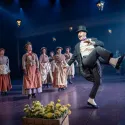
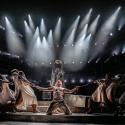
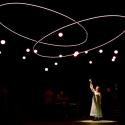
Grandage’s fast-paced, nimble staging sets great store by Peter McKintosh’s flexible scenic design, which conveys the story’s various settings through efficiently atmospheric backdrops. It is fitting that this vision of the self as an inherently theatrical project should unfold on a stage unafraid to showcase its artifice. McKintosh’s sumptuous costumes, also vital to the storytelling, demonstrate the ways in which identity can be a sartorial construction. Howard Hudson’s eclectic lighting and Alex Baranowski’s sound design endow our frenetic journey through diverse periods and locations with a playful smoothness.
Why, then, do the high energy of the proceedings and all the engaging performances fail to culminate in a wholly satisfying evening? The answer lies in the 90-minute production’s inability to channel properly the astounding richness of Woolf’s novel. It’s not only that what we see on stage reflects only the skeleton of that work, but that it makes hardly any attempt to capture the unique texture and timbre of Woolf’s style there. The integration of Woolf herself into the story, too, appears to be an underdeveloped concept: it is not clear, for example, why Woolf’s suicide needs to be mentioned several times in relation to Orlando’s life, while her relationship to Vita Sackville-West – the muse and model for Orlando – should receive not even a nod.
Though economical, Bartlett’s adaptation is ultimately an incomplete and unfulfilling reworking of a novel that could have easily provided this cast and production team with at least another 90 minutes’ worth of material. As a result, both Corrin and Findlay – fascinating as they are – turn out to be underutilised, their expressive reach constrained by an adaptive logic that doesn’t give them all that they need or deserve.
There is enough flair and wit in this slick production to convey some sense of Woolf’s wildly original vision. But greater heights could have been reached: when the frenzied flow of time is finally arrested at its close, this Orlando leaves one wanting much more.