

Is there a connection between revolution and theatre? The answer has to be yes – a visceral one. The supremacy of symbols, the collective strength of a crowd, a sense that some kind of pressure valve is being released to challenge the dominant social narrative. The Ancient Greeks understood this – it was from such impulses that theatre had its birth. So how does that work amid the populist turbulence of the twenty-first century?
Counting Sheep explodes on London’s theatre fringe scene with rave reviews from Edinburgh about its recreation of the 2014 Ukrainian revolution. For a Brexit-broken crowd there seems to be plenty that resonates. The EU, as a force for good, is being rejected by toxic politicians, though here, rather than navel-gazing Tories, it’s Moscow-fixated plutocrats who are challenging it. The differences are still more crucial: where, in Britain, we are simply bludgeoned by a tedium of parliamentary amendments, in Ukraine, to embrace the EU is a decisive break from Russia’s authority meaning it’s not long before the snipers arrive.
How do you express this theatrically? With much sound and fury, according to this production from Belarus Free Theatre, an organisation that understands better than most the relationship between the suppression of free speech and the spilling of blood. At the heart of the action is the real-life love story of Mark and Marichka Marczyk, one a Ukrainian-Canadian, one a pure Ukrainian, who met on the barricades. As Westerners, we are invited to join this from the perspective of Mark, a gluten-intolerant dumpling-phobe, who pitches up in his ancestral country after a lengthy journey, only to find himself invited to rewrite the future.
There are three kinds of ticket on offer for the show – that of observer, protester or premium protester. Even if the idea of ‘immersive’ theatre makes you faintly queasy, protesting really is the only decent option here. For while, as the company reminds us, revolution is about challenging politically unjust behemoths, the release of undiluted emotion means it is also about youth, music, anger, and, frankly, sex. We are not here to discuss the pros and cons of former president Viktor Yanukovych’s regime, we’re here to experience the visceral eddying and swirling of anarchic passions, and those who don’t dance or build barricades (see below) are missing the point.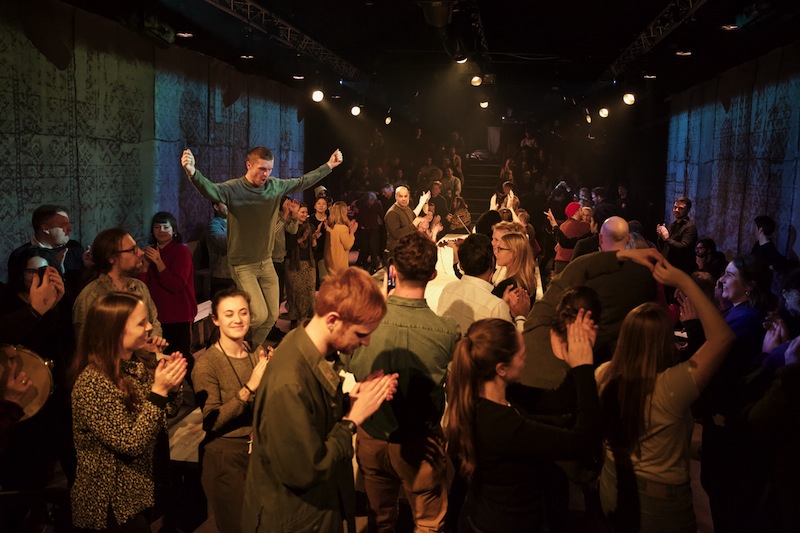 It has to be said that there was a part of me that felt a little uneasy at proclaiming myself as a revolutionary when I had done so little to earn my rabble-rousing spurs. Unlike Mark and Marichka, and indeed, Natalia Khaliada and Nikolia Khalezin (who as well as writing the play are the brave co-founders of the Belarus Free Theatre) most of my political outrage is experienced safely behind a newspaper. In the 2014 uprising, as we are reminded, people died – officially around 100, in actuality many more, and those who carried on protesting did so in the knowledge that they were in danger of being picked off by snipers. Yet here I was, donning a hard hat, passing sandbags and shouting slogans when the greatest apparent danger facing me that night was the possibility of a dodgy signal on the tube on the way home.
This, though, is partly the point. In a politically turbulent world, where all that is really predictable is the unpredictable, we need to fight to stay in touch with the urgency of the problems that face us. As the audience rushes around the theatre, news footage flashing along the walls reminds us how events that happened just five years ago continue to have consequences. Hundreds of Ukrainian protesters from that time are still detained in Russian jails, while the tensions from the uprising and Russia’s subsequence annexation of Crimea will inevitably play their part in the country’s presidential elections this year.
Beyond this, one of the most fascinating aspects of the evening is getting a sense of how you spontaneously organise a large group to demonstrate a cohesive emotion against an oppressive force. Before the snipers come out, the predominant feeling is that of being at a wild music festival – as food is served, vodka (if you’re a premium protester) is poured, and we are invited to dance, clap, and sing. Revolution is about outrage, but at its most abstract it is also about rhythm, synchronised movement, and the primal way in which this expresses the beating heart of a crowd. And the touching truth of the love story at the evening's centre is a reminder of how, in the worst of circumstances, when certain individuals are given the chance they can transcend what is ugly and cynical to create a redemptive, if fragile, new reality.

Add comment