Who were the Vorticists? Were they significant? Were they any good? And does this little-known British avant-garde movement – if it can be called anything as cohesive - really deserve a major survey at Tate Britain? Many of the group’s paintings never survived the First World War, and nor did one of its most talented supporters, the precocious French sculptor Henri Gaudier-Brzeska; two of the most talented artists who did – David Bomberg and Jacob Epstein – were never signatories to its manifesto, and Epstein, for one, distanced himself; and, in its short life, there was only one exhibition on home turf, while its journal, Blast!, survived only two issues.
The group was originally conceived as The Rebel Art Centre in 1913, as a rival to that other avant-garde set, the Bloomsbury Group. Percy Wyndham Lewis, an arch self-publicist (he soon dropped the unvirile-sounding first name), had worked alongside Bloomsbury member Roger Fry, taking part in Omega Workshops that year. But after Fry failed to inform others of a commission for the Daily Mail Ideal Home Exhibition, Lewis wrote a round robin denouncing him for misappropriation. Core members of what was soon to become the Vorticists, named by Ezra Pound (after the image of a vortex, “from which, through which and into which ideas are constantly rushing”), abandoned Fry and Britain’s most radical art movement, such as it was, was born.
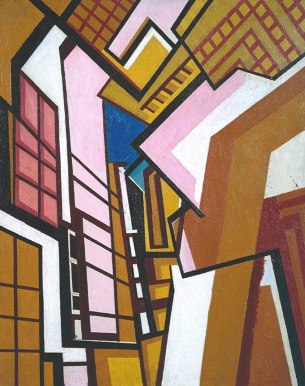 Having spent some time in avant-garde circles in Europe, Lewis was already acquainted with European Modernism at first hand, with the fervent ideas of Cubism, Futurism and Expressionism. And so his paintings had already appropriated Cubist motifs, marrying its strong structures – soaring planes, jagged angles and interlocking forms – with the fluidity and movement of Italian Futurism and the vitality of German Expressionism (pictured right: Workshop, 1914-15).
But although many of his paintings haven’t survived, the exhibition gives a tantalising flavour of that early work through numerous studies and sketches. A series of lithographs from 1913 which illustrate Shakespeare’s Timon of Athens shows just how dynamic, radical and forceful his work at this stage was – and how different from the rather more genteel lyricism of the paintings and designs, with their bright colours and pastel shades, of the Bloomsbury Group.
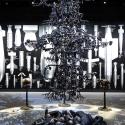
But the exhibition doesn’t begin with Lewis. It begins with an extraordinary work by Epstein, a work which was, in fact, conceived just before the movement’s inception. But however tenuous its link, in terms of embodying some of its many contradictory ideas - a fear of the machine age as well as an embracing of it – Rock Drill (pictured below), 1913-15, (or rather a much later reconstruction) makes for a startling opener.
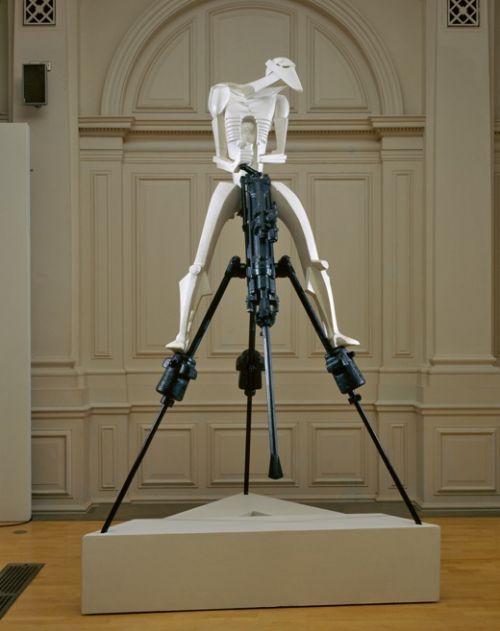 Occupying a gallery by itself, it features a robotic android atop a tall tripod drill. With its craning neck, visor-like features and exoskeletal body, it’s both a majestic and a frightful vision. Through its open abdominal cavity, we see that this monstrous vision is, in fact, carrying a foetus, rendering it vulnerable but also engendering Wellsian fears of sub-human or non-human species – fears, in fact, to do with the catastrophic end of civilisation through the unstoppable power of the machine.
A few rooms on and we encounter this same figure as a truncated form, cast in bronze. It’s shorn of the lower part of its body and it’s no longer steering a drill – no longer, it appears, master of all it surveys. But along with the subject’s loss of power, there’s a corresponding loss of some of its vitality and power as an artwork.
The second room provides a work of equal brutal force, but of a rather different kind. Carved in stone, it’s Gaudier-Brzeska’s magnificent Hieratic Head of Ezra Pound, 1914 (main picture). Pound instructed the young sculptor to make him look "virile”, and Gaudier-Brzeska, who was just 22, interprets this rather literally, by making the head resemble, from the back, a huge phallus: we clearly make out the carving of buttocks for its base and the glabrous penile head. It certainly puts a different spin on the phrase “penis head”, but the sculpture’s brooding, arrogant presence stills any risible associations with schoolboy smut.
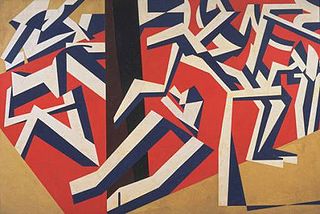 In the following rooms we encounter paintings and sketches by the female members of the group: Jessica Dismorr, Dorothy Shakepear, Pound’s wife, and Helen Saunders. It’s interesting and, given its incendiary politics, somewhat surprising to note that the movement promoted its female members, but these works are not particularly distinguished. Of the larger-scale paintings, of which there are so few, it is David Bomberg’s bold zig-zagging Mud Bath, 1914 (pictured right), that easily dominates, while Alvin Langdon Coburn’s “Vortagraphs” provide us with the first abstract photographs (though, executed in 1917, the movement was, by then, effectively over). Edward Wadsworth, meanwhile, shows himself to have been the most elegant printmaker of them all. Rotterdam, 1914, is a dizzying, seductive vision of tumbling geometric forms in bold black and white.
Despite expectations to the contrary – with such a paucity of surviving works, what would we find? – this exhibition provides a wonderfully rich insight into Britain’s first major 20th-century avant-garde movement.
- The Vorticists: Manifesto for a Modern World at Tate Britain until 4 September
 Find the exhibition catalogue on Amazon