Richard Dadd is best known as the mad Victorian painter incarcerated in mental hospitals for 42 years for killing his father; but this Royal Academy show reveals him to be a far more interesting artist than the stereotype of the deranged psychotic would suggest.
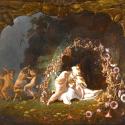
Famously he was a painter of fairies, yet he was far from being away with the fairies. His interest in the wee folk was aroused early on by Shakespeare’s A Midsummer Night’s Dream. He was still a student at the Royal Academy when he showed Titania Sleeping (main picture) in the Summer Exhibition of 1841. A group of happy revellers dances under twinkling stars, while nearby the fairy queen and her attendants form a titillating tableau of exposed female flesh. So far, so Victorian; the surroundings are what make this painting uniquely strange and wonderful.
The nocturnal scene is framed by the outspread wings of golden bats, while Titania is serenaded on exotic instruments by naked goblins who could have migrated from a painting by Hieronymous Bosch. A frieze of fleshy convolvulus flowers seems to trumpet the delights of sensual pleasure, while lurking in the dark interior of Titania’s cave, her husband Oberon awaits the chance to anoint her eyes with the juice of a flower that will make her fall in love with the donkey-headed Bottom. In this world of sinister magic and enchantment, wet dreams collide with nightmare. Freud would have had a field day interpreting it!
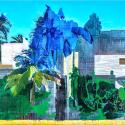
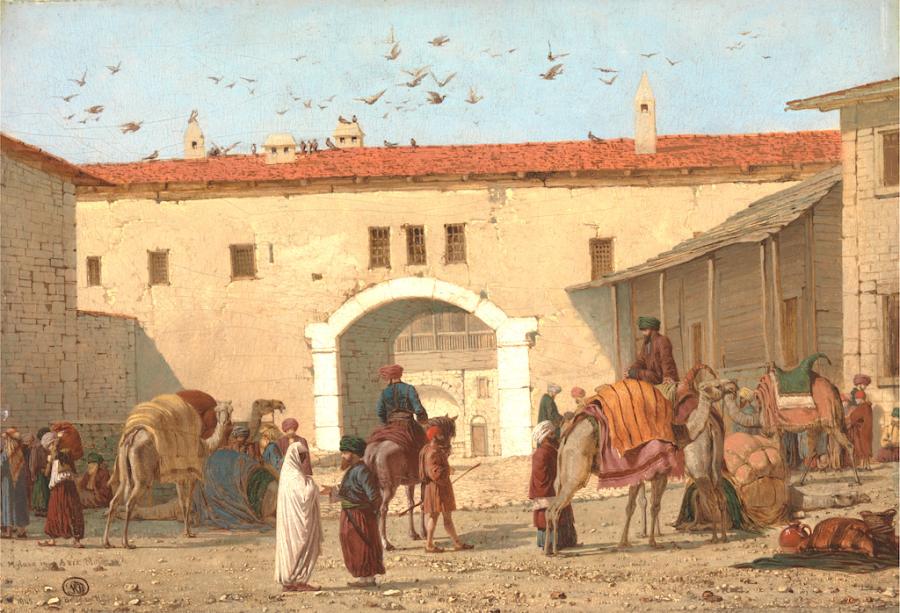
The following year Dadd accompanied Sir Thomas Phillips on a tour of the Eastern Mediterranean. The idea was to make sketches of oriental scenes that would be worked up into paintings on his return. The party travelled by boat and on horseback and Dadd complained that the gruelling schedule allowed little time for sketching. Yet on show are detailed drawings that allowed him, several years later, to paint a beautiful watercolour of the parched landscape of the Island of Rhodes, a nocturnal scene of the group camping by the Dead Sea under a full moon which, oddly, is pierced by a lance and a charming painting of travellers at a Turkish caravanserai (pictured above: Caravanserai at Mylasa,1845).
During the exhausting trip Dadd began having delusions and, convinced that he was the son of the Egyptian God Osiris, on his return he murdered his actual father. He fled to France, but was soon arrested and sentenced to spend the rest of his life in Bethlem and later in Broadmoor, where he died of TB over four decades later.
Although incarcerated, he was able to continue painting and you would never guess from the pictures that he was psychotic. Far from disappearing into a fantasy world dominated by fairies, he kept abreast of happenings in the art world and painted portraits of his doctors and pictures inspired by literature or based on his travels. But the fairy pictures are his undoubted masterpieces.
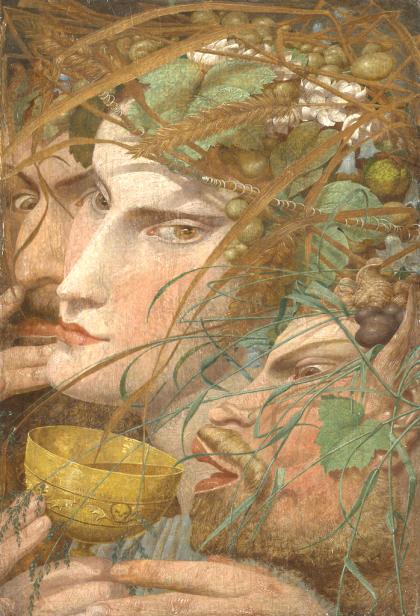
Bachanalian Scene 1862 (pictured above right) shows a satyr with horns and goat-like hair drinking wine from a golden chalice closely watched by a beautiful nymph and her hairy companion. Painted in the soft green and warm sepia tints that he loved, the trio have flowers, fruit, nuts, wheat stems and grasses woven into their hair while their high cheek bones and slanted eyes lend them an exotic other-worldliness. They could be characters from the fairy paintings seen in close-up – to reveal the level of hidden detail in his fairyland extravaganzas. To enable people to appreciate his exquisite miniature world, Dadd would give them magnifying glasses and I recommend that you take one with you.
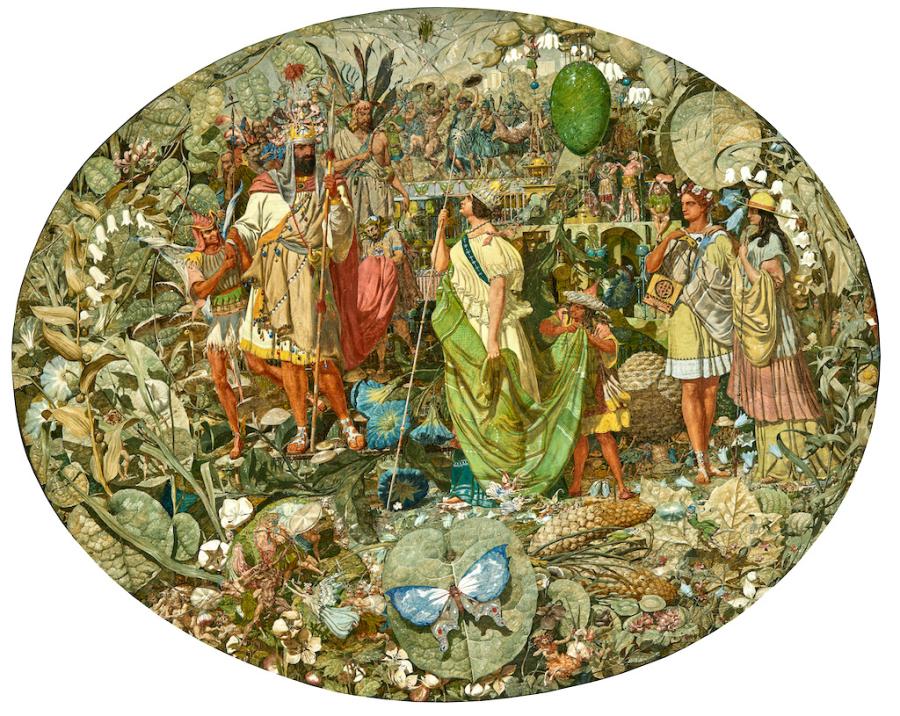
Contradiction. Oberon and Titania 1854-8 (pictured above) shows a stand-off between the King and Queen of the fairies, in which Titania refuses to hand over the orphan that Oberon wants as his page boy. The royal couple may look rather stolid and earth bound, but hidden in the jewel-like background are multiple tiny thrills. Beneath the white lily-of-the-valley bells, for instance, an orgy of dancing and feasting is going on while, among the anemones, there are battles raging.
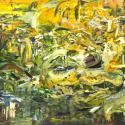
The Fairy-Feller’s Master Stroke 1855-64 (pictured below left) is similarly alive with miniature incident. Queen Mab, who spends her nights planting dreams in human minds, needs a new carriage despite her large gossamer wings. She stands beside the king on the broad brim of a hat worn by a bearded old man, while the Feller raises his axe to cleave open a hazelnut which he’ll fashion into her new coach.
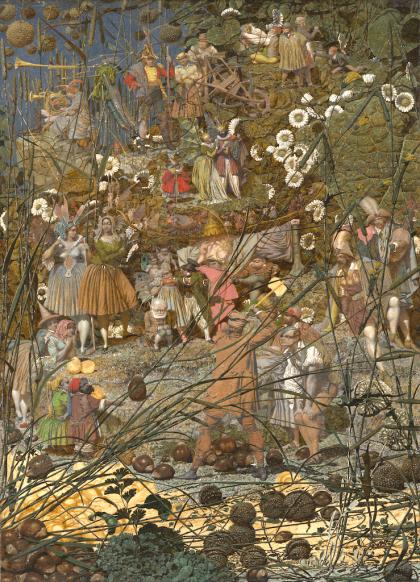
Seen though a screen of long grasses is an amazing cast of tiny characters gleaned from all historical ages and walks of life; princes and peasants, a ploughman and an admiral watch from amongst the daisies alongside imps, pixies, elves and other fairy folk too tiny to identify while a green dragonfly sounds the trumpet. The carnivalesque scene is painted with such hallucinatory clarity that you become convinced that if you were to creep out on a balmy summer night with a flashlight, you’d uncover a similar event unfolding at the bottom of your garden.
If anything, these paintings suggest a less troubled mind than the one that produced Titania Sleeping before psychosis took hold. Although restrictive, the ordered life of the institution seems to have afforded Dadd a degree of calm that allowed him to journey freely into the realms of the unconscious.