Literary adaptations are a godsend to an industry that loves a good story but is too busy blowing the budget on chase sequences and explosions to pay a decent screenwriter. But among the glossy, desperately earnest adaptations (last year’s Jane Eyre, this year’s The Great Gatsby) there are also some quirkier reworkings that invite audiences to play an extended game of spot-the-classic – Clueless (Jane Austen’s Emma), Tamara Drewe (Far From The Madding Crowd) The Lion King (Hamlet – yes really). The novels of Thomas Hardy have drawn more attention than most, providing a whole filmic sub-genre of which director Michael Winterbottom is surely the high priest.
Trishna is Winterbottom’s third cinema date with a Thomas Hardy. Following on from 1996’s does-what-it-says-on-the-tin Jude and The Claim (a Western take on The Mayor of Casterbridge), Winterbottom here tackles the tragic romance of Tess of the D’Urbervilles, transforming the muted landscapes of rural 19th-century Wessex into the bustling city scenes of contemporary India.
Winterbottom’s hallmark naturalism is a surprisingly good fit for Hardy’s tale
Trishna (Frieda Pinto, pictured below) is the eldest daughter of an impoverished Rajasthani family, supplementing her father’s income by labouring in the fields and occasionally dancing for tourists at a local hotel. Here she encounters Jay (Riz Ahmed, Four Lions), the westernised son of a hotelier, whose offer of work seems to promise salvation to Trishna and her family after her father is seriously injured in an accident. Professional interest soon turns personal however, and Trishna finds herself caught up in a cross-class romance that promises her so much but ultimately takes much more away.
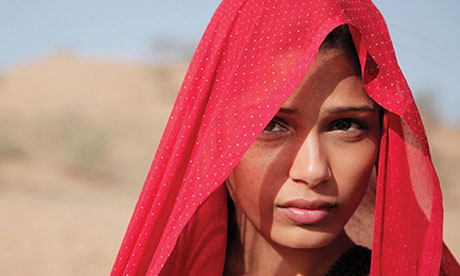 Winterbottom’s hallmark naturalism is a surprisingly good fit for Hardy’s tale, taking the sting out of the melodrama and smoothing out the story’s more baroque elements. Dialogue is often improvised, and the syncopated, jostling rhythms of speech ground the drama in its contemporary setting, giving it an authenticity that is matched by Winterbottom’s attention to visual detail. The writer-director’s fascination with the living canvas of India, whether it’s the seething traffic of Mumbai or the country’s gardens and temples, almost exceeds his interest in his characters, dwarfing them in faithfully Hardy-esque fashion with their surroundings.
Artistically this works well enough, but practically it means we see frustratingly little inner life from our heroine. If anyone can match Nastassja Kinski (so memorable a Tess in Roman Polanski’s adaptation) for luminous beauty it’s Pinto, but such is her passivity and monosyllabic gentleness that we glean little of the journey that takes her from adoration to murder. Just a little more dialogue and a little less Bollywood dancing (and did we really need a sequence of six or eight all-but-rape scenes to justify her closing actions?) might have given her some scaffolding for this tricky dramatic arc.
There’s also the problem of believability. Hardy’s tragedy is essentially a social rather than personal one, and Winterbottom never quite succeeds in translating the class divide of 19th-century England to his Indian setting, never fully convincing us of the inexorable political and societal forces at work here. Aesthetically however Trishna is a treat, with Marcel Zyskind’s sensitive cinematography lent resonance by a Bollywood-style soundtrack of ballads and instrumental dance numbers, by turns propelling the action and giving it pause.
Ahmed is impressively watchable as composite Alec-Angel (anti-)hero, though rather more convincing in his earlier charm than his later abuse, and Winterbottom’s instinct to elide Tess’s rival suitors into a single figure is a good one – even if doesn’t follow through and fully exploit the moral conflict this creates.
Resisting any too-restrictive fidelity, Winterbottom perhaps gets closest to his Hardy original in this, his most exotic cinematic rethink yet. It’s a shame though that some of the bold violence of his last feature The Killer Inside Me wasn’t allowed to bleed across into Trishna. Vibrant and emotionally authentic, the film lacks the brutality that Hardy’s vistas, however verdant, conceal beneath their soft grasses.
Watch the trailer for Trishna