

Elgar’s The Dream of Gerontius is generally discussed and judged – and judgment, of course, stands at the heart of the work – by those who love, indeed revere, without any caveats this journey of the soul through death.
Even now, I can understand some Anglican bishops’ reluctance to have the work played in their cathedrals in the 1900s. Perhaps that revealed not simply small-minded anti-Catholic prejudice (the default critical position) but a credible resistance to the cruel doctrine of Purgatory. God has forgiven you, has already assured you of eternal bliss, but will torture you (however immaterially you interpret that suffering) for an indefinite period anyway. Because He can. As for the post-Wagnerian hyperbole of the musical idiom in some (not all) sections, it can still sound to me like a composer seeking to grasp through overwrought orchestration a state of grace that heart, and mind, have not yet reached.
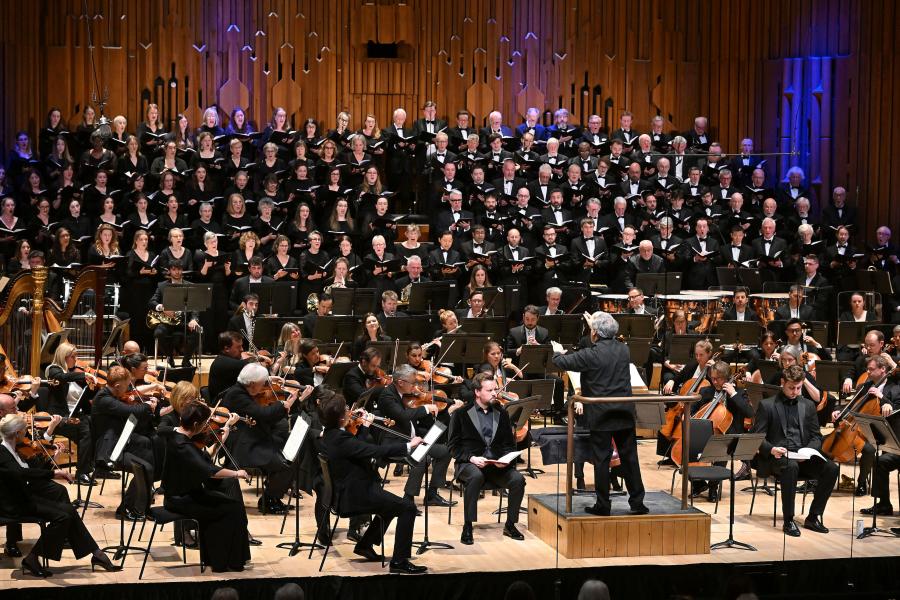
Confession over. There were some jarring notes struck in Alan Bennett’s recent film The Choral, about an amateur performance of Gerontius in First World War Yorkshire. Still, Bennett hit the mark with his mutilated veteran of the trenches who interpreted Purgatory as the Western Front he had endured. The returned soldier did precisely what many contemporary listeners choose to do. Root this spiritual no-man’s-land in the ordeals of your own life, and dogma be damned. Free of ecclesiastical trappings, in the strictly secular Barbican Hall, Antonio Pappano with the London Symphony Orchestra and Chorus (pictured below) had to contend with a sometimes unhelpful acoustic, but did robustly seize the chance to foreground the inescapable human drama of the soul’s approach to death.
Thanks in large measure to David Butt Philip’s magisterial Gerontius, an expiring Everyman whose every dread and hope registered in the timbre and grain of the voice, Pappano’s reading happily eclipsed any theological doubts. With Pappano abundantly displaying all his close-focus virtues as a choral conductor, physically wired (it seemed) to every changing accent and emphasis, this was a Gerontius that found a resonant universality in both the pre- and post-mortem struggle.
Rather than Wagner, it was the Verdi of the Requiem – another sublime surpasser of doctrine – who seemed to sound behind Butt Philip’s terrified, anguished fervour before death (“Sanctus fortis, Sanctus Deus”), or his violent yearning for eventual rest (“Take me away, and in the lowest deep/ There let me be”) after it. Because of the hard-edged specificity of the Catholic doctrine in Cardinal Newman’s didactic poem, Gerontius probably has to work harder to touch a modern audience than (say) the standard devotions of a Renaissance mass. Elgarians seldom admit this; but here the impassioned singing, and playing, made that leap.
Butt Philip’s fellow-soloists were the bass William Thomas – as usual, doubling the Priest and the Angel of the Agony (pictured below) – and Emily D’Angelo as the guardian Angel who leads the Soul into the “penal waters” (Newman imagines trial by water, not medieval fire) that will purify it in a second baptism. Behind them, the LSC generated not just a mighty but – when required – an infinitely varied, responsive and dynamically flexible sound, crisp in diction but also nuanced in feeling. From cackling demons to soothing junior “angelicals”, the chorus must switch roles and idioms with the kind of quick-change dramatic agility that makes Gerontius more operatic than oratorio-like. They did, with no signs of strain. Rightly, chorus director Mariana Rosas won huge cheers at the close.
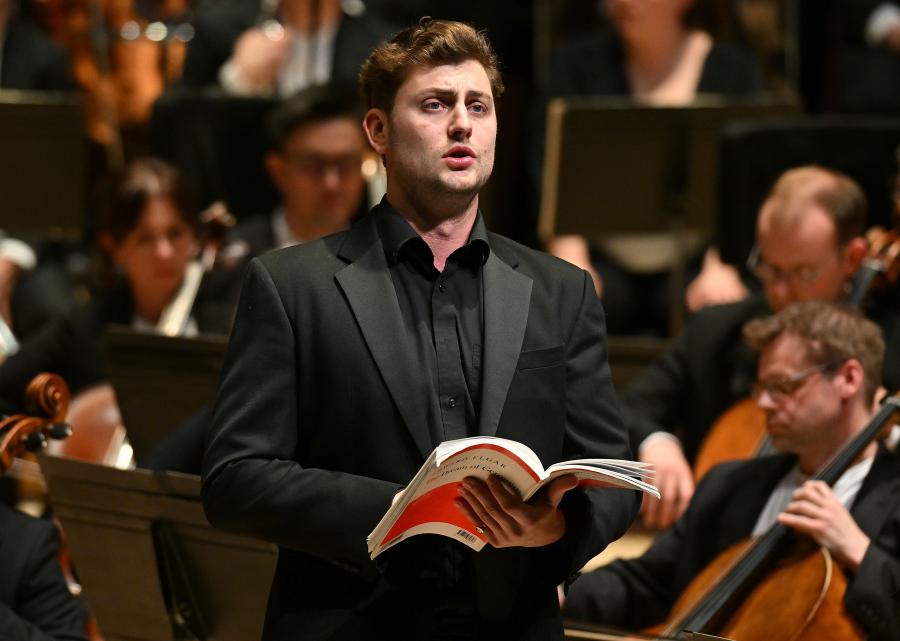
Thomas impresses more with every outing. He mastered the rather intimidating gravity of the Priest who commands Gerontius to “Go forth upon this journey, Christian soul”, although some phrasing and delivery here felt over-emphatic: hardly needed, given the sheer quality of voice. Thomas truly soared for me with the imploring intensity of his prayer as “Angel of the Agony”, both ripe and fierce but – more important – locating a tone of almost desperate entreaty in his pleas to Jesus to “spare these souls”. At this point (as it should dramatically, if not dogmatically), the salvation of Gerontius doesn’t feel remotely like a done deal. Thomas injected a hefty dose of sheer suspense.
As the Angel, D’Angelo (pictured below) lovingly coloured her lines with shady, smoky tints that may have lacked obvious celestial radiance, but achieved a darker kind of deathbed communion with Gerontius. Again, the drama trumped theology. Sometimes her voice blended almost too well with the silky, burnished depth of the LSO strings – with, from my seat, an occasional loss of clarity – but there was a glow and sheen to the performance that lent it a special warmth.
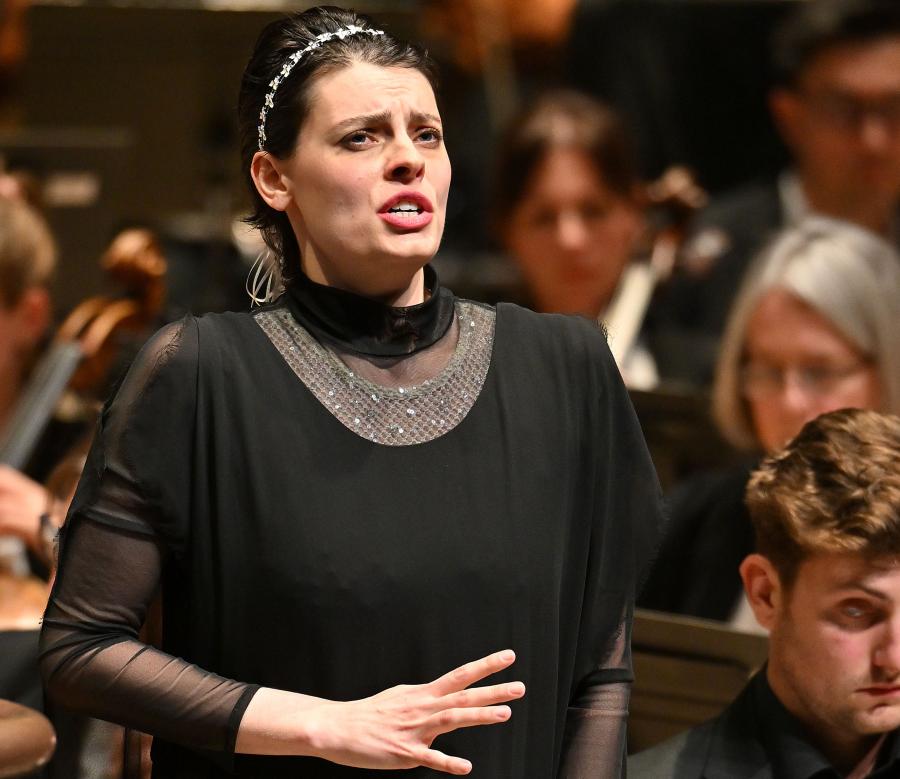
Not every Angel has to sound like Janet Baker: D’Angelo found her own wings, not only in the signature leave-taking (“Softly and gently, dearly ransomed soul”) but, above all, in the frightening ferocity of her storytelling about St Francis, whose stigmata prove that “the flame of Everlasting Love/ Doth burn ere it transform”. Her “Alleluias” too had a floated, dreamy wonder about them that compelled assent.
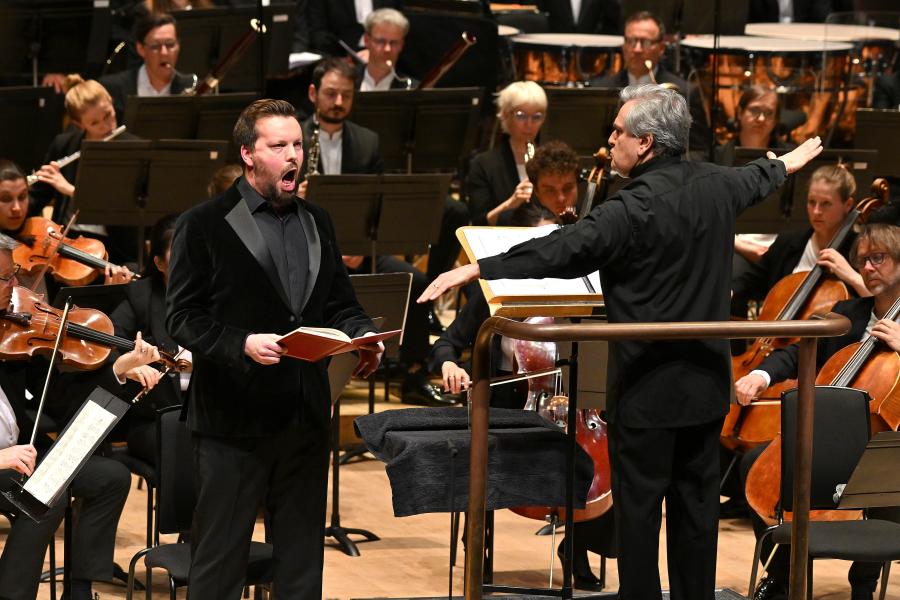
As for Butt Philip (pictured below), he led Gerontius across a spectacular landscape of mixed feelings that stretched from the surging panic mitigated by hope of his opening prayer (De profundis oro te”), to the ecstatic terror of his forthcoming purification (“motionless, and happy in my pain”). He clutched the heart with his opening howl (“Jesu, Maria – I am near to death”) and never slackened his grip. Line by line, he dodged melodrama but found catharsis. An undertow of urgency, or dread, regularly coursed through those well-shaped arioso lines.
Pappano, meanwhile, ensured that the Chorus matched the soloists in breadth of colour and spread of emotion. The jaunty scepticism of the demons’ fugal chorus – which, after all, would have voiced a portion of the audience’s true feelings even in 1900, and still more today – had a properly sassy wit and bite. Yet they slipped into the beguiling sweetness, and then triumphal power, of the Angelicals’ hymns with equal conviction and exactitude.
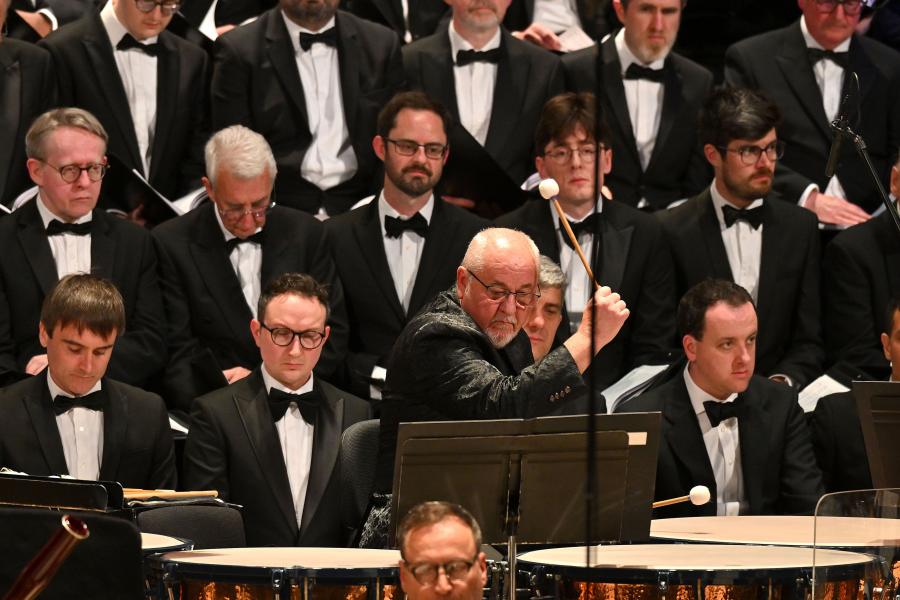
Pappano drew from the LSO plenty of subtle shadings to relish as well as tutti passages of wild exclamatory uplift. Horns and trombones, sombrely thrilling and ominous throughout, joined with deftly etched woodwind parts (clarinets and oboes especially fine) and those lustrous, golden but never soupy strings. And Nigel Thomas's timpani (pictured below) thundered like Almighty wrath.
The high-explosive treble-forte instant of divine judgment rocked the Barbican, just as it should. With the Angel’s farewell, however, Gerontius departs not in heavenly bombast but with a tender, fluid, melodic compassion that passes beyond the awe of the orthodox. Pappano could make the harshest scoffer believe in that.









Add comment