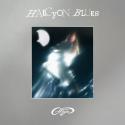
Norway's Hedvig Mollestad Weejuns take a wild ride with 'Bitches Blues'

From the pacific to the pulverising, jazz-adjacent trio carve-out their own musical character

share this article

Hedvig Mollestad Weejuns' ‘Bitches Blues’: just within the limits of the outer edges of jazz

Blues? Maybe, in atmospheric terms. But not in the 12-bar, blues-rock or Delta blues sense. Or most other senses. The album title is a play on Miles Davis’ end-of-Sixties LP Bitches Brew which, at that point, was his most overt nod to the dynamics of rock music. Nonetheless, Bitches Blues doesn’t obviously use the 1969 set as a point from which to jump.

But the reference sets up the first studio album from Hedvig Mollestad Weejuns – the latter word a slang reference to the trio’s Norwegian identity – as non-conformist, carving-out their own musical character; albeit just within the limits of the outer edges of jazz.

Hedvig Mollestad Weejuns are guitarist Hedvig Mollestad Thomassen, whose other band Hedvig Mollestad Trio distorts the boundaries between jazz and hard rock, organ and synth player Ståle Storløkken, familiar from Elephant9 and Supersilent as well as Motorpsycho, and drummer Ole Mofjell, who has played with Amoeba and Krokofant, and his own free-jazz trio 3 Days Of Maceration. Hedvig Mollestad Weejuns first surfaced at the Kongsberg Jazz Festival. A live double album followed. Now, this particular trio have recorded in the studio. The all-instrumental Bitches Blues features six tracks.

At its most pacific, on “For a Moment I Thought I Could Hear You” and “Limite,” Mollestad Thomassen’s guitar is filigreed, Storløkken’s keyboards are light, evoking Sweden’s Bo Hansson, and Mofjell is an understated, rippling presence. While clearly jazz, this aspect of the album could – oddly – be taken as a form of Swedish progg (sic).

At its stormiest, most explosive, on the pulverising opening title track and the, well, dynamic “Dynamax,” the album is about the interplay between each player. Here, it seems as though Bitches Blues is about playing off each other, pushing each other to new, shattering heights.

It ends with the lyrical “Recollection of Sorrow,” close-to eight minutes of sinuousness and spaciness – not so far from Sweden’s late Sixties/early Seventies space cadets Älgarnas Trädgård.

A wild ride, one which begs to be experienced in a live setting.
@kierontyler.bsky.social

Add comment

The content of this field is kept private and will not be shown publicly.
Name that you would like to appear as the author of the comment
At its stormiest, most explosive, ‘Bitches Blues’ is about the interplay between each player

rating

4

explore topics

share this article

Help secure the future of arts journalism

In this era of algorithmic recommendation, opaquely sponsored content and AI slop, theartsdesk’s mission to preserve real journalistic and critical values has never been more important.

If you like what you see here, please join us 
in this mission.

Subscribing to the site will help us in our coming 
redesign and expansion.


If you do this before the 31st August this will be at our guaranteed founder’s rate: 
your subs will never increase again.

Subscribe now for £5 per month. 
or yearly for just £40.

Or if you simply want to support us with a one-off donation, you can do so here.

more new music

The welcome return of a foundational album of electronic minimalism
Surrealism, social observation and more muscular sound from the Leeds quartet
A powerful personal outpouring of joy and pain - with a great beat
The London quartet have taken to playing large venues with ease, as this career-spanning set showed
The Philadelphia punk rockers continue to impress
A partial account of how Brit-punk absorbed an aspect of reggae
The Fez Festival Of World Sacred Music and the Fes Gathering bring the world together
Bristol band aren't happy but offer up the occasional sing-along
A new album is unveiled and old tunes are played for the last time