It’s not for nothing that Alfonso Cuarón’s mercurial CV includes Harry Potter and the Prisoner of Azkaban, because this director really knows something about alchemy. His last, the Oscar-winning Gravity, was a science fiction spectacular made oddly intimate by its focus on a lone astronaut in the expanse of space; his latest concerns the travails of a domestic worker in Mexico City, and is a family story with the visual expression of an epic.
That versatility and facility are the domain of a master filmmaker. And the glorious Roma may well be Cuarón’s best yet. The Mexican’s first film in his homeland since Y tu mamá tambiénin 2001 is deeply autobiographical, drawing on his childhood in the Colonia Roma district of the capital in the early 1970s. It’s an evocative, touching, female-centric story, which both highlights the iniquities of the servant culture (which remains strong in Latin America) yet suggests the positive, loving attachments that can exist within and despite it.
The central character is Cleo (newcomer Yalitza Aparicio), a Mixtec maid who with her friend Adela (Nancy García) does every scrap of domestic work for a middle-class couple – cleaning, washing, cooking and to a large degree caring for their four children. One recurring image is of them washing the dog shit from the garage floor, ready for when the man of the house, the doctor Antonio, meticulously parks his gleaming Galaxy.
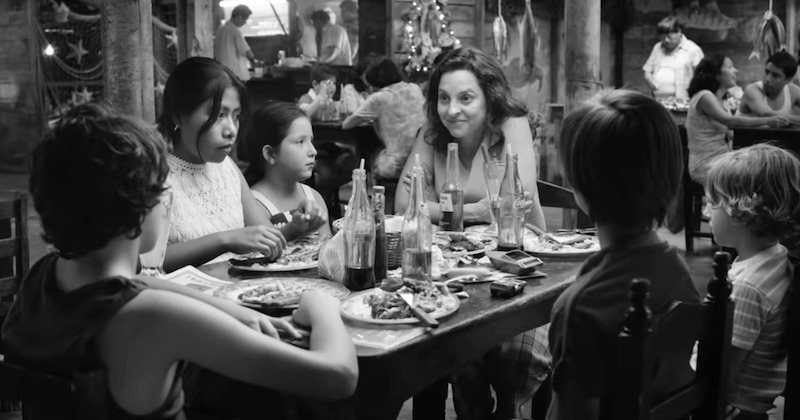
If there is a saving grace to their situation, it’s the genuine warmth felt for them by their mistress Sofia (Marina de Tavira), her children, and her mother, who lives with the family. When the considerable chores are completed, the servants curl up with mum and the kids on the sofa, a typically tactile and extended Latin family.
These women have to contend with two parallel crises. For Cleo, it’s an unexpected pregnancy; her new boyfriend immediately abandons her on the news, leaving Cleo fearful of what a child will mean for her employment. Meanwhile Sofia is deserted by her husband and is suddenly sole parent of a gaggle of young kids, emotionally devastated while having, also, to consider a return to work. The film is, chiefly, a paean to the women, as they forge a sort of unspoken solidarity; men here are mostly heels.
In the background of the domestic drama, civil unrest brews, in the form of student demonstrations for democratic reform, which will lead to the infamous Corpus Christi massacre.
As well as directing, Cuarón writes, produces, edits and does the camerawork – filming in exquisite, widescreen black and white. This is a profoundly cinematic film, astonishingly beautiful, with one memorable shot or sequence after another: the servants doing laundry on the rooftops; the pair on a day off, the fast-tracking camera chasing them as they run gaily through the city streets; a forest fire, an earthquake, a beach rescue, the massacre. Even when capturing the most day-to-day, for example the camera following a character through the inside and outside of the house in one continuous pan, every inch of every frame contains some marvelous detail. With Oscar-winning production designer Eugenio Caballero (Pan’s Labyrinth) also at the top of his game, it’s simply too risky to take your eyes off the screen for a second.
Performances are outstanding, especially from the non-actors. Aparacio, who gives her long-suffering character a captivating poise and grace, has to hold the attention for almost all of the film’s 135 minutes and does so admirably.
The film won the Golden Lion for best film in Venice in September, and ought to be in contention throughout the awards season leading to the Oscars. First and foremost: though Netflix can be thanked for funding such a personal project, Roma does have a theatrical window - and really needs to be seen on the big screen.