Floria (the superb Leonie Benesch: The Crown; The Teachers’ Lounge; September 5) is a nurse, working the severely understaffed night shift in a Zurich hospital. She is constantly doing three things at once, sanitising her hands, snapping her gloves on and off, measuring medications into syringes, finding veins for IVs and saying, endlessly, “Ich komme gleich” (I’ll be there soon) or “Have you pain on a scale of one to ten?”
Swiss writer-director Petra Volpe’s film is compulsively watchable and brilliantly paced and edited, with an exceptional soundtrack by Emilie Levienaise-Farrouch (All of Us Strangers). From the first moment, in a clever take of an assembly line of laundered blue and white uniforms, we’re plunged into the life of the hospital.
Benesch worked as an intern in the abdominal surgery department at a hospital to prepare for the role and her straight-backed efficiency, steely yet benign and reminiscent of her role in The Teachers’ Lounge, is totally convincing. (The DOP is Judith Kaufmann: Dreamland; Corsage; The Teachers’ Lounge.)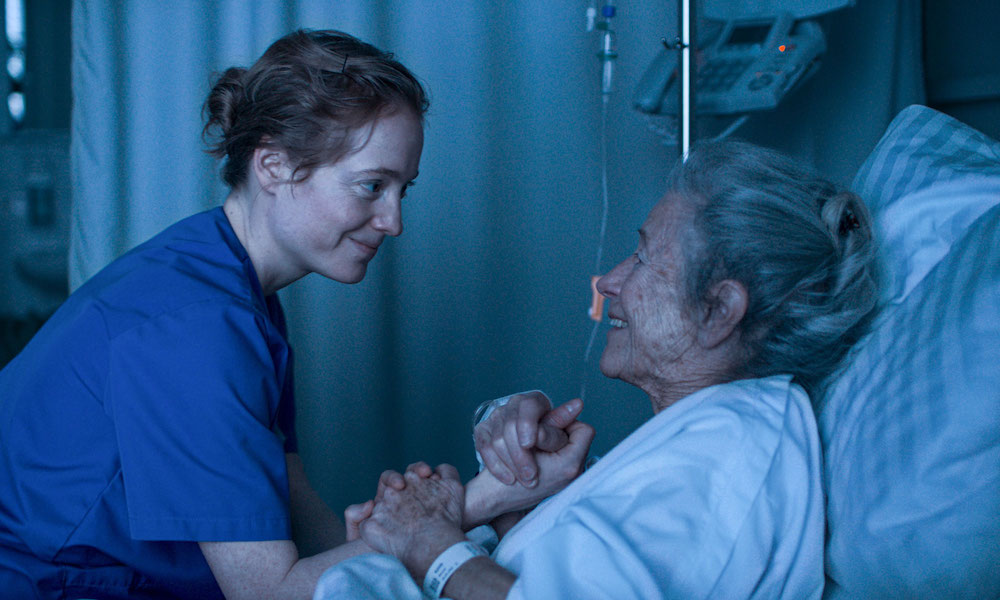 Floria and one other nurse, as well as an unconfident student, are the only ones on duty, taking care of an array of patients. These include one elderly lady with dementia and constipation (Margherita Schoch, pictured above) and a man from Burkina Faso (Urbain Guiguemdé). “I have no friends here,” he says. “You have me,” says Floria.
There’s also Mr Leu (Urs Bihler), who’s waiting in vain for the doctor to come and deliver his diagnosis (Floria knows it’s colon cancer but can’t tell him), a woman with a tumour who suspects that undergoing yet more surgery and chemo is pointless (she jokes that morphine is the only positive aspect), and Mr Severin (Jurg Pluss), who has pancreatic cancer and is the sole private patient on the corridor. He’s always timing Floria on his watch. That’s a record, he tells her: one hour and 15 minutes wait for a painkiller. Finally, towards the end of the shift, driven beyond endurance when he yells that he wants peppermint tea now, not in a minute, she tells him he’s an utter asshole, that he’s going to croak, and throws his 40,000 euro watch out of the window.
But we’re getting ahead of ourselves. Floria is otherwise a model of patience and restraint, calming the woman with dementia by singing to her, an old children’s song about the moon rising. The woman remembers the words, and they sing together, harmonising beautifully. Perhaps a little far-fetched, it’s nonetheless a moving scene.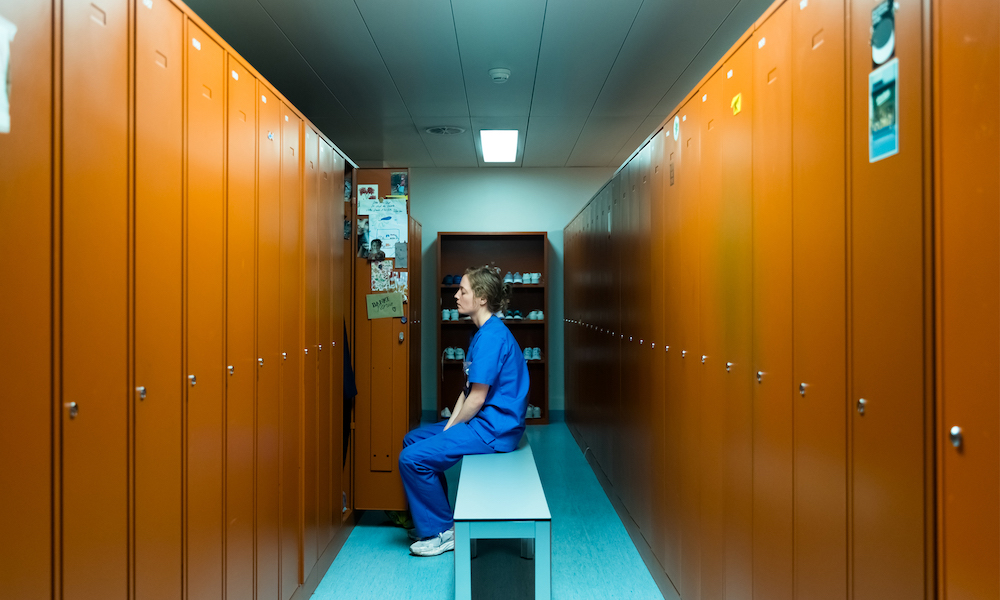 There’s a disconnect between the gleaming, relatively luxurious ward, far better appointed than those in many crumbling NHS hospitals (there are never more than two patients in a room, though some of them complain about sharing) and the desperate circumstances beneath the impression of order. This is very much a film with a message: although it’s particularly marked in Switzerland, the shortage of nurses is a global crisis, with predications by the WHO of a shortage of 13 million nurses by the year 2030.
In Late Shift, (the title in German is Heldin, meaning heroine) the system is cracking under the strain. A woman with oesophageal cancer dies suddenly. “You didn’t check on her once,” shouts the son. A patient’s antibiotic infusion is several hours late because Floria has no time to attend to it. And Mr Song (Jeremia Chung) develops a severe allergic reaction after Floria mixes up his medication. “Everyone makes mistakes,” the doctor reassures her, but Floria is devastated and takes a few minutes off to weep quietly beside a window, while raindrops spatter the glass.
Although the final scenes are too neat and sentimental – patients are resting peacefully or playing chess together and the private patient has even apologised for being an asshole – the image of Floria in her blue uniform, pushing her trolley up the ward, her phone trilling, remains indelibly powerful.