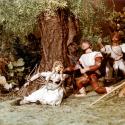
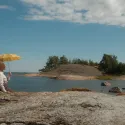
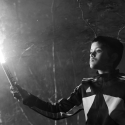
Slovak director Štefan Uher is often acclaimed as the figure who initiated the movement that came to be known as the Czech New Wave with his 1962 work, The Sun in a Net. While that film certainly had a style, both visual and narrative, that was original for its time, Uher would continue to stretch other boundaries over the few years in which the New Wave lasted, not least in his 1966 The Miraculous Virgin (Panna zázra nica).
For, as well as pushing the social boundaries of what was acceptable in cinema for which it would become better known, the new political circumstances also ushered in freedoms that included stylistic experimentation, in the case of The Miraculous Virgin one towards “pure cinema”; its removal from reality looks as pronounced as the manner in which other directors were revealing new aspects to that reality. As one of the contributors to the main supporting feature on Second Run’s release, the new 23-minute documentary The Story of ‘The Miraculous Virgin’ from the Slovak Film Institute, recalls, it was an era in which the responsibilities of the studio head came to be directed as much towards managing budgets as ideologies. It wouldn’t last, of course.
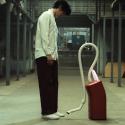
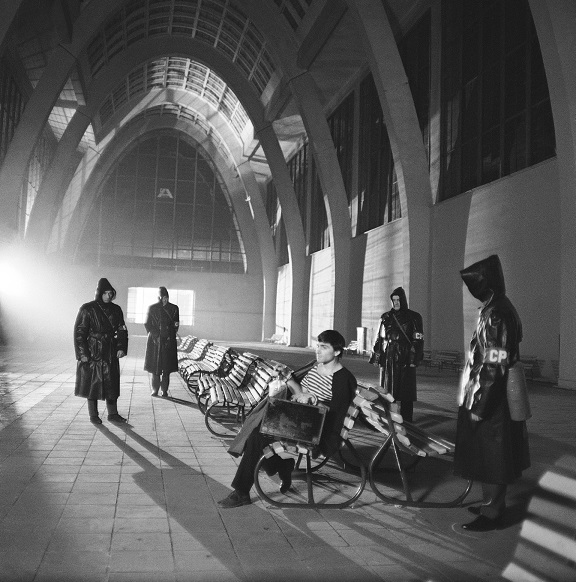 Uher is here assaying Surrealism, or “Nadrealism” as it was known in its Slovak context in the years that spanned both sides of World War Two. The Miraculous Virgin adapts the 1944 novel by Dominik Tatarka, who was on the edge of the artistic movements concerned, its loose context drawing on the 1960s even while its immediate setting is that of the wartime Slovak Republic. One of the film’s most striking visual settings is a lofty railway station (pictured above), with an architecture that seems both totalitarian-fascist in spirit as well as somehow out of the canvases of Giorgio de Chirico.
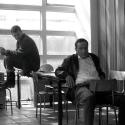
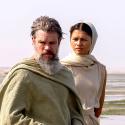
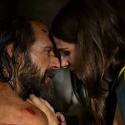
It’s the arrival there of the titular character Anabella (played by Poland’s Jolanta Umecka, fresh from Polanski’s Knife in the Water) that sets the film’s action, such as it is, in motion. Her mysterious beauty captures the attention of two dramatically different characters, the young painter Tristan (Ladislav Mrkvička), who exists in a convivial artistic community, as well as the older solitary sculptor, known as “Raven” (Otakar Janda), whose main artistic endeavour seems to be creating plaster masks from the faces of dead women.
But it’s the latter character’s second creative direction, as a creator of monumental portrait sculpture who works at the behest of an authoritarian state, that adds an extra dimension that is as interesting as the film’s metaphysical aspects may prove difficult to engage with. (The early 1960s, after all, had seen the destruction of the monuments of the previous decade, not least Prague’s massive Stalin statue, so issues of official iconography were very much in the air).
Uher was again working with cinematographer Stanislav Szomolányi, whose style had done so much to define The Sun in a Net; the result is no less striking, albeit developed in a different direction, its imagery looking impressive in this new 2K restoration. Collaborators including scriptwriter Albert Marenčin, as well as Uher’s student Martin Šulík, who would emerge as the main Slovak director of the next generation, offer detailed context on the film, as does Michal Michalovi’s booklet essay.
The Sun in a Net will remain the film on which Uher’s reputation rests. There’s some interesting, almost prequel-like commentary on one of that work's main themes, sight, in the other principle extra on this new release, the director’s 1959 short Marked by Darkness. The 16-minute documentary about children at a school for the blind has a powerful humanity that transcends its immediate context.