It’s common to see the term “vanity project” applied to self-produced shows by ballet stars, but Alina – the first such London venture by Alina Cojocaru – was quite the opposite of vain. If the opening item (a duo for violin and cello, with no dancing) was a mission statement, then this programme wasn’t about the 38-year-old Romanian at all: it was about the music and the people whose talents have nourished hers.
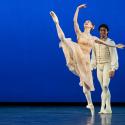
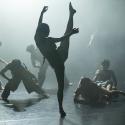
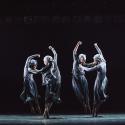
Halvorsen’s Passacaglia, a fiendish 19th-century showpiece for strings, was delivered with throwaway panache by violinist Charlie Siem and cellist Margarita Balanas, whose spirited and reactive playing was a dance in almost every sense. Siem, with pianist Sasha Grynyuk, later provided off-the-scale virtuosic accompaniment to the dance trio Les Lutins (“The Imps”), choreographed by Johan Kobborg, in which the dancers Marcelino Sambé and Takahiro Tamagawa humorously compete, first with the onstage fiddler, then with each other, then join forces to impress Cojocaru, who responds with a delighted wiggle of her bottom but stops short of showing the boys that she can play the virtuoso too – which was a bit of a lost opportunity.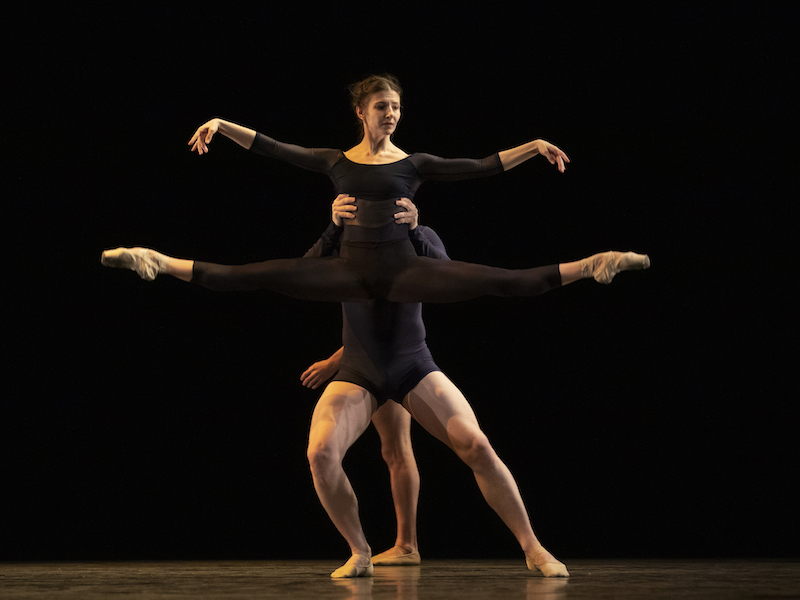 Technique was more evenly distributed in Journey (pictured above), by Juliano Nuñes, who was also one of the dancers in this oblique neo-classical study of a long-term relationship, its false starts and pitfalls, and the growth of trust, most clearly illustrated by Cojocaru flinging herself repeatedly and with increasing recklessness into the arms of Dominic Harrison. Yet it was a quieter duet danced with her on- and off-stage partner Johan Kobborg that delivered the intimate personal portrait that Cojocaru’s fans ultimately crave.
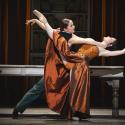
To a cello arrangement of Arvo Pärt’s Spiegel im Spiegel (over-familiar, but perfect here) Reminiscence, by Tim Rushton (main picture), showcased the profound mutual understanding that made Cojocaru and Kobborg’s one of the great partnerships of the ballet stage. Kobborg effectively vanishes when lifting the sliver of muscle and bone that is Cojocaru, the pair's preparation and execution so in tune that it’s as if she is being elevated by a cushion of air. Their palm-to-palm play of hands and affectionate teasing also made the piece very touching.
What gels on stage, what doesn’t and why is sometimes hard to fathom
Further intimate insights were offered in two mesmerising short films directed by Kim Brandstrup. Faces holds Cojocaru’s face in close-up as she “marks” steps in her head while listening to the music of a new ballet, subtle inflections passing across her features like clouds. Kiev follows Cojocaru on a visit to her old ballet school in Ukraine and pays personal tribute to her four teachers (now ancient, their faces are deeply etched with experience) and to the centuries-old ballet practice of passing on the finer points of technique largely through touch.
The more conventional latter half of the programme was less successful, with Frederick Ashton’s 35-minute Marguerite and Armand looking stagey and overblown. Perhaps the slowish tempo taken by the pianist in Liszt’s great B minor Sonata stinted the dramatic flow. Perhaps the absence of half the scenery (which had somehow come to grief at a rehearsal on the day) threw the cast. For whatever reason, the piece that was such a weepy hit for Fonteyn and Nureyev in 1963 and later for Sylvie Guillem and Massimo Murru failed to deliver the emotional goods. Again, it was in the interactions between Cojocaru and Kobborg (as Armand’s father) that the spark of dramatic truth briefly flickered. And yet Francesco Gabriele Frola’s performance of Armand was, taken individually, impassioned and very fine. What gels on stage, what doesn’t and why is sometimes hard to fathom.