

The centenary bandwagon always passes some composers by: how many organisations in Britain will be celebrating George Lloyd or Tikhon Khrennikov? Other figures almost get steamrollered flat with attention; Britten, I’d say, is this year’s likely candidate. But who could throw any stones at the birthday cake and bunting created by the Philharmonia Orchestra for that mercurial Polish wizard Witold Lutoslawski? Born 100 years ago last Friday, he’s the subject of a straggling international strand of concerts called Woven Words, stretching from here until late May, with a final Berlin gig popping up in September.
In these hard times we neglect Lutoslawski’s fastidious, fantastical, humane, free-spirited, multi-faceted music at our peril. His textures are gorgeously imaginative, his drama is flamboyant, and his structural ingenuity a constant delight. Besides, why waste the skills of the Philharmonia’s Esa-Pekka Salonen conducting music he doesn’t like? Always strong in the prettier part of 20th-century musical literature, he’s regularly championed Lutoslawski’s dynamic symphonies. But here in the series’ opening concert he contented himself with the 1958 Bartók memorial, Musique funébre, and the late-ish Piano Concerto, premiered in 1988 by the pianist sitting at the keys last night, the almost mythical Krystian Zimerman.
When Ravel takes flight it’s overwhelming, and the excitement Salonen whipped up during the closing bacchanale was electrifying
The last time Lutoslawski’s fellow Pole played in the Festival Hall – a Chopin recital in 2010 – he was driven close to distraction at times by someone at close range illicitly recording his performance. No distraction struck here: how could it when nearly every second of Zimerman’s time was spent massively absorbed in thundering thumps, filigree arabesques, pensive doodles, or harmonies that might have strayed from Brahms, while turning the score’s pages inbetween. This garrulous, ultimately uplifting piece – imagine a 19th-century virtuoso creation clothed in late 20th-century finery – is not something that could ever be played timidly. Zimerman, the concerto’s dedicatee, delivered it with such physical force at times that he almost fell off his stool.
Inbetween the rhetorical flights, the Zimerman who can weave rare magic with his delicacy of touch and phrasing poked through to delight us: there were those early light strokes taming the woodwinds’ avian chatter, the dewdrop sparkle, the incisive articulation, every move mirrored by the Philharmonia’s precision as they ducked and weaved through Lutoslawski’s quixotic quartet of movements. But the quieter moments ultimately paled beside Zimerman’s fire and brimstone, let loose on a piano that was probably rushed off for hospital surgery as soon as it got offstage. After the fury was done and several rounds of audience applause passed, Zimerman came on alone and made a beeline for the instrument. Not an encore, surely? Some little sweetmeat by Chaminade? Nothing like it. He picked up the score, kissed it, and left.
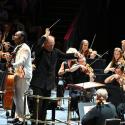
The piano concerto’s effusive drama threatened to dominate the whole night, though there were other reasons in Salonen’s concert to sit on the edge of your seat. The Musique funébre, pivotal in the establishment of Lutoslawski’s personal language, was one of the reasons: music of great tension, ingenuity, and sorrow, resonantly despatched here by the Philharmonia strings, divided into 10 parts. Then there was the entire second half, devoted to the complete Daphnis et Chloé ballet of Ravel – a composer who with Debussy is going to accompany Lutoslawski throughout Salonen’s series. (Fair enough: there’s an aural kinship.)
The complete score may not be engineered to keep us riveted every minute, but when Ravel takes flight it’s overwhelming, and the excitement Salonen whipped up during the closing bacchanale was electrifying. Beauties also rained down through each of the ballet’s languorous episodes, with dazzlingly limpid flute playing from Samuel Coles, and mellifluous pearls from the Philharmonia Voices, wordless sirens singing sometimes behind cupped hands.
More Lutoslawski follows next Wednesday at the Queen Elizabeth Hall. What a magician this composer is: a series of Lloyd and Khrennikov just wouldn’t be the same.




Add comment