The last time Theatre of Voices performed Stockhausen’s STIMMUNG in London was at the Albert Hall, at a late night Prom in 2008, so Kings Place made for a much more intimate setting. In fact, the work, which is for six unaccompanied voices, relies heavily on electronic amplification, so can be adapted to almost any environment. And Kings Place proved perfect, with its sympathetic acoustic and hi-tech audio array. Some mood lighting completed the atmosphere, creating a comfortable but slightly surreal ambiance, somewhere between concert and séance.
In STIMMUNG, six singers sit cross-legged around a low circular table, illuminated by a central light – in this case a 3D-printed scale model of the moon. Most of the music is based on overtone throat singing, but with many other elements added in. Theatre of Voices, a Copenhagen-base ensemble, have much experience with the work and are able to finely balance its competing demands, for ritual, musical drama, and even slapstick comedy. The ritual is acknowledged in their attire – all wear Indian-looking pastel linens – and in their solemn entrance and bow to each other before the performance commences.
But as the work unfolds, the solemnity is left behind, and the real strength of this performance was the fluidity and dynamism of the ensemble. STIMMUNG plays out as a single 70-minute span, but it is made up of 51 short sections (the group must first decide on the order in which they are to be sung – this was the “Copenhagen version” they devised in 2006). Within those sections, there is often a big dramatic effect, a storm of repeated consonants that grows to a frenzy, or a shared vowel sound gradually disappearing to silence. Theatre of Voices make the most of these localised effects. Their ensemble is always tight, but their tempos (or apparent tempos, it’s a graphic score) are fluid, sometimes gradually changing, but just as often switching in an instant. That is particularly effective in the transitions, where typically a single voice continues with the previous music while the other singers switch to a contrasting tempo and sound.
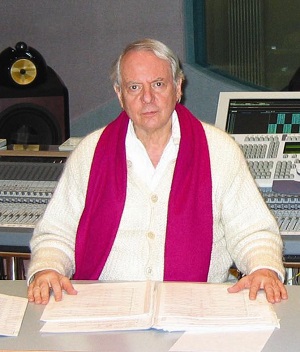 The performance shared many strengths with another recent STIMMUNG in London, by Singcircle at the Barbican in November (Theatre of Voices founder Paul Hillier is the link between the groups, but wasn’t present at either concert). Singcircle made much of the ritual quality of the music, and their reading was more solemn and more imposing. But Theatre of Voices scored over them in several important respects. Most significantly, the voices here were younger and more flexible, and also better integrated as an ensemble. That allowed for the greater dynamic contrasts and also brought more clarity to the textures. Although all here were impressive, the men really shone. Special mention should go to bass-baritone Jakob Bloch Jespersen, whose rich low register has the ideal dramatic potential for Stockhausen’s (pictured above by Kathinka Pasveer) many interludes and diversions, and also to tenor Wolodymyr Smishkewych, who is a master of the overtone singing, producing all sorts of high-pitched whistles and wails when required. The final ingredient here that set the performance above the competition was the sound design of Ian Dearden, admittedly working with the impressive audio array at Kings Place, but producing a suitably immersive soundscape, well balanced between the singers and always natural sounding.
Kings Place took an unusually didactic approach to the presentation of this concert. The publicity offered an English translation of the work’s nebulous title: “Tuning In”. And the programme (with exemplary notes from Tim Rutherford-Johnson) included a “cast list” of all the gods whose names are intoned in the work, as well as a full translation of the erotic poetry, written by Stockhausen’s then wife, that make up much of the work’s text. That might have been an annotation too far, given how most of us try to hide behind our monoglot ignorance when these sections crop up, although given the crystal clear, and highly suggestive delivery here, that was always going to be a tall order. But best of all, the performance began with an introduction from the singers, where the audience was encouraged to try out the overtone singing for ourselves. It didn’t sound much like the professionals, but it was a lot of fun!